
Tuesday, May 27, 2014
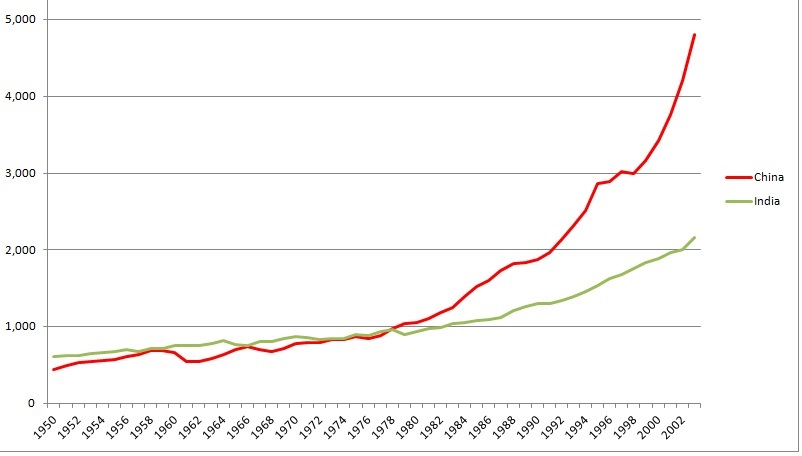
China will become the world's biggest economy this year, overtaking the United States in GDP. As the FT drily notes, "Most economists previously thought China would pull ahead in 2019."
So China powers on, at a greater pace than had been predicted by Western economic experts, who are supposed to know about these things. But our leaders still can't seem to figure out why.
Which shows the power of compound growth. Back in 2008 I discussed this, pointing out that at 10% growth gdp doubles in 7 years and that by 21 years from then (15 from now) they would have reached our current per person wealth.
Of course we could have had such growth any time we wanted as I have been saying since starting this blog. Indeed since then I have come to the conclusion we could have grown more easily and faster than China, had the political parasites in charge wanted it. But they don't.
The Register goes on to say why China is managing this - because they are competent people just as capable of innovation as we are (or were) which is true but not the whole story.

The graphs don't cover exactly the same period, though the trend is unmistakable but if we take the 1990 to 2002 period electricity production goes up just under 3 fold and gdp went up just under 3 fold. Who woulda thought? Allegedly absolutely nobody in our political class (except in Holyrood where it is provable they know.
"In modern times the main driver of economic growth has been, and continues to be, energy" - Jim Mather, SNP minister. Jim was the only competent and patriotic SNP MEP but unfortunately has now retired.
Labels: economic growth, Fixing the economy, International politics


Thursday, March 06, 2014
Enerconics Speech again
It also has some biographical material I didn't know before, but which does fit him perfectly:
A physics and electronics graduate of St Andrews University, Mike Haseler worked for a variety of industrial manufacturing companies, on a large range of projects controlling or monitoring temperature, before starting his own temperature control company and designing precision temperature controllers.
He joined the Scottish Parliamentary Renewable Energy Group and carried out extensive research into the renewable energy sector, becoming increasingly concerned at the lack of economic benefit from existing policy. He began campaigning to secure more jobs for Scotland in wind energy, joining the Green party who chose him to stand at the 2003 Scottish election, although he later took the decision to withdraw his candidacy.
While he continued to work in the wind industry in Scotland, erecting weather monitoring equipment, he finally gave up after accidentally informing a farmer that a windfarm was going to be built next to his property and seeing his look of absolute horror.
Since then Mike has been a campaigner against wind energy, and for energy policies that are based on ‘real’ science rather than global warming alarmism, and on pragmatic, evidence-based reasoning rather than utopianism. A keen blogger, he established the Scottish Climate and Energy Forum in 2011
------------------------------------------
And lets look at that worldwide correlation of energy use and gdp once again. its beautiful.

Labels: Cheap Energy, economic growth, economics, Science/technology
Wednesday, January 29, 2014
BBC Caught Lying Again, To Hide How Corrupt & Useless Our Ruling Class Are
------------------------------------------
Nonetheless that that is a remarkable lie by even BBC standards. The truth is that far from being the fastest growth in the world - the US is growing more slowly than the world AVERAGE of 4% (with the EU in recession the non-EU average is near 6%) and Britain, of course, is below the US's below average performance.
One can see why the Westminster thieves are so keen that the BBC lie to support them. It is obvious that if our ruling parasites really wished an end to recession they could at least match the non-EU average.
Nonetheless, cynical as I am about our Ministry of Truth broadcasters I am surprised that the BBC told and have decided to publicly maintain a lie so gross and easily checked.
(US #116, UK #173)
Labels: BBC, economic growth, Rise of modern fascism
Sunday, January 19, 2014
BRITAIN CAN BE THE WORLD'S LEADING NATION, AT LEAST PER CAPITA, ANY TIME OUR POLITICAL CLASS STOP PREVENTING IT.

It relates our global reach to Universities, major cities, military and intelligence reach etc.
OK the elephant in the room of national power is gdp, as I have always said, and our poor growth rate (our economy was recently passed by Brazil's) is abysmal.
But high measures by other standards do strongly suggest we are a world leader in many fields and, if we get the economy right, have the potential to be so widely.
That wouldn't matter if we were doing well just by this measurement (which looks arguably self selecting to me - for example the historic best universities may be cruising on their record while Asian ones are working on current achievement).
However I have previously noted how, by measurement of scientific citations Britain is not only 2nd overall worldwide but doing twice as well per capita as the USA and ahead of all but a small number of very small countries.
Or if you go to the Worldmapper site, where where the size of countries is distorted to make them match not geography but other qualities the UK is almost always far larger than its geographical size. It is also consistently smaller than the USA, which means we are competing in the same fields, but better than 1/5th the size of the USA on almost everything though that is our population ratio.
Except on gdp where we are close to the 5:1 ratio and electricity production where the US outpowers us by 11.27:1.
The evidence that gdp is very closely related to energy & particularly energy use seems not seriously disputed (though it is studiously ignored by our political class). If we had the same electricity use to production ratio as they do (ie building about 50 x 1 GW nuclear power stations costing inder £800 bn each) we could expect gdp to rise 2.25 times.
I have previously said that government regulatory parasitism quadruples the cost of housing and child care, increases electricity costs at least 90% etc etc and thereby robs us at least another 100% of the gdp we actually have & perhaps 300%.
I have previously put forward my 24 point plan out of recession which would, if the combined decision of experts not to dispute it would work, is any clue, certainly get us into a growth rate unmatched by any other country.
CONCLUSION
Britain is a world leader in so many scientific and cultural fields that it is our relative economic failure that is the outlier not the others. That means it should be relatively easy to fix.
If we aimed to maximise gdp growth we could expect to move to the sort of gdp ratio that we have for other cultural factors. Indeed if we are being held back by our poor economy, as one would expect, the cultural benchmark would move up as our economy grows.
By the listing in the graph we are doing 2.43 times better than the USA per capita, though we only have 1/5th the population. By gdp to energy use we are producing 2.25 times as much. By my estimate of the cost of state parasitism we could be 2-4 times better off. By scientific citations we are 1.76 times better than the USA per capita.
And the USA provides the benchmark to which, on most measures, nobody else (except maybe Singapore & Hong Kong) comes close to matching across the board.
Far from Britain being a "2nd class" power or "a small offshore island" as our political class so often say as an excuse for their own failure -
BRITAIN CAN BE THE WORLD'S LEADING NATION, AT LEAST PER CAPITA & BY MANY MEASURES IN ABSOLUTE TERMS, ANY TIME OUR POLITICAL CLASS STOP PREVENTING IT.
---------------------------------------
Personally, being an ambitious sort I think if we also put a national effort into an X-Prize Foundation across the fields of science, space development, Orion (or more likely more modern nuclear spaceships), floating equatorial islands, mass manufacturing of nuclear plants there is virtually no field in which we could not lead the world into a wealth, educated and peaceful future. But am willing to start small with is just increasing gdp 2.4 times.
Labels: British politics, economic growth, economics, Science/technology
Wednesday, October 02, 2013
Glasgow University European Society Debate
I am certainly convinced we won the intellectually. I intend to post my speech tomorrow.
It was divided into 3 sections - 40 minutes for 4 speeches, the same for debate on the platform and a bit longer for questions/points from the floor.
It was also done with good manners on both sides though at one point I was forced to object to a claim by John Purves, former Tory MEP, that if UKIP took power we would be attacking Syracuse (Sicily) pointing out that his party supported wars against Yugoslavia, Iraq, Libya and (at least the party leader) Syria whereas UKIP had opposed them all. He was perfectly entitled to approve of those wars but he was not entitled to say that UKIP were the warmongerings.
The other 'phile speaker was John Brand, a former British diplomat and now leader of the (partly EU funded) European Movement in Scotland, which arguably says something about the impartiality of our foreign office.
Their arguments were largely about the benefits of a free trading zone and how much good it had done us. I believe this was negated by my speech and indeed during the 2nd section I asked if they disputed my figures of the EU zone massively economically underperforming the rest of the world and likely to do worse in future. John Brand said this was because it is easier for poor countries to grow and I replied that this is an excuse popular with politicians in wealthy but failing countries and very popular in Britain but is not true. History shows that it is actually easier for already rich countries to grow than poor ones because they have the education, spare capital and infrastructure thus the industrial revolution happened in Britain not one of the poorer nations of the time. That it is confirmed by the fact that back then the disparity in income between Britain and Senegal was only about 3 times but is now 200 times. I said that the reason for the current faster 3rd world growth is that they have adopted the Washington Consensus, which is basically what Adam Smith taught 200 years ago, while we have adopted Luddism instead but that we could achieve world average growth any time our political class allow it. As confirmation I pointed out that Singapore, Hong Kong, the US, Canada, Australia and now Taiwan are richer per capita than us and still growing faster, indeed that Singapore recently achieved 14% growth in 1 year.
That later brought a question from the floor by somebody who said Singapore allows unlimited immigration, unlike UKIP's policy. I'm afraid that I got a bit shirty about that when, after I said it is very careful about limiting immigration to skilled workers and that it is quite obvious, since they are surrounded by poor countries, that if they allowed unlimited immigration they would quickly be swamped by millions of immigrants. He again insisted they did and I simply said that was a silly assertion, which was not courteous but is true.
Mr Brand also complained about how the media is biased against the EU - ie the Mail and Mirror and I said that the BBC, which is far more important is overwhelmingly biased in favour of the EU.
Professor Curtis, who regularly, on election night, explains the trends on the BBC, moderated with patience and courtesy keeping even Christopher Monckton to time (and firmly asking a questioner making what appeared to be a personal attack on Monckton whether this was about the EU and excluding it when, despite the questioner's assertion, it turned out not to be).
Lord Monckton was far and away the best speaker, eschewing mere microphones to march to the front of the stage and speak from there. I won't even attempt to repeat his definition of what the EU call a spade since it must have run to 100 words. He knows his facts and he knows his anecdotes and he knows a dozen languages. He dominated the debate and clearly knew it (but this is my blog so I get to big up me ;-) ).
I took half a minute from Chris's summing up (he is a gentleman and agreed though he was clearly the right person to do it) to say that, since it was agreed by all, that this debate had been informative as well as entertaining, and since free debate is a necessary condition of a real democracy, that I hoped everybody would agree that it would be a good thing if the BBC were to follow the example and actually broadcast some formal debates where both sides were present.
And so to the beer bar.
According to this the audience was 269 which feels about right.
Labels: economic growth, EU, Media
Tuesday, September 10, 2013
25 Point Programme Out Of Recession / Constitutional Amendments 18
http://a-place-to-stand.blogspot.co.uk/2011/11/we-could-get-out-of-recession-in-days.html
I'd like to add this 25th point:
25 - Make it illegal for government to give any money to any charity that, in the last 5 years, has advertised for more government. That isn't a charity's job and the conflict of interest is clear. Similarly make a legal requirement that any funding from outside the country of any "charity" that has pushed a political opinion be registered and subject to a 50% windfall tax - half of this money to be earmarked for organisations committed to reducing the size of government. In the same way, over the next 5 years, be 10% as much money as our state donated to pro-government charities should be donated to organisations promoting smaller government.
The same ban should apply to any government department, quango or council and they should be limited to spending not more than 1/2% of their budget on PR/press liaison /raising awareness or such activity under other names.
According to Chris Snowdens admirable report on sock puppets"Between 1997 and 2005, the combined income of Britain’s charities nearly doubled, from £19.8 billion to £37.9 billion, with the biggest growth coming in grants and contracts from government departments (Smith and Whittington, 2006, p. 1). According to the Centre for Policy Studies, state funding rose by 38 per cent in the first years of the twenty-first century while private donations rose by just seven per cent".
This suggests donations to fakecharities was at least half of the increase ie £9.05 bn (£37.9-£19.8bn) and that this amounts to 38% of total funding of 138% which would thus be £32,9bn. Assuming only the same is being spent directly by government this comes to over £60 bn spent by government on advertising how much more of it we need. Since that comes to over half the budget deficit it is clearly something we could well manage without.
=======================================
I am also including this under CONSTITUTIONAL AMENDMENTS 18 since, by reducing the power of government to frighten us with their "endless series of hobgoblins, all of them imaginary (Mencken) would significantly improve quality of life and reduce the parasitic power of the state.
Labels: British politics, constitutional amendments, economic growth, economics, Fixing the economy
Tuesday, August 13, 2013
The Bad News - Britain in Last Place - The Good News - Lots of Room to Improve
So lets look at how well Britain is doing in terms, not of the whole world, but of the English speaking world. This is from the bottom end of Wikipedia's list of growth for 2012:
163 Ireland 0.9%
172 Trinidad 0.4%
175 United Kingdom 0.2%
177 Cook Islands 0.1%
177 Jamaica 0.1%
181 Barbados 0.0%
196 St Kitts and Nevis -0.9%
214 Bermuda -3.5% (2011 est)
219 Anguilla -8.5 (2009 est)
Hardly surprising that postage stamp countries should be at both ends of the list - they are so small that they will have a far larger random statistical variability.
Excluding them Britain is the worst economically performing country in the world, with the runner up being Ireland, a fellow EU member, about whose performance we have, over the last few years, been scathing (& whom our media ignored for the previous 2 decades of 7% annual growth)
This may look pretty pitiful, and it is, but it also reinforces my opinion that, with world average growth of 4.8%, non-EU growth of 6% and Commonwealth average growth of 7.3% it would take no great effort to reach the average, or surpass it. I don't think that with this evidence anybody could seriously dispute that it isn't the "world recession" or international bankers or any of those, it is entirely the fault of our political class backed by the BBC state propaganda service (who ALWAYS CENSOR how well the rest of the world, outside the EU is doing). All that is required for that is for politicians to get out of the way, let the free market be free, end Luddite banning or making artificially expensive our shale gas, nuclear power, housing etc. etc., quit the EU and revel in our good luck of speaking English and having the world's highest ratio of scientific citations to population of any sizable country.
To do much better than average my 24 point programme for growth has never been seriously disputed.
Labels: British politics, economic growth, economics
Tuesday, July 09, 2013
The State Supported Parties Plans To Drive Up Electricity Prices
This is the extent to which our ruling class intend to push up electricity prices. They intend to "guarantee" this level of subsidy. Which produces a constitutional problem
Scots Professor Peter Cameron, professor of international energy law and policy at the University of Dundee said "In modern times the main driver of economic growth has been, and continues to be, energy"
Labels: British politics, Cheap Energy, economic growth
Wednesday, July 03, 2013
New Nuclear Thorium Reactors Can Be Built in 18-24 Months
The TPC (Thorium Power Canada) Thorium Reactor is a one-of-a-kind technology whose modular design can achieve any output desired at significantly reduced capital and carrying costs. The cost to build a reactor is estimated at $2.0 million per MW and can be built in 18-24 months versus conventional reactors at 5-7 years. Through a partnership with DBI, the company’s thorium reactor design provides a nuclear alternative to fossil fuel consumption, taking advantage of abundant and widely available thorium deposits. The TPC Thorium Reactor has been in research and development since 1970.
There is 2010 patent Thorium-based nuclear reactor and method US 20100067644 A1 by Hector A. D'Auvergne who is the main person behind this reactor design.
Nextbigfuture has summarized the patent.
Chilean 10 MW Thorium Desalination Plant
They are planning a 10 MW thorium reactor located in Copiapó, Chile consists of a core and reactor manufactured by DBI Operating Company in California. The balance of plant, including all buildings and required infrastructure will be constructed on site.....
Indonesian 25 MW Thorium Power Project
Thorium Power Canada is presently preparing a proposal for the development of a 25 MW thorium reactor in Indonesia. This demonstration power project will provide electrical power to the country’s power grid.
Indonesia could install a reactor on the island of Kalimantan in as soon as two years, Kerr said. The reactor would either connect to the grid in the rapidly expanding country, or power a water desalination plant.
The $2 million per MW quoted is marginally higher than the $1.2-1.8 bn for the Westinghouse AP1000 1GW but that is probably a diseconomy of scale - "design can achieve any output desired" certainly suggests much of the cost would be flat for larger outputs.
Thorium is considered to be inherently safer because being non-explosive, unlike uranium, passive safety systems are feasible. There is also 4 times as much thorium in the world as uranium.
But the real killer is the timescale. 18 months to 2 years (previously the minimum has been 3 years in China or 10 in Europe) makes it nearly as fast as building new gas generators. Even with all the decades wasted we could still, possibly, prevent blackouts. I did previously discuss reactors with an 18 month build time but this time we actually have something already being contracted for.
And I have previously suggested building (or allowing the building of) a factory for mass producing modular reactors in Scotland.
Labels: Dalgety Bay, economic growth, nuclear, Science/technology
Tuesday, January 29, 2013
Gold in Them Thar ...
In the last year, we've seen two commercial ventures announce different plans to harvest the material bounty of the solar system by mining asteroids. So are we at the foothills of a post-scarcity economy or are people blowing a lot of hot air on the latest fad du jour?
In April, Planetary Resources announced a scheme to fire off water and platinum mining equipment onto Near Earth Objects (NEO), after first sending out a series of smaller telescopes to find suitable candidates for mining. The first of these Arkyd Series 100 spacecraft should be in orbit by 2014, with probes to land on asteroids launching by 2016, and the first mining robots in place by 2022.
.....Little mention was made of what the cargo might do to metals markets.
At the time, this El Reg hack expressed the view that the timescale that Planetary Ventures had set was overly ambitions, but on Tuesday Deep Space Industries (DSI) came up with a slightly different business plan that the company claims will have it returning materials to orbit within the next few years.
This is starting to feel like the start of the dotcom boom. Whjile that boom did also turn into a bust, as is normal with business cycles, the bust was a lot smaller than the boom and a lot of the world's major companies (Google, Amazon, Facebook etc etc) came about then.
And obviously the boom in space is going to, largely, involve tangible products and there is no clear place, once we have done the big step to orbit, where it will stop.
Labels: economic growth, Fixing the economy, space
Monday, December 03, 2012
Scotland Not Sinking into Recession But Being Pushed Down By the SNP
Firstly the Scottish economy is considerably underperforming the UK one. Although our political class, all traditional parties, is ignoring this for the navel gazing of the "independence" referendum (which isn't about independence from the Brussels Parliament that makes 75% of our laws) it is bound to be the determining factor in that debate. The Greens alone have said that we should vote for separation in the expectation that we will then spend the next 10 years in recession. The SNP are more sensibly reticent about admiting it but that is obviously also their intention.
The decline in Scotland's economy is similar to that of Spain, according to a global accountancy firm.
A report by Ernst & Young said Scotland's overall output decline of 4% over the past four years put it on par with the troubled Spanish economy.
This will be the third year in five in which the economy shrank.
The report predicted growth of just 0.7% next year - which it said was "well below normal" and lower than the expected UK figure of 1.2%.
Ernst & Young also found that Scotland's economy remained in an "unenviable" position, with exports "uncomfortably" low in the world rankings.
And the country faces "an extended period of convalescence" ahead, it stated.
The firm estimated that 60,000 jobs will have been shed in the Scottish public sector between the start of the 2008 financial crisis and the end of its forecast in 2015.
While the growth rate in the rest of the world excluding the EU remains at a very creditable 6%. Nobody has ever attempted to seriously argue that Scotland or Britain could not manage to be at least average were it not that our political class is actively preventing growth.
The reason for this is because of the deliberate policy of the SNP - to destroy our energy and thus industrial capacity (& the capacity of hundreds of thousands of pensioners for survival.)
Which brings us to the 2nd point. That ECONOMIC FREEDOM + CHEAP ENERGY = FAST GROWTH
I have tried to get some politician to say why, since they oppose the 2nd and usually the first of these policies. The fact that none of them will strongly suggests they know the answer and it is discreditable.
The nearest I have got is this, underlined, from John Redwood. John had done a lecture on what we need to get out of recession. 6 good points on economic freedom, but nothing on energy. I commented and he replied:
Neil Craig
Posted November 25, 2012 at 2:09 pm
Obviously I regret that you did not mention energy prices and availability as something consistently showin a 1:1 correlation with growth in economically free economies and a still very close relation in those where government artificially restricts supply and increases prices, such as ours.
Reply: Yes, I regularly explain why more cheaper energy would help.
Neil Craig
John I happily acknowledge you have done so. Nonetheless if the correlation is as close as I suggest (or even if it were quite a bit less) it must be the single most important factor in getting out of, or falling deeper into, recession. It should thus always be listed among the 6 main ways of achieving growth. I would argue, at #1.
This is a matter that is going to be increasingly raised because, although the leaders of the LabConDems remain committed to reducing power and making it more expensive UKIP’ (energy spokesman Roger Helmer former Tory MEP) is fully committed to allowing the free market to produce the power that will get us out of recession.
John, who is certainly among the most intelligent and competent of our MPs clearly knows I am correct though he cannot, for party reasons, completely admit his party are, along with the LabDemGreens, the problem not the solution.
Only UKIP, whose Roger Helmer put UKIP on an unequivocal route to a free enterprise driven energy policy can be the solution.
Labels: British politics, economic growth, Scottish politics
Saturday, September 08, 2012
The Laffer Curve Primary Effect Is On Government Revenue - But Secondary Effects On The Whole Economy Are Far Greater

Which suggests that the optimum level for raising the maximum as a proportion of GNP is about 26
Professor John Brignal of Numberwatch explains it as somebody whose expertise in maths greatly exceeds that of virtually everybody in the "science" of economics. If economics were a "hard science" like engineering, bearing in mind its importance, it would seek to attract the very best mathematicians. But instead it is a political "science" where advancement depends more on knowing what the employing government wants to hear than on what is true.
The Laffer curve is not just a hypothesis that can be, as some left wing commentators suggest, debunked: it is a mathematical necessity.
Consider a function y(x) which has the following properties:
The independent variable x lies between two bounds. Let us call them x=0 and x=100 for convenience.
The continuous function y(x) is non-negative between these two bounds.
The function y(x) is zero at the bounds: x(0) = x(100) = 0.
We discard the trivial case of y(x) = 0 everywhere.
We do not have to appeal to the theorems of elementary algebra. It is common sense that y(x) must exhibit a maximum somewhere in the range (0,100).
In the case of the Laffer curve x represents the percentage rate of tax and y represents the total tax take. It is clear that the relationship has the properties above. If x = 0 there can be no tax taken. If x = 100 there can also be no tax taken (unless you allow the proposition that people will work for nothing, which has not been relevant since the abolition of slavery)......
The mechanisms by which such a decline is effected are many and various and are largely anecdotal.
As an example, consider the experience of the UK during the Chancellorship of Dennis Healey, who allegedly vowed to tax “the rich” until the pips squeak”. Whether he ever made that remark is moot, but the results of his actions are not.
This author was a young(ish) academic at the time and was bemused to find himself sitting round a swimming pool with a bunch of private businessmen (it was a summer party for parents whose children were in the same class at school). The main topic of conversation was “amusing ways of wasting your company’s money to avoid making a profit”. The effects were, however, much wider than that. A subterranean cash economy sprang up almost overnight. There were two prices for almost everything; the invoice price and the much lower cash price. Even the local vicar was known to inquire whether there was a cash reduction. A basically honest society was corrupted forever.
You can see other phenomena in modern times, such as mobile businesses upping sticks to move to Dublin or Geneva , where the corporation tax rate is lower.
###################################
Ireland's place above the graph probably reflects such movement of tax payment to Dublin, but its place is not that much higher than local industrial success suggests.
However it seems to me that the normal use of this curve, to show the effect on taxes raised, is limited and reflects the interests of the state rather than society as a whole.
Tax avoidance obviously involves making decisions and allocating resources (including to pay accountants) which subtract from national wealth well beyond the loss in revenue. My guesstimate, including Brignal's anecdotal example, is that the loss to the economy, including tax, will be measured by extending the straight line of the graph up to 12.5%. That would mean that for Britain at the rate shown, while CT takes aboutt 3% of GDP it removes just under 8% of GDP from the economy (admittedly that government spending will then find its way back into the economy, or probably about 2/3tds will due to inherent inefficiency) which means the cost to the country is about 6% of GDP. Even at the the rate which maximises the tax take, 26%, the cost to society as a whole is still about 5%.
The 2nd unaddressed factor, larger but more difficult to assess, is the higher rate of growth available to countries with lower CT rates.
Between 1989 and 2007 Ireland grew at 7% a year going from 60% of British per capita GDP to 140%. This cannot have been entirely, probably not mostly, having CT less than half the average of their competitors, because they also carried out substantial regulatory reform, but I think we should reasonably ascribe 1/3rd of the growth to that.
That means lower 15% lower CT rates raised GDP by about 1/3rd (this involves a bit of discounting for compounded growth rates). I'm going to assume, for no good reason, that rates of zero would not have increased Irish growth rates further. I don't think any supporter of high taxes will quibble with that because if I assumed otherwise the case for CT would get MUCH worse.
So the countries with around 30% CT rates over 2 decades lost 33% growth in GDP.
This means that the amount of GDP lost to the people, as opposed to the government from having around 30% CT rates is, after 2 decades, 33% + 5% = 38% for the whole of us. Even from the point of view of government, not only do they get a marginal reduction on actual tax rake of the real economy, they, assuming that government spending would, unfortunately, remained the same percentage of GDP, they have lost 1/3rd of their total income.
Making that assumption about there being no benefit in cutting CT below 12.5% the sensible thing to do for the interests of the nation & in anything but the very short term, the interests of the Treasury, is to cut CT to Ireland's 12.5%. Then we can see if it makes sense to cut further.
Labels: economic growth, economics, Government parasitism
Tuesday, July 17, 2012
British Growth Prediction down to 0.2% - Test - Is There Any Part of the MSM Not 100% Censored?
The International Monetary Fund (IMF), has slashed its growth forecast for the UK economy to 0.2% in 2012 (from 2.3% in its June 2011 forecast) and 1.4% in 2013.Letter,
Last summer the IMF predicted economic growth of 2.3% this year. Since then the UK has experienced a double-dip recession and if the predictions by the IMF are to be believed, the economy is now not set to recover for at least another year.
The government's alleged policy to get us out of recession is clearly in taters with the IMF announcement that they expect growth over this year to be 0.2% (about £3 bn in an economy of £1.6 trillion).
However this is not so surprising since none of the officially supported parties in Britain are actually intent on achieving growth. They all claim to, in the same way they all claim to want a "bonfire of the quangos", to cut immigration, all promised us an EU referendum over the Lisbon treaty, all claim to believe in catastrophic global warming.
Throughout what has been reported as the "world recession" of the last few years, the world economy has been growing at 5%. If we exclude the EU portion, the rest of the world economy has been growing at 6%. There is no question that if this is being achieved by even average countries it can be achieved by us.
All that is required is to allow the free market to work. The correlation between growth in electricity use and the total economy is as close as any relationship in economics. A free market in energy, allowing shale gas & nuclear to develop and not pouring 10s of billions into windmills would, over time, cut energy costs by over 90%. %0% of the money in Britain is spent by the state, which not only produces nothing but whose regulatory busybodies destroy the effort of many millions of productive workers. A free market in housing would allow modular building and cut housing costs across the board by 75%. EU Commissioner Verheugen years ago admitted that EU regulations alone destroy 6% of the economy of the member countries. And so on and on.
Every serious politician and tame journalist in Britain knows we could be out of recession in days if such political parasitism were ended.
By definition this means that every politician or tame journalist who denies that we could be out of recession in days if they would end this parasitism cannot be trusted to tell the truth on any other subject either.
I have just watched a BBC "news" discussion involving representatives of what the polls show are the 1st, 2nd & 4th parties (Labour, Conservative & LibDem). Absent from what the the BBC, untruthfully, call a "debate" was any representative from the sole party willing to put the case for real growth - UKIP.
Such censorship of political debate is incompatible with any claim that our state broadcaster is maintaining the "balance" legally required under its Charter. A monopoly of broadcast news (70% is an official monopoly & the state broadcasters together easily exceed it in news coverage) is , quite obviously, incompatible with a real democracy.
The OECD recently suggested the Russian elections weren't fully democratic because the government owned considerably less than half the media and the smaller parties were only guaranteed 21 hours of airtime. How much further from democracy must Britain be?
One example of how the government could actually help growth, rather than just getting out of the way, is in the commercial space industry. This is growing at £1 billion a year, which means it will make up 1/3rd of the entire British economic growth this year unless the IMF estimate is downgraded again. Yet the total promised future support to our most successful industry will be £10 million - barely token compared the £200 billion to be wasted on windmills. Once again only UKIP - with its promise that the money we give to and is wasted by the European Space Agency, instead be put into technology X-Prizes for the industry. Nobody in any other party even disputes that this would give us a British space plane, but not one of these useless MPs support doing so.
######################################
It appears I one again underestimated the uselessness of our current leaders a few days ago when I suggested growth of 0.5% and thus that the space economy would be just under 20% of our total growth. Clearly it will be about 30%.
If anybody on the "left" thinks this can be disputed as less than fully truthfiul without making themselves look ridiculous one of them or of my self appointed nemesii will doubtless try.
If I find it published, even in a severely edited form (which I have specifically allowed) it will be evidence that there is some part of the British media which is not 100% censored. I will let you know if this proves to be the case.
Labels: BBC, economic growth, Unpublished letters
Sunday, June 03, 2012
Land Value Tax
I’m an economist not a politician, and I can only repeat what all the great economists have said down the centuries – taxes on land values are the least bad taxes because they do not depress or distort economic activity, i.e. wealth creation. Land Value Tax is easy to assess, cheap to collect and impossible to evade.
Not only that, LVT is an entirely voluntary tax – you decide how much you are willing to pay and you choose a house or a flat within that price range. Only instead of handing over all the rent or purchase price to the current owner, the location value would go to the government.
But with my politician’s hat on, I am perfectly aware that the oldest counter argument in the book is that ‘poor widows who want to stay in the family home won’t be able to pay it and will be forced to sell up’, and, to be fair, under current rules, most pensioners pay very little in income tax, so I see no harm in exempting pensioners’ main residences from Land Value Tax.Basically a tax on the value of the buildings on land provides a disincentive to build or improve the buildings. All taxes on wealth creation, including income, give disincentives to creating wealth/earring income. A tax on the inherent value of land, which largely cannot be changed* by the owner does not disincentivise him from wealth creation. Indeed it does the opposite. Currently if you own land you can do absolutely nothing with it and you won't have to pay any taxes. This gives anybody who owns some in the centre of London the whip hand in renting it out. In the Highlands it also gives the whip hand to owners of massive estates, or islands, who can and do prevent the building of new houses around villages and stifle communities.
* OK land value can be enhanced by draining swamps or by having roads or other infrastructure built going past them. The latter is a lucky accident for the owner. Anybody who can get permission from our eco obsessed government to improve their own land by draining it or otherwise improving it deserves all the credit they get and should be allowed to sell all the flying pigs that land there too.
The Heinlein bit is from Number of the Beast, where he describes the best of all possible worlds - literally since the protagonists chose it from an infinity of alternate worlds. I have quoted it before.
This state derives most of its revenue from real estate taxes. It is a uniform rate set annually, with no property exempted, not even churches, hospitals, or schools-or roads; the best roads are toll roads. The surprise lies in this: The owner appraises his own property.Ideally the purchaser would also have to pay the replacement value of any non-movable property (buildings) on the site, otherwise it would be a tax on land values plus building values - though that is still an improvement on the present situation.
There is a sting in the tail: Anyone can buy property against the owner's wishes at the appraisal the owner placed on it. The owner can hang on only by raising his appraisal at once to a figure so high that no buyer wants it- and pay three years back taxes at his new appraisal.
The advantage of this open semi-compulsory purchase system is that it ends land being the least mobile and thus most monopolistic part of the economic system. The 3 conventional factors in production economists care about are Land, Labour & Capital & much of the social antagonism created by the free market is that Capital can largely move wherever it wants, Labour is generally less mobile though sometimes people do go "on your bike" and Land is wholly imobile. This distorts negotiations between the holders of each.
It would also be necessary to exclude any property for which planning permission has been refused within the last, say, 10 years or is in the Green Belt since the low value of such property is entirely due to government refusal. We would not want friends of councillors to become rich purely by buying up land that the current owners are refused permission to develop and then getting permission to develop it from their friends - though in fact this happens all the time in the current world.
I would also suggest that the tax come in slowly. For properties already paying rates it could be brought in immediately and the rates reduced by the same to keep it revenue neutral. But for land not built on it should come in at an initial rate of, say 0.1% and rise annually by not more than 10% which would take 23 years to reach 1% annually. This gives a generation for landowners to adjust
But I don't think there can be any dispute that this would grease the wheels of the economy (ie reduce frictional losses). If a growing economy is desirable & though most politicians secretly and the Greens openly don't want one, I do, then it is a reform that should be put in place unless there are very strong arguments against.
Labels: British politics, economic growth, Social
Wednesday, April 18, 2012
Economist Article - Methinks Salmond Doth Protest Too Much
In fact the Economist was not as doom laden as one might thimk.
Nationalists argue that, mostly thanks to North Sea oil and gas, Scotland subsidises the union and would be better off alone. The more sneering sort of unionist argues the opposite, that Scotland is a parasitic subsidy junkie.Their argument amounts to With My opinion in bold
Both are wrong, in the short term at least. Assuming it keeps the oil and gas extracted from under Scottish waters, an independent Scotland would currently gain roughly as much in taxes as it would lose in subsidies
In fact it performs better than all regions outside the south-east of England, and has done particularly well in the past decade (see chart). In 2010-11 Scotland’s GDP was £145 billion ($225 billion) including a geographical share of North Sea oil and gas, around 10% of Britain’s, with 8.4% of the population.
Historically Scotland has received bigger grants per head from central government than Wales, for example—in part a tacit acknowledgment that it contributes handsomely to oil revenues, which in 2010-11 amounted to £8.8 billion. An independent Scotland would lose that subsidy, but gain the right to collect taxes on hydrocarbons locally. For the moment, Scotland’s day-to-day accounts would look little different to now. But the argument does not end there.
in 2010-11 offshore activity accounted for 18% of GDP. The equivalent share for the whole of Britain was just 1.8%....
The North Sea is gradually running dry. Many fields will stop producing in the 2020s; by the 2040s oil is likely to be dribbling rather than gushing forth. Tax revenues from oil and gas are highly volatile—they are soaring now because commodity prices are high. And if prices fall both production and receipts could plummet.... Julian Simon, in the wager which, by them now refusing to accept it, proved no "environmentalist actually believes their "peak oil" scare stories. He showed that the long term price of resources is always down in real terms. Thus even were our oil to continue forever it would provide proportionately less of our national income.
It is quite possible that there is enough oil off the west coast to match what we are losing but that raises the question whether a Scottish government committed to Luddism will allow it to be exploited. The initial reaction of the UK government and current reaction of the Scottish government to shale gas suggests that if North Sea oil had first been discovered now it would be kept under wraps.
Another point about oil is that it is notorious that governments who depend on oil revenue are less concerned about having a healthy national economy than those who depend on that economy for their money "resource-rich countries are usually slightly more prosperous than resource-poor ones. The problem is that they are not as prosperous as they should be". This, on its own, may well explain why Scotland's government, which gets more money per capita than The UK average, is more parasitic and generally socialist than the UK's.
The second question over Scotland’s future is whether renewable energy could replace oil as a cash cow... OK I've been over this repeatedly and lets just say that Salmond's plan to create electricity at 3 times the competitive cost and get rich by selling it to england is clearly clinically insane.
third long-term problem is the state of its financial-services industry. The country has done well out of banking, but in the past five years the problems of having an outsize banking sector have become apparent. In 2008 the British government bailed out Scotland’s two biggest banks, Royal Bank of Scotland (RBS) and HBOS, which was acquired by Lloyds Banking Group. These would probably be broken up as part of an independence settlement, not least because many of their assets are English.
But Edinburgh’s fortunes as a banking centre would be hard to revive. A small, newly seceded economy would struggle to support a large financial sector, Clearly trueAnother point I have not seen discussed anywhere is our long term demographic future. Scotland's population is growing older faster than the UK average. The major reason is seen to be emigration from Scotland - particularly to the rest of the United Kingdom. If we are going to gave more pensioners per worker, even moreso than in England, it is impossible to see how pensions can be kept at current rates without increasingng taxes further.
Fourth and most testing for Scotland’s future would be the question of its currency. Mr Salmond’s hopes of joining the euro have soured—for now he plans to stick with the pound. Yet the euro zone has amply demonstrated the dangers of entering a monetary union without fiscal union. Soothing niceties from Cheshire-cat politicians no longer reassure bond markets—Scotland would pay a premium for being part of a monetary union that could break. It would have no central bank, no monetary freedom and limited fiscal autonomy. Again true. England is a large country with relatively sane government. Scotland would be a small new one where both government and opposition are committed to borrowing more than in England. The only sort of person who would choose to lend money to Scotland at the same rate as England is the sort who would choose to lend it to Greece rather than Germany and such people have little spare money. The only way we could do it is by paying a significantly higher interest rate.
None of these are insoluble problems. Indeed Scotland could become far richer than the UK if only we had a competent government committed to economic growth. But then so could the UK. The discussion of whether we would lose or gain from separation is about no more than 5-10% of GNP - 1 year's growth in the rest of the world. Which shows how silly it is to concentrate on this as if it were a serious answer.
What I suggest is that we need to detoxify the oil money we get. That can only be done if this money goes to the Exchequer. Rather than leaving it all there, which would indeed hurt us, it should then be handed over not according to the current "needs" based Barnett formula but as a proportionate bonus on the other taxes we pay. Perhaps by oil money all going to central funds and Scotland getting a higher proportion of our tax money back than England. This would provide the necessary incentive to government to promote a growing economy rather than just girning that they need more for their windmills and quangos.
Labels: economic growth, Scottish politics, scottish progress
Tuesday, March 06, 2012
Comparing Growth Here and Across the World
In 2010 the EU economy grew by 1.9% and the American one by 3% so we are clearly doing much worse than the world average. But in reality it is worse than that because our own growth is being counted on both sides of the figures.
The normal world figures must include the EU and USA. The EU makes up 25.7% and the USA 23% of human GDP.
Thus taking the Humanity outwith US & Europe (HOUSE) countries (an acronym not widely in use since I just invented it but it builds on the BRIC one, which is more limited) alone, 51.3% we find the average growth rate of them must have been 7.05% . EU growth accounted for 0.488 of the world 4.8%, the US was 0.69 and the rest of the world thus 0.362 or 7.05%.
If the average growth rate of the rest of the world is 7% our 1.9% (barely a quarter) or now slipping back into recession can only be explained by the degree of political parasitism imposed by our masters.
The good news is that if the average growth rate of the world is actually 7%, an awful lot of which is still very badly ruled, then there is no question that we can, at the very least, reach that average as soon as we are allowed to and I suspect considerably exceed it whenever the political will is there.
Labels: economic growth, economics, International politics
Sunday, March 04, 2012
Nick Clegg Asked to Retract Another Lie
Interviewed today on the Scottish edition of the Politics Show today you said you actually wished anybody who had a solution to Britain's recession to send it to you on a postcard..
While I recoginse your suggestion that you are actually interesetd in getting out of recession as representing the very highest stanmdard of honesty to which you and your party ever aspire I must ask you to publicly retract it as a toptal and deliberate lie. Anything else would suggest that I am lying when I say you already have that answer and I tru8st neither you nor any opther member of your corrupt racist, organlegging Nazi party will choose to slander me so.
You have long been in receipt of such advice, admittely on an email since it wouldn't quite fit on a postcard. You have had my 24 point programme to get us out of recession within days for some months.
At no time have you or any economic advisor of yours purported to dispute in any slightest factual way (or indeed non-factual but that would be irrelevant) that this programme would work. You cannot therefore claim to be in need of any such advice when you already have it and deliberately refuse to use it to get out of recession.
Neil Craig
And what will doubtless still be unpublishable in the any British newspaper unless it turns out there is now 1 with some interest in allowing factual discussion rather than Big Government parasitic propaganda.
Sir,
Interviewed on Sunday Nick Clegg said he was desperate that he wished anybody who knows of a way out of recession to send it to him on a postcard (Scottish Politics programme 1 pm). Since the rest of the world economy has not been in recession and is currently growing at 5% & China at 10% not being in recession is clearly not in any way a difficult problem if the politicians in question actually wish it.
In fact he has long had such a programme in hand - my own 24 point programme. This largely involves stopping government overspending; cutting overregulation; & allowing nuclear production of electricity at up to 93% less than Britain currently pays. Mr Clegg (or any other major party leader) has not come with any slightest factual objection to the programme. This is because they know it would work.
He, along with Cameron and Miliband & their parties owe us public apologies for ever suggesting they wish to end the recession, or indeed for ever suggesting that the fact that we are in it is in any way the fault of anybody other than these parasitic politicians and their lackeys.
Neil Craig
24 point programme. I look forward to seeing if this paper also still wishes to censor any reporting of genuine ways to end the recession, as it previously has. http://www.thinkscotland.org/change-scotland/articles.html?read_full=11369&article=www.thinkscotland.org
---------------------------------
OK so this is a bit of a rant. We all know that neither politicians in the main parties nor the media whores who lie and censor on their behalf have the remotest interest in any action that will get us out of recession because it would weaken their hold over us. We also know, from their inability to factually dispute any point of it, that they know we could, like such bastions of more competent & less corrupt government like Nigeria, we would be out of recession now if the thieves had wanted it.
Of course should any of the politicians feel they can dispute that this programme will work I will publish it, but I said that before.
Labels: economic growth, Government parasitism, Unpublished letters
Saturday, December 31, 2011
Mass Produced Compact Nuclear Reactors with 18 Month Build Time

Via Next Big Future comes this from Westinghouse, the manufacturer of the industry standard AP1000 nuclear generator that they are planning to mass produce a new line. The Westinghouse SMR. >225MWe. Passive safety systems and an extension of the AP1000 technology.
What really gets me is
"The Rail-Shippable scale allows for efficient factory fabrication and delivery allows quality control unattainable with on-site construction...Since the AP1000 costs around $1.8bn but in quantity $1.2bn (£800 m) so when these are being mass produced if they cost less we are talking of not more than £200m a shot. Because they are tall objects designed to be buried 4 of them should only take up about as much space as 1 conventional reactor. This does look like being a breakthrough and one which it will be difficult for the Luddites to regulate out of existence. Requiring no on site building & rail portable makes it easy to set up and at this power level even quite small communities can run them. And once they are being widely used it will become increasingly difficult to persuade people they shouldn't have one, or not to let them realise when 90% of the cost isn't actually being paid for the engineering but for the political regulatory parasitism.
The most economical
Simple compact system configuration reduces operations and maintenance and cost.
The most rapid project development
...modular approach provides for rapid project development and installation [elsewhere stated as 18 months]
The biggest problem with nuclear has always been the political parasites. Because it has been such a big structure taking 3 years (plus political parasite time) to build it has been very vulnerable to changes in the political wind.
We see the same effect in comparing the housing industry to the car industry. A century ago houses and cars cost the same. Houses have increased fourfold in real terms and car prices reduced because local authorities can control the land and thus the building of houses but you can just drive up in a new car. If that comes about in the nuclear industry and it becomes possible to just buy a transportable reactor off the shelf we should see the same effect. The manufacturers will not have to kowtow to political parasites - they just wait till the next customer rolls up.
Since "Economic Freedom + Cheap Energy = Success" it may become impossible for the Luddites and parasites to retain at least half of the cause of the current recession.
Admittedly they are unlikely to have this going in less than 18 months so it won't close the gap in our immediate blackout problems but the future is clear.
Happy New Year.
Labels: economic growth, Government parasitism, nuclear
Friday, December 09, 2011
Remember That Irish Economic Collapse?
I blogged previously on how Jack McConnell, when asked why, having so often promised to make growing the economy his "first priority|" had not done so, when Ireland had proven 7% annual growth achievable said "3 years ago that would have been a difficult question to answer" but Ireland's recession no longer made it difficult.
In fact Ireland's collapse was nothing to do with the economic basics. It was because they (A) were stuck in the Euro, which in the good times led to lots of rich Germans deciding it was a good investment and (B) the Irish government making a very silly 100% guarantee of their banks so that when they collapsed the ordinary Irish had to pay off the rich Germans and being in the Euro were unable to devalue as normal countries (including us) do and had to accept lots of German bureaucrats vetoing anything their government wants to do.
Well despite the collapse (a collapse to a GDP still higher than ours, though they started at 60% of our per capita GNP) and despite an enormous drain from the debt they accepted the basics are still good and growth is still there. Albeit not as high as it used to be but still far better than ours.
There are signs of improvement. Compared with the previous year, exports are up 5.4 per cent for the first nine months of 2011, fuelled by gains from Pfizer, Intel, SAP and other multinational companies that were drawn to Ireland in the 1990s and 2000s by its low taxes, well-educated English-speaking workforce and access to the European market.Strangely enough the state controlled British broadcast media has been far less enthusiastic about reporting this evidence of free market success.
New information technology companies like LinkedIn and Facebook have recently arrived.
Prospects for local technology companies are improving, too. Brian Farrell founded Tethras with a partner three years ago to develop mobile applications for smartphones.
He now has 16 employees and hopes to double his workforce in the next 18 months.
Gross domestic product grew 1.2 per cent in the second quarter from a year earlier, compared with a decline of 0.4 per cent for all of 2010 and seven per cent in 2009.
Proof that economic freedom always works. There has been excuse after excuse by British politicians for not learning the lesson - Ireland's boom will end soon; they are just playing catch up and will stop when they get to our GNP; yes it would have worked had we started back then when they did but it won't now (Wendy Alexander|).
For balance I should point out that the Irish government have downgraded their forecasts of growth, though still to better than ours, on the basis that the Euro's problems are not being solved. Britain did downgrade our growth forecasts, following a fall in "growth" but unlike their's our current lower forecasts are predicated on the Euro troubles being solved. Believe whoever you think more competent.
This is not to say Ireland are doing everything perfectly. They should quit the Euro, let the currency fall and thereby inflate away the debt.
Economic Freedom + Cheap Energy = Economic Growth
They have a serious problem that they are one of the very few developed countries with a worse GNP to electricity ratio than us (7.75 as against 6.14) because they are even more anti-nuclear than Britain and pouring money into windmills. If they do nothing this will get worse, if only because some of it comes from Hunterston in Scotland and not only is Scotland going to be short soon but Hunterston was due to close this year and cannot have its life extended by political fiat forever. In the circumstances we are not in a position to enjoy schadenfreude over that.
However if they could achieve 7% growth for years before entangling them selves in the Euro our politicians have no excuse for not doi8ng the same. And if they were seriously held back by an an energy policy (or more properly anti-energy policy) similar to ours they could change it and achieve even higher growth at any time.
So could we.
Labels: $nek, economic growth, International politics
Wednesday, December 07, 2011
£60 Billion Promise From The SNP - What A Load Of Bollocks
Over the next 20 years.
Which suggests he expects a rather long recession and that he will be in power for a long time too. One might expect the former to reduce his slim chance of the later.
Looking at the "key points" it seems to be dualling the A9 which has been on everybody's "first priority" list since before devolution, next generation broadband to all by 2020, largely the work of the free market and available already in places like Singapore, asking England to build a railway and rebuilding Scotland's millions of homes to keep them warm without being heated - at a rate of 6,000 a year.
Fortunately this is all obvious political flannel.
I say fortunately because, while infrastructure building is one of the very few ways governments can help an economy grow (mainly the best thing they can do is get out of the way) but in Britain government infrastructure spending is, by an overwhelming margin, wasted. The previous Forth Bridge cost £19.5 million, £320m in today's money, but the new one will cost £2,300 million. This means 7/8th of the price is going missing. I like, being a trusting sort, to think it is going into paperwork, but going it certainly is. Nor is this an unusual example. We have a parliament building that went more than 10 times over budget. Trams which, at the original price would have been 5 times more expensive than if built elsewhere but will now be half the length and twice the price.
I did put in an FoI on the subject asking why and was told that this is because such government projects have an automatic inflation rate of 4% per annum above inflation which, while it explains an 8 fold increase in bridge costs over 53 years almost exactly, rather begs the question so I put in another FoI
FoI request, exactly why the Scottish civil service believes that inflation in their costs in tunnelling projects; bridge building projects, other construction projects; and those other areas of government who claim this applies, insist that the very long term rate of cost increases for things they do simply cannot ever be reduced to less than 4% above what applies to the rest of the world.
To which I have now received another reply. The nearest it gets to giving a reason is that "over the last decade the construction industry has faced higher costs with significantly higher oil prices" which (A) applies to everybody and so does not explain why the government bureaucracy has a higher "inflation rate" & (B) doesn't explain over 50 years of it. I am, also helpfully advised that the growth in the costs of government projects is proven (I never doubted it the question was is there an excuse) and "evidenced by research carried out recently by Transport Scotland" which "is yet to be published".
There have been cases where I have made FoIs where I was and am certain the failure to reply or provide information was deliberate. However I don't think this is one of them.
I believe the inability to produce any outside justification for the cost of government work increasing 4% more than the rest of the world's is a responsive answer. There simply is no slightest excuse for this massive state parasitism and there is no slightest intention to control it. Not only is it expected that costs will be 8 times higher than they could be the rise in wastefulness is intended to continue. In another 5 years it will be 10 times and so on ad finitum.
In which case there are no circumstances whatsoever under which it would be a good thing if Alex Neil's promises were to be worthwhile. In 20 years time government parasitism will be taking 17 times more than the engineering costs of projects. Overall, if government were actually to take £60 billion out of the economy or add it to the next generation's debts the benefit it would produce would be well under £6 billion. That is not a way to grow an economy it is (yet another as if our government hadn't produced enough of them) way to impoverish us.
Now if the government actually wanted to grow the economy and had £60 billion to spare over the next 20 years all they would have to do is halve corporation tax (£1 bn a year), halve business rates (£1 bn) and cut income tax by "the Tartan Tax" 3p (£1 bn) and keep at it for 20 years. That would grow the economy even under Scotland's political nomenklatura.
I will repeat what I said would be the inevitable conclusion if there were no technical reason for this price increase since clearly there isn't and thus clearly there is no other conclusion possible .
One obvious answer would be an enormous growth of government employees whose work adds zero, or less, to productivity. Another would be massive fraud. I do not insist it be either but it is clearly, at least in this case, not in any way an engineering cost and there must be otherwise some enormous, irreducable and generationally continuing reason or reasons for this....
Obviously this effect does suggest, overwhelmingly, that, whatever the reason, no activity should ever be left in government's hands over the long term where it could possibly be put into the free market, even if there were cases where government appeared to be currently doing it at less cost.
Labels: economic growth, Government parasitism, Scottish politics
