Click to get your own widget

Thursday, June 19, 2014

Going Beyond Maurice Saatchi's Cutting Corporation Tax Idea

    Maurice Saatchi has produced for the Centre For Policy Studies (and implicitly for the Tory Party) a proposal to abolish Corporation Tax for all but the 10% of largest companies and also abolish Capital Gains Tax for the same people. Saying

"The Policy outlined in this document will:
 abolish Corporation Tax for 90% of UK companies
 reduce the deficit faster than predicted by the OBR 
 expand employment faster than predicted by the OBR
 increase competition and challenge Cartel Capitalism
 let millions of people grow tall. 
These millions of individuals will enjoy:
 the opportunity to say “I am the captain of my ship”
 more money
 more freedom
 the first step on The Road from Serfdom.
The nation as a whole will benefit from:
 a change in culture as big as “Own your own Home” in the 1980s
 greater economic growth and lower unemployment than forecast by the OBR
 more competitive market places
 more freedom and independence from Big Government and Big Companies."
 

   I have been pushing for CT cuts since before I started this blog in 2004. Basically following the example of Ireland where they cut CT, in a series of steps to 12.5%, and reduced regulation, particularly on housebuilding and achieved a 7% average growth rate.

    So what do I think of Saatchi's slightly different proposal? It is an improvement. His is costed at £10.5 bn. Mine of cutting all CT by slightly more than half would cost just over a billion more. Not much difference. However by concentrating it all on smaller companies he gets some advantages - smaller companies provide more employment growth; smaller companies tend to be more innovative, until they grow into bigger companies; smaller companies have more difficulty borrowing so profits are more important for expansion.

    He also has the advantage of being able to run it through an economic model. Lets take advantage of that.

    The conclusion is that this £10.5 bn cut would increase growth by about 0.8%, though not in the first year because the investment has to work through. That means that by the end of a 5 year Parliament that growth would have replaced all that tax cut. Saatchi says that this 0.8% estimate is "conservative" and I agree. Indeed that is 1 of 3 reasons I believe the position is much better than he offers:

1 - Irish growth was 7% - 4.5% better than ours. Even if we assume more than half was due  to the regulatory cuts (not the common feeling but probably true) and that, because Ireland is so much smaller than us, having lower taxes opened them up to proportionately more investment than us we still come out with the growth potential being around twice the 0.8% given. Also Irish growth did not take a year to take off and this is reasonable if investors see an improved investment opportunity - they will not wait, but start investing immediately, if they can.

2 - Increased national debt is only a problem in relation to the size of the economy. If we have growth of an extra 0.8% in the economy, debt can increase the same without making payment more difficult. Indeed if the size of government is unaltered there is actually proportionately more uncommitted money in the economy, though this is only a marginal effect.

Our current national debt is £1.4 trillion so 0.8% is £11.2 bn, just slightly above initial and maximum borrowing.

3 - If you have a growing economy you need to increase the money supply to keep prices stable. Money in UK circulation is rather larger than 1 year's gdp. In fact it was £2,200 bn in 2010 - presumably about £2,400 bn now. So an extra unexpected 0.8% growth means we can and should print £19 billion extra.
--------------------
   This is not estimating conservatively but it is the realistic best estimate and if we don't do it there is no reason to believe reality will be conservative either.

    So clearly we should go with this asap.

   I would go further - promise that the take on CT and other business taxes will not be allowed to rise - if the economy grows, as it will, increasing the tax take, we will raise the level at which CT comes in (and when it is fully abolished, business rated and other such taxes). This means investors can look forward to a stable profitable investment, which is all they need.
--------------------

    But I would like to see this as merely the start.

    The formula for economic growth is:     Economic Freedom + Cheap Energy

    Low business tax is only part, the smaller part, of economic freedom. The greater part is not having parasitic state regulation. At least tax money goes back into the economy, albeit in less efficient ways and excluding the cost of government taxing and returning it. Wealth destroyed by regulation, for example 98% of the cost of electricity, is gone forever.

   So we should should cut regulations wherever possible. As a minor effect that also cuts government spending a bit - it costs government all of 1/20th, to regulate, of what it costs the productive economy to be regulated.

75% of housing cost is regulatory - 34% X 75% = 25.5%
(I assume this includes heating it)

The EU regulations come to another 5%
(assuming the cost is equally borne by the people as by the government sector which is an optimistic assumption)

Remaining portion of income that goes to the value of what we actually choose
100% - 25.5% - 5% =69.5%

That 69.5% is, in turn reduced proportionately by all the other factors. Take off commercial building costs (est 2.5%), electricity charges through the rest of the economy (est 2%),accountancy (7.5%), child care (est 2.5%), assorted other (est 10%)
Total 24.5%

Therefore percentage of income we nominally get to spend which we actually get in our pockets & spent on the product not the surrounding regulation
69.5% X (100% - 24.5% = 52.5%
  
     But if the regulatory part of economic freedom costs us more than the tax part the other side of the equation, cheap energy has even more potential. Roger Helmer has written of the advantages of letting decisions on electricity be made on economic not ideological grounds.

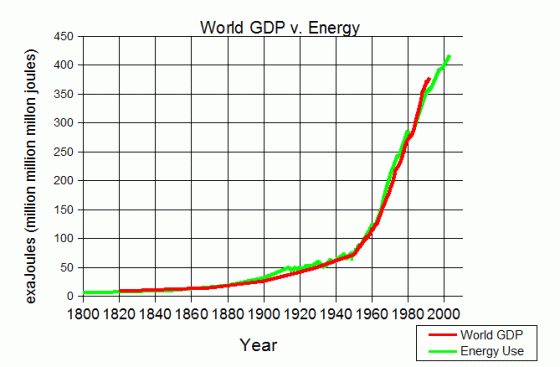
    The correlation between growth in energy use and in gdp is undisputable.

Enerconics1_html_m68263661
        It has been calculated and indeed is undisputed that app 98% of the cost of producing electricity here is governmental parasitism. 

       Nuclear is currently 40% of the average cost of our power basket.
China is building at 0.27 our costs.

Because China is building in three years and us in ten we have seven years foregone income while paying interest – assuming the normal 10% return that is 1.10^7 = 1.95
Assume China is not entirely without state parasitism – say 10% 
VAT and carbon levies 20%
How much could cost be reduced if it was allowed to mass produce reactors - three fold seems a conservative estimate.

60% X 0.27 X 1/1.95 X 90% X 1/1.20% X 1/3 = 0.0208 or 2.08% of current costs.
97.92% parasitism.
       Major reductions, not quite as major, could be done by allowing the market to produce shale gas. Any reduction on electricity costs, not just one as major as this, if the laws of supply and  demand work, would produce a many fold increase in energy use and therefore a many fold increase in gdp.

       Indeed I have previously proposed a 24 point programme to the world's fastest growth, which includes my original CT cutting proposal, and it would work. Theoretically we might expect most of the proposals to increase growth by about an average of 2% a year, Some more, some less.

       In practice we might be limited to a bit above the 20% growth Guandong province in China managed for years. Certainly the theoretical maximum, if we make growth our "Number one priority" (Scottish labour leader Jack McConnell promising at 2 elections - he knew what people want even if he lied about giving it) cannot be lower than the actually achieved maximum.

=================================
      Saatchi's proposal is a very good one, well thought out and verified. It is a small fraction of our potential.


Labels: , , ,


Wednesday, June 18, 2014

LPP Fusion Crowdfunding at £73,500 of £117,600

    I have lifted this bodily from Next Big Future. I achieving it - the possibility of getting a working fusion device - would be wonderful. Odds are it will take longer and cost more, as such things do but even if that were so any slight shortening of the period to till humanity has unlimited power is worthwhile. So I ask you to make a small investment as advised in the ######### section. I consider copying NBF as a better way to use my photons here than an original article I would write.

 
      Crowdfunding looks like a way those of us committed to human progress can bypass the parasitism of political pressure. I will have to look into it further but trying to get policitcal organisations, even the most sensible of them, to put even a tiny fraction  of the money they take "to fund things that can only be funded by government" has not, so far, been very successful.

LPP Fusion Crowdfunding at $125K of $200K target


Scientists at LPP Fusion, led by Chief Scientist Eric Lerner, are just one step away from technically proving out dense plasma focus fusion and you a few thousand other people can help for the final push. They are already 63% of the way to the $200,000 they needed for a few key experiments with 19 days to go in the crowdfunding effort.

Success would be better than doubling NASA's budget and 100,000 times cheaper than one year of double NASA budget

Lawrenceville Plasma Physics has thanked Nextbigfuture.com and                                    the Nextbigfuture community.

The Nextbigfuture community have been early contributors to this key energy project and we have helped to get the word out on social media.

A few thousand people can change the course of the future

If this project is successfully fully funded and then leads to a successful experiment, then Nextbigfuture and the Nextbigfuture community will have been a significant part of creating a better future for space technology and energy.

LPP needs about 4000 more people to donate on average about $25 each or fewer people with larger average donations.

The Battle of Thermopylae was fought between an alliance of Greek city-states, led by King Leonidas of Sparta, and the Persian Empire of Xerxes I over the course of three days, during the second Persian invasion of Greece. It changed the course of history. It is remembered for the 300 Spartans at the battle. However, it was a Greek force of 7000 men at the start. Later the bulk of the Greek army was dismissed and 300 Spartans, 700 Thespians, 400 Thebans and perhaps a few hundred others, most of whom were killed fought to the end. They died making history but you can help make the future for a few dollars.

Relatively Painless Money Saving Ideas to free up money to possibly change the world

You can rent two movies from Redbox instead of going to the theater and donate the savings.
######################################################################
Switch out of cable or satellite television and use Netflix and a HDTV antenna.

Use voice over internet phone services like OOMA or only use a mobile phone and no landline.

######################################################################

This is a nuclear fusion project where a bit of public funding will have a huge impact.
It is ten thousand times cheaper than the International Tokamak project. ITER costs billions and will still require decades and two more projects to possibly get to a commercial fusion reactor and those fusion reactors will be about fifteen story tall buildings the size of a football stadium.

This project could be proven for about $1-5 million with critical components and testing helped by another $127,000.

LPP needs to get their Tungsten electrode and then later switch to a berrylium electrode.
If successful with their research and then commercialization they will achieve commercial nuclear fusion at the cost of $400,000-1 million for a 5 megawatt generator that would produce power for about 0.3 cents per kwh instead of 6 cents per kwh for coal and natural gas. This can lead to commercial energy that is twenty times cheaper than natural gas or coal Last night coal mining killed another 238 274 people.

Energy that is twenty times cheaper will provide a massive pollution-free boost to the global economy. Instead of global 3% growth with not enough jobs it will mean 5+% growth for 60 years or more at least.

SuperCheap energy also means cheap clean water.

Go to this link to donate.

They have imaged the pinch which shows that much of the physics is as expected

Shot 9-09-10-02, 0.225 microsec before pinch

Right - Shot 9-15-10-07, magnified plasmoid at the pinch. We see the plasmoid on axis, which is about 150 microns across. The small dots are individual pixels, and do not represent actual fluctuations in intensity.


LPP’s mission is the development of a new environmentally safe, clean, cheap and unlimited energy source based on hydrogen-boron fusion and the dense plasma focus device, a combination we call Focus Fusion.

This work was initially funded by NASA’s Jet Propulsion Laboratory and is now backed by over forty private investors including the Abell Foundation of Baltimore. LPP’s patented technology and peer-reviewed science are guiding the design of this technology for this virtually unlimited source of clean energy that can be significantly cheaper than any other energy sources currently in use. Non-exclusive licenses to government agencies and manufacturing partners will aim to ensure rapid adoption of Focus Fusion generators as the primary source of electrical power worldwide.






Labels: , ,


Monday, June 09, 2014

Precis Of Eco-Parasitism

 
Most of this lobbying is harmless or slightly beneficial. Cutting business taxes on sector X would create growth because cutting taxes always does (as long as you don’t put them up in another sector). Where it is genuinely harmful is when the lobbyists are demanding subsidy, or rather, more subsidy (the ecofascist and arts lobbies do this) because that money must, by definition, come from the productive economy.

For example it has been proven that every “Green” job created costs 3.7 jobs in the real economy so every time some politician promises to create X-hundred thousand jobs in “renewables” they are actually saying they intend, quite deliberately, to destroy 2.7X-hundred thousand jobs.


Even worse is when the lobbyist isn’t even an honestish industry lobby but a government funded sockpuppet created by government to lobby itself and propagandise (see much of the arts and all of the ecofascists). This is far worse because it creates a positive feedback system of sgtate parasitism and both positive feedback and parasitism are obviously always destructive, often catastrophically so.
------------------------------------------
     This is a response I put up on Freethinking Economist in reply to an attack he was making on industry lobby groups who lobby politicians for aid to their particular industry.

    FE is probably the most intelligent of the LibDem bloggers (& as such got a good job as soon as they got into power - which he has now left for reasons we can only speculate on.

    He usually makes good points but without being willing to go far enough to reach obvious conclusion.

    So I do, usually showing that, as in this case, among the worst offenders against economic sanity are his own party. No reply so I assume this précis of exactly how much the politically approved subsidy junkies damage the country is indisputable.


Labels: , ,


Tuesday, May 20, 2014

We Should Be 4 Times Better Off

    This graph was put up by Tim Worstall from an article in the New Yorker.

   He was making a point about rates of return being higher when property rights are insecure, as they once were, and are looking like becoming again.

   However I was interested in the yellow line which fits in with stuff I have been saying before about growth in western countries having peaked in 1959 and that, by all the normal rules of statistics we should expect such curves to rise at an increasing rate, as this did till the 1950s and then the rate of growth to tale off. If that yellow curve had continued at the rate of acceleration form 1950-2012 as up to 1950 we would have an average growth rate of 7-8% now.

     The further decline in growth after 2012 - is obviously not actual but only what the miserabilist who did it is extrapolating. Nonetheless valuable since it shows what is intended if we allow it.

    When you have different research coming to similar endpoints you can be fairly sure you are onto something. In this case that it is only because of the Luddism, primarily but not exclusively in suppressing the very cheap electricity we should all have now, and the growing degree of state regulatory parasitism that is responsible. Technologically we could have that 7-8% annual growth at any time. Actually probably quite a bit more for some years as we catch up on using technology that has been suppressed. 60 years of growth averaging 3.5% when we could have had 6% means the entire planet could have been 4 times better off by now.
chart-06.jpg

Labels: , ,


Tuesday, April 29, 2014

BBC Head Of Censorship Says Censor To Promote Our lie

  This was on Andrew Montford's blog Bishop Hill some time ago (a Scottish blogger who is one of the world's leading sites on the "catastrophic global warming" fraud):

 -----------------------
In his Mail on Sunday article today (keep scrolling) David Rose reveals that the BBC - at least in Scotland - has a new policy of protecting climatologists from challenge on air.
A BBC executive in charge of editorial standards has ordered programme editors not to broadcast debates between climate scientists and global warming sceptics. 
Alasdair MacLeod claimed that such discussions amount to ‘false balance’ and breach an undertaking to the Corporation’s watchdog, the BBC Trust. 
Mr MacLeod, head of editorial standards and compliance for BBC Scotland, sent an email on  February 27 to 18 senior producers and editors, which has been obtained by The Mail on Sunday. 
It reads: ‘When covering climate change stories, we should not run debates / discussions directly between scientists and sceptics.
If dissenters from the climate consensus are not to be allowed to put their case directly, there is presumably little point in having those arguments put by BBC interviewers. So from now on the pronouncements of climatologists will be treated as holy writ and the most alarmist scientists can be allowed to scaremonger without fear of contradiction.
----------------------------------------------------------

      "Head of Editorial Standards and Compliance" can barely even be described as a euphemism for "Head of the Censorship Department".

      The BBC Charter does specifically make it a legal requirement that they report impartially and with "balance". The very existence of a Censorship Department proves that they are engaged in extensive and illegal censorship, and have no worries about being brought to account for their illegalities.

      The existence of a department large enough to require a Head, let alone a regional Head, simply to provide instructions on what must be censored means the amount of across the board censorship at the BBC must be massive.
-------------------------------------------------
     
      Another example, from the same site some days later would be the extensive BBC coverage of the possible poisoning of 6 birds (I have also heard the same news being gone over again yesterday) while the fact that windfarms in Scotland kill in the high thousands of birds a year, goes entirely censored.

     Since this is roughly 1,000 times more it would clearly be impossible for the BBC to give equal coverage to both news items unless it were no more than 1/1000th honest (ie 99.9% corrupt).

    By not reporting the windmill news at all they have clearly proven they do not aspire to even that level of integrity. Because the 28 Gate fraud became public we know that across all departments, the BBC have been aware, for a proven 7 years, that the warming story is, at least in large measure, fraudulent. There can therefore be no possible suggestion that any of these 99.9%+ corrupt totalitarian liars have any excuse or that any other state owned broadcaster anywhere in the world is as dishonest as our the BBC. 

Labels: , , ,


Friday, March 28, 2014

More Statistical Proof - Recession Is Caused By State Parasitism & Ecofascism - We Should & Could Be 4 To 16 Times Better Off


    This graph was put up by Tim Worstall from an article in the New Yorker.
chart-06.jpg


    Ignore the original article - it is about some economist complaining about rising inequality. Inequality is less important than overall growth unless you are one of those people who would rather have us all poorer than all of us better off, but some betterer off than others in which case you are motivated by hate and jealousy rather caring about society.

    Also ignore the purple line. It is about long term interest rates which is simply about how the wealth is divided up. The rate of interest is probably more a function of the reliability of the banking system before and after 1820. Also ignore the extension of the line beyond 2012 - that is just evidence free pushing of a political line.

    The important bit is the yellow line, which shows the long term growth rate in what is described as the world but I suspect is just the developed western world.

     This fits well with a previous graph on a previous post I presented. Indeed this post is pretty much a repetition of that one - but it is important enough to do so.

     Both graphs show that western growth rates have been going up throughout recorded history up until 1958.
And have been falling since.

    Now that just doesn't happen without very good reason.
    It isn't inevitable because as the 2nd graph shows, growth outside the developed west has not been affected, indeed is faster than at any time.
    It isn't because we have reached the end of technological progress because, measured by things like Moore's Law or increases in strength of materials, progress is far faster than at any time inn human history.

    Rising graphs like that are indicative of being at the foot of an S curve - human wealth should be increasing not just at the 1913-1950 rate (which would mean 6% annual growth now - pretty much what the non-EU/US countries are doing) but well above it - a bit speculative but at least 12% seems likely looking at the increasing of the slope between 1820-1913 & 1913-1950. Had we had growth of 6% average over the last 62 years we would all be 4 times better off. If we had had growth starting at 3% and rising to 12% (ie averaging 4.5% ahead of reality) we would ALL average 16 times better off.

   The only reason we know of to explain that is the growth in state regulatory parasitism. I have also noted the same tailing off of growth in nuclear power where, had the pre-1980 trend continued we would now all have at least 4 times as much power and be 4 times wealthier. Government parasitism has banned cheap power; it has banned cheap GM foods, it has destroyed at least 75% of the economy we could have had. And so on.

   As I say a bit of a repetition of what I have said before but every bit of extra evidence supports the position.

    We could get back on the natural growth rate at any time. Indeed I think that government parasitism must have repressed our growth and if released, like a spring, we would expect it to go well beyond the average 12% rate for some years. Which in turn supports my 24 point programme out of recession plan which suggested a maximum of 23%.
--------------------------------------------
      In a more modest vein John Redwood says that with cheaper power (the lack of which he wrongly blames on the EU) our industry would be 15% better off and creating half a million jobs. I have a comment.
    

Labels: , ,


Thursday, March 20, 2014

Newt on Minimum Wages

       This is from an article Newt Gingerich did recently.


    Not exactly an absolute correlation. Also one must make allowances for the variation in average national income - Greece & Portugal are less than half as well of as us so it is obvious minimum wage would have to be half as well (though this does rather make a nonsense of the theories that minimum wage laws either produce fairness or increase earnings. US minimums well below those of European states that they are richer than are also going to cause less interference in the market.

   In theory low minimum wages should do as little harm as no minimum wages because neither discourage people from paying the amounts of money real employers are willing to  pay.

   But overall there is a clear trend that those countries with no minimum wage laws, or with minimums, low compared to national income, have generally lower levels of unemployment.

   Who would have guessed?

  But it is better to have evidence. 

Labels: , ,


Thursday, March 06, 2014

Enerconics Speech again

   This links to a video presentation  of Mike Haseler's article/speech on the absolute correlation between energy use and gdp worldwide. Getting him tomake this public may be one of my better claims to fame since this, which he calls Enerconics seems to me to be a substantial contribution to economic theory.

  It also has some biographical material I didn't know before, but which does fit him perfectly:

A physics and electronics graduate of St Andrews University, Mike Haseler worked for a variety of industrial manufacturing companies, on a large range of projects controlling or monitoring temperature, before starting his own temperature control company and designing precision temperature controllers.

He joined the Scottish Parliamentary Renewable Energy Group and carried out extensive research into the renewable energy sector, becoming increasingly concerned at the lack of economic benefit from existing policy. He began campaigning to secure more jobs for Scotland in wind energy, joining the Green party who chose him to stand at the 2003 Scottish election, although he later took the decision to withdraw his candidacy.

While he continued to work in the wind industry in Scotland, erecting weather monitoring equipment, he finally gave up after accidentally informing a farmer that a windfarm was going to be built next to his property and seeing his look of absolute horror.

Since then Mike has been a campaigner against wind energy, and for energy policies that are based on ‘real’ science rather than global warming alarmism, and on pragmatic, evidence-based reasoning rather than utopianism. A keen blogger, he established the Scottish Climate and Energy Forum in 2011
------------------------------------------

And lets look at that worldwide correlation of energy use and gdp once again. its beautiful.Enerconics1_html_m68263661
 

Labels: , , ,


Wednesday, February 26, 2014

Constitutional Amendments 19 Banking Liability

     Limited liability companies are one of the social inventions that made entrepreneurialism possible. By limiting the liability of shareholders to their investment it became practical for large ventures that few individuals were able to afford possible. By comparison in partnerships every partner is liable for all the losses another partner makes. So long as those trading with them knows it is a limited liability company, which is why it is a legal requirement companies use the term "ltd" on correspondence, they know the risk they run.

     However banking is a different matter. Banks have to be big to be stable (though probably not "to big to fail"). However currently banks own your money as an asset & their debt to you is a liability so if they go bust you will, by definition get only so much in the £ back, or would if governments didn't bail them out. Worse than that, because it is limited liability, the managers can walk away or even, as the Fred Goodwin case showed, keep their pensions or assets which have been removed from the bank before it collapsed. This creates what is known as a moral hazard - that there is an incentive to take unjustified risks because the benefits of risks go to the managers, in the form of bonuses and promotions, but the costs are borne by society.

    So I think we should at least roll back the limitations on liability for those looking after people's money.

      Dan Hannan suggests this:

      reform would be the one backed by Steve Baker MP and the Cobden Centre, which is being introduced on Wednesday as a Ten Minute Rule Bill by the leader of Direct Democracy's Westminster wing, Douglas Carswell. Essentially, Douglas wants to amend the law so that depositors remain the owners of the money which they place in bank accounts. Currently, contrary to widespread belief, such assets are legally the property of the bank. Douglas's reform is to be recommended on several grounds: as a consumer protection measure; as a way of removing a peculiar legal exemption enjoyed by banks, but by no other businesses; as a prophylactic against the credit booms that precede recessions.
    
     The major, still current, example of a massive unlimited liability financial organisation is the Lloyds insurance organisation, which did indeed go bust some time ago and a number of Lloyds "names" (people who have guaranteed their assets for a share of the business profits) did indeed lose heavily, but the organisation survived.

      I'm agnostic as to how far we should go in increasing bank liability - having deposited money remain the property of the depositors so that in the event of failure they get it first/ making directors of banks financially liable for losses/ making shareholders (actually partners) liable up to a set value per share/ making them liable to an unlimited extent - but any of these steps would act as a greater or lesser discouragement of the moral hazard of casino banking and encouragement to fiscal conservatism by those responsible for people's deposits.

     In turn this would be negative feedback to the sort of boom and bust cycles we have recently seen.

Labels: , ,


Saturday, February 22, 2014

Links

  The Russian government underestimated when they said the US was paying Ukrainian violence by $20mill a week. Assistant Secretary Nuland says total is $5 billion so far.
----------------------------------------
Though no LudDims have replied to my invitation to debate the EU with them they have accepted Nigel's. Ah well, RHIP.
----------------------------------------
Mike Haseler on Scottish Sceptic carries out a complex mathematical assessment of when he expects the Met Office to be able to justly claim they can forecast climate a century hence. Not this century.
--------------------------------------
Julian Simon - the one who won the Simon-Ehrlich bet and has been proven essentially right in his optimism about human progress when Ehrlich's doomsaying has been absolutely wrong in every possible way. So obviously, seeing the needs of those who control "practical politics" and don't want progress, Ehrlich got the "genius" grants and Simon didn't.
----------------------------------
 Tragic: The child - named by neighbours as Zane Gbangbola - was discovered during a night-time rescue. It is thought he died from carbon monoxide poisoning
The 7 year old boy who died in the floods deliberately caused by our Environment Agency.
----------------------------------------
Chinese Lunar Lander Jade Rabbit comes back from the dead.
----------------------------------------

  • Office of Gordon and Sarah Brown has £10,000-a-week expenses
  • Not a registered charity, two thirds of funds raised spent on expenses
  • Less than  £1 million given to charity out of over £3 million
  • raised
  • Vanity project lets  Gordon and Sarah enjoy jet-set premier life-style of first class flights and five star hotels
from Guido
---------------------------------------
There is a perfect storm developing then in the European banking sector.

First, there is the increasing likelihood that the ECB will unleash a new round of asset purchases from the banks to flood them with the liquidity they need to buy up their respective national governments’ sovereign bonds and so hold bond yields down.

Second, there is a Eurozone-wide regulatory initiative to recapitalize the banks, likely following on from the results of the ECB’s bank stress tests. Third, there is an increasing chance of a deep stock market correction happening this summer. All three, taken collectively, could trigger a crisis of confidence in the banking sector. An insolvency crisis too should not be ruled out in the event of some large banks failing to recover from derivatives markets exposures in an increasingly volatile currency, interest rate, and stock-market environment.

from the von Mises Institute which is a pretty damn credible source
----------------------------------
Breibart - the new home for Delingpole
------------------------------------
Austria is getting pissed off at Germany destabilising the grid by dumping intermittent windmill power on them (via Poland and the Czechs who are already pissed at them).

Instructive bearing in mind that the SNP have promised us any English government will not only want our windmill power but will keep subsidising it after separation and supply us with mittent power whenever the wind doesn't blow,
 

Labels: , ,


Thursday, February 13, 2014

Osborne's 4 Conditions Represent Economic Reality - The SNP Must Decide What They Are Willing To Pay For

Dealing with the First Minister's claims that Scotland can share sterling with the UK despite separation, Mr Osborne said that "people need to know that is not going to happen".

He outlined the four criteria that would be needed to make a currency union work, based on analysis published today by the Treasury, and said neither the Scottish or British public would accept the reality of such an arrangement.
 
The four necessary criteria were (1)banking union, (2)great fiscal risk sharing, (3)the same monetary policy and a (4)union that could prove its permanence.

   While this is being reported here as a vindictive threat that fact is that economically he is quite right. A common currency would mean England was liable if Scotland couldn't pay (technically Scotland too in the opposite circumstances but it would we couldn't pay.

    Those 4 conditions are perfectly reasonable, considering their liability, and it is unlikely that even if they offered such a union future English governments would get elected if they promised to maintain it.

   There is always the option that the SNP could publicly accept that these conditions are inevitable and seek to prove they could meet them.

   (1) would mean the Bank of England running Scots fiscal regulation - this is not a bad idea and Scotland's banks might well prefer this to being subject to SNP fashions. It would certainly help keep Scotland's reputation as a financial centre and for this industry reputation is everything.

  (2) How does Scotland prove we are taking on as much risk AND in a position to pay it. The only way I can think of would be by mortgaging North Sea Oil as a common property. Anybody think the SNP will do that.

  (3) That means virtually all financial policy would be subject to a Westminster veto. That all Scottish borrowing be subject to London agreement. This largely makes us more dependent than we are now since now we at least have the Scotland Act to say what we control.

     Indeed there is an extra problem. 18% of our gdp is oil - but its price goes up and down like a yo-yo and, because Scottish oil is relatively expensive to get out, the profit on it is even more variable. That means if the Scottish government is to spend consistently sometimes it will be borrowing extensively and sometimes it will be in large surplus (at least in theory because I'm not sure I trust any of them not to find something to blow the surplus on.

   (4) This is a tough one, at least for an SNP government. A few years ago they were going to sign Scotland up to the Euro - but that went down the tubes for reasons which make it obvious why currency unions take more than hope. Worse, and I am surprised nobody has made an issue of it, the SNP have already made noises about repudiating Scotland's share of the national debt. Worse, our future Chancellor, John Swinney, has said it. It is a general rule that Chancellors do not threaten defaults - it gives potential lenders a bad impression. Any Scottish government led by the SNP has already given away a lot of financial credibility simply by making that threat. And has give away much of the credibility of being committed to a long term currency union.

============================================

Plans B

Nothing prevents the current UK money continuing to circulate in Scotland. As a number of countries use the US $. No London government could, or would want to prevent that. Holyrood could also print its own currency - making sure it is only a fairly small share of the currency in circulation. That would work - it would mean that our trade was still largely in UK £s so no extra transaction costs.

    So long as Holyrood was financially sensible they would be able to have a Scottish £ in circulation that matched the UK one.

   But then almost any financially sensible policy will work. It is only if Holyrood borrow more per head than the UK, print more and spend more and/or grow the economy more slowly that there will be any financial problem. But spending more while cutting taxes is exactly what they want independence to do. Well no, a financially destructive policy destroys - and will do so wherever the seat of government is.

   Independence does not make an SNP government independent of reality. In fact it makes us much more closely connected to reality, without a big neighbour to provide a cushion. With independence comes responsibility for our own future. The SNP's entire history has been of  blaming the English for everything and threatening to throw our toys out of the pram if they don't get more money from Westminster.

    That probably stops, one way or the other, with this referendum.

Labels: , ,


Friday, February 07, 2014

Yet Another Academic Report Agrees How Expensive EU Membership Is

The average Dutch household could be better off by over £8,000 a year and national income will grow by over £1 trillion [by 2035] if the Netherlands leaves the euro and the EU, according to a new study.
 
The study by the respected British Capital Economics research consultancy into "Nexit" - as a potential exit by the Netherlands has been termed - finds significant benefits over the next two decades if the country swaps its EU membership for a status similar to Switzerland or Norway.
 
I commented:
 
The £8,000 per household fits fairly well with Tim Congdon's assessment that EU membership costs us £170 bn (about £6K per household) but I am pleased they also include the effect on long term growth which is the main effect. The EU is the only world zone in recession - the rest is growing at an average of 6% a year. This is not something that our media mention - they keep blaming our problems on what they know to be a non-existent "world recession".

The important thing is not whether this report is more or less authoritative than Professor Congdon's but that there are a whole series of such, virtually all of which come to broadly similar conclusions.

Also that our own beloved government have always refused to authorise their own investigation.

   The Netherland's population is 16.8 million - 3 1/3rd Scotland's so that would be £336 billion more in the Scottish economy or £3.7 trillion for the UK by 2035. Do not expect to hear this getting BBC coverage or indeed mentioned by any of the cartel of parties in Holyrood who, whether they want "independence" from the UK or not are agreed in opposing independence from Brussels.

      6% growth over 21 years would increase gdp 3.4 times. £1 trillion increase in gdp by 2035 looks like about twice current Dutch gdp so this is a reasonable, arguably cautious, assessment.

    Bear in mind that several polls have shown that most people would be persuadable on Salmond's pretend "independence" if it could be shown they would be either £500 a year better or worse off after separation. Yet we are being prevented, not least by the nominally independence supporting SNP, from having a referendum on the entity that creates 75% of our legislation.

     I have sent this as a letter to most of the Scottish press. We will, as normal, see if this is another of these things you may not say in Scottish politics.

Labels: , , ,


Thursday, January 23, 2014

GDP & Energy - 2 sides Of The Same Coin - But What Was The 20thC's Turning Point In 1950?

Enerconics1_html_m68263661
   Some time ago I published this graph as part of an article and series of graphs from Mike Haseler.

   However it is so beautiful that it deserves a post devoted to it alone,

   When he gave his talk he explained how the initial figures, which had included only officially produced figures had come to a less satisfactory result - then he added cooking fires across the world and it all fitted into place. That sort of elegance emerging from chaos does tend to mean something profound (E=MC^2 being an example).

     You just don't get data correlations as close as this if you are measuring different things. Thus energy use and wealth simply are the same things.

    This is a world figure - the correlation is less close nationally/ Partly because it is colder in Canada than Equador. partly because the local energy availability (usually oil or hydro power both of which Canada have) varies. However this also shows that where one country prevents people using energy the effect is to move the industry elsewhere in the world.

    I also find the slight variations from perfection of the curve fascinating:

1 - From about 1890-1930 energy use slightly leads growth. That era up till WW1 is indeed often held up as the era when most technological change in people's lives occurred. Also fascinating that WW1, the depression and WW2, all of which are treated as massive changes, usually for the worst, simply do not register on either energy or wealth.

2 - Then just before 1950 we get a significant increase in the rate of growth of both. It isn't an immediate post war boom - a few years late for that. Nor the production of commercial nuclear power - to early for that. Conceivably it is the cold war turning hot in Korea leading the US to encourage the reindustrialisation of Japan but that seems to minor. Whatever it is in economic terms this is the most important literal economic turning point of the 20thC.

3 - Which in turn shows how the graph is close to but not exactly a classic S curve:


   If there had not been the 1950 turn it would be a perfect fit for an S curve which would suggest we still have quite a way to go before hitting the top - anywhere between another 30 years and forever before we hit top. And though it isn't a perfect S curve it is as close as real economics is going to produce, so that conclusion is still very reasonable.

4 - Around 1962 we get another minor acceleration. Possibly this is nuclear coming on line. possibly not.

5 - From 1962 to 1980 we also see energy use slightly leading wealth growth. I'd be fairly confident in putting that down to nuclear (the anti-nuclear movement became effective about 1970 but because of the lead time in building plants this only means that plants would only stop coming online about 1980.

    Note that when it comes to cause and effect, causes must always lead effect. Thus the growth in energy in the 1890-1930 & 1962-80 period can only be a cause not an effect of wealth increase.

6 - After the mid 1980s it switches over. Wealth growth continues at the same rate as from 1962 (possibly even marginally faster between 1982-4) whereas growth in world energy use starts to lag it significantly. That does look entirely like the effect of the Luddite movement. It has certainly had an enormous effect across the western world, where most of the Luddism is, and if it were to start affecting China etc., could then have a serious effect on the wealth of the entire human race.
---------------------
    
    My feeling is that, unless we embrace Luddism, the start of topping of the S curve for world energy use/gdp will be at least as far ahead as 1950 was behind. Moreover by then there will be 2 graphs - World GDP/Energy and Human GDP/Energy. By 2078 a lot, perhaps most human energy use will be in the off planet economy, and that it will be increasing at an even faster rate, around twice as fast, as terrestrial energy use has increased for since 1950.

   Up till we start using anti-matter to power interstellar craft - which will need at least an order of magnitude more energy again. 

Labels: , ,


Sunday, January 19, 2014

BRITAIN CAN BE THE WORLD'S LEADING NATION, AT LEAST PER CAPITA, ANY TIME OUR POLITICAL CLASS STOP PREVENTING IT.

      Dan Hannan highlights this report on the influence of Britain in the world
Great Powers, Superpowers, Global Powers, Regional Powers, Power Matrix, Countries Ranking

    It relates our global reach to Universities, major cities, military and intelligence reach etc.

    OK the elephant in the room of national power is gdp, as I have always said, and our poor growth rate (our economy was recently passed by Brazil's) is abysmal.

    But high measures by other standards do strongly suggest we are a world leader in many fields and, if we get the economy right, have the potential to be so widely.

    That wouldn't matter if we were doing well just by this measurement (which looks arguably self selecting to me - for example the historic best universities may be cruising on their record while Asian ones are working on current achievement).

    However I have previously noted how, by measurement of scientific citations Britain is not only 2nd overall worldwide but doing twice as well per capita as the USA and ahead of all but a small number of very small countries.

    Or if you go to the Worldmapper site, where where the size of countries is distorted to make them match not geography but other qualities the UK is almost always far larger than its geographical size. It is also consistently smaller than the USA, which means we are competing in the same fields, but better than 1/5th the size of the USA on almost everything though that is our population ratio.

   Except on gdp where we are close to the 5:1 ratio and electricity production where the US outpowers us by 11.27:1.

   The evidence that gdp is very closely related to energy & particularly energy use seems not seriously disputed (though it is studiously ignored by our political class). If we had the same electricity use to production ratio as they do (ie building about 50 x 1 GW nuclear power stations costing inder £800 bn each) we could expect gdp to rise 2.25 times.

   I have previously said that government regulatory parasitism quadruples the cost of housing and child care, increases electricity costs at least 90% etc etc and thereby robs us at least another 100% of the gdp we actually have & perhaps 300%.

   I have previously put forward my 24 point plan out of recession which would, if the combined decision of experts not to dispute it would work, is any clue, certainly get us into a growth rate unmatched by any other country.

CONCLUSION

   Britain is a world leader in so many scientific and cultural fields that it is our relative economic failure that is the outlier not the others. That means it should be relatively easy to fix.

   If we aimed to maximise gdp growth we could expect to move to the sort of gdp ratio that we have for other cultural factors. Indeed if we are being held back by our poor economy, as one would expect, the cultural benchmark would move up as our economy grows.

   By the listing in the graph we are doing 2.43 times better than the USA per capita, though we only have 1/5th the population. By gdp to energy use we are producing  2.25 times as much. By my estimate of the cost of state parasitism we could be 2-4 times better off. By scientific citations we are 1.76 times better than the USA per capita.

   And the USA provides the benchmark to which, on most measures, nobody else (except maybe Singapore & Hong Kong) comes close to matching across the board.

   Far from Britain being a "2nd class" power or "a small offshore island" as our political class so often say as an excuse for their own failure -

   BRITAIN CAN BE THE WORLD'S LEADING NATION, AT LEAST PER CAPITA & BY MANY MEASURES IN ABSOLUTE TERMS, ANY TIME OUR POLITICAL CLASS STOP PREVENTING IT.

---------------------------------------
   Personally, being an ambitious sort I think if we also put a national effort into an X-Prize Foundation across the fields of science, space development, Orion (or more likely more modern nuclear spaceships), floating equatorial islands, mass manufacturing of nuclear plants there is virtually no field in which we could not lead the world into a wealth, educated and peaceful future. But am willing to start small with is just increasing gdp 2.4 times.
 

Labels: , , ,


Monday, December 30, 2013

A Few Facts

      Three links to useful facts.

UKIP on the EU:
  • The EU’s accounts have not been signed off by the European Court of Auditors for 19 years in a row.
  • Germany exported almost half a million (474,000) more cars to the UK in 2011 than she imported from the UK, exporting 3.7 times as many cars to the UK than she imported from the UK.  It’s not in Germany’s interest to see tariff’s go up on German cars when we leave the EU – there will be a free trade deal.
  • In September 2013 the overall trade in goods balance with the EU reached a record deficit of £6.0 billion.  They sell so much more to us than we do to them.
  • Professor Tim Congdon has calculated in his 2013 Costs of the EU to be 11% of GDP, roughly £170bn to the whole economy.  This includes:
    • Direct Fiscal cost of the EU 1.25% of GDP.
    • Cost of Regulation 5.5% of GDP.
    • Cost of misallocating EU resources/grants etc 3.25% of GDP.
    • The EU spends £2bn on advertising, more than Coca Cola did in 2008.
    • The EU lost £1.2bn of foreign aid last year
    • The Common Fisheries Policy has cost the UK economy £2.8bn.  In 1970, there were 21,443 fishermen in the UK, about one in seven working part time. As of 2008, there were 12,700.
    • The EU Large Combustion Plant Directive is forcing the closure of a third of our coal and oil fired power stations in 2015.
    • The Government admits its policies (and the EU) add 14% to energy bills.
    • MEPs earn 740% more than the average EU citizen.  In the UK it’s 695% more.
    • Baroness Ashton’s EU External Action Service was set up with a £5.8m budget, employing over 7,000 people.
SONE (Supporters of Nuclear Energy):

WORLD ENERGY USE %

Global energy consumption grew strongly by 5.6% in 2010 – the latest figures available – to 12bn tonnes of oil equivalent (toe). It was the biggest annual growth since 1973 and took consumption to well beyond its 2008 peak. (5.6% is within random variability of the 4.8% world economic gtowth, confirming how closely they are related)
The contributions were: oil 33.5%; coal 29.5%, natural gas 23.8%; hydroelectricity 6.5%; nuclear 5.2%; and renewables 1.3%. Less useful energy was delivered because of losses in converting fossil fuels to heat and light. The main shares were: oil 28%; coal 23.8%, natural gas 19.2%, hydro 16% and nuclear 13%.

UK ENERGY SOURCES %

The UK now has to import coal, oil, gas and even biomass (wood) and within a decade could become dependent on gas imports for 80-90% of demand. In 2010 we used 227.5mtoe, up 3.4% on 2009. The useful energy supplied came from natural gas 38%; oil 32%, nuclear 14%; coal 13% and renewables 3%.

UK ELECTRICITY DEMAND %

UK electricity demand varies from around 24,000MW in summer to 61,000MW in winter. Its peak was 60,893MW in the middle of a cold spell in December 2010. Electricity generation, including pumped storage, rose 1.2% on 2009 to 381TWh and total supply, including net imports, by 1.1%. It was generated by natural gas (46%); coal (up 1% to 28%);. nuclear 16% (down 2% because of maintenance) and renewables marginally up at 6.8%. Households accounted for 31% of total demand; industry 27% and transport and services 27%; fuel industry 7% and losses 7%.

UK CARBON EMISSIONS BY FUEL

Nuclear is the cleanest fuel used in the UK today. It emits next to no CO2, taking account of uranium mining and decommissioning and waste management. Expressed in terms of grams per unit of electricity (kWh) the score is nuclear 4gm; wind 8; hydro 8-9; energy crops 17; geothermal 79; solar 133; gas 430; diesel 772; oil 828; and coal 955gpkWh.
Nuclear is 200 and 100 times “cleaner” than coal and gas respectively. It is crucial to achieving the Governmentʼs ambitious carbon reduction emissions targets.

NUCLEAR ACROSS THE WORLD

Britain led the world into the nuclear power age at Calder Hall in Cumbria 55 years ago. Now there are 440 reactors in operation in 30 countries, another 61 are under construction, 156 are planned (for the next 8-10 years) and another 343 proposed longer term. Current total capacity is 377,000MW, roughly equivalent to 370 large power stations. Sixty-one new reactors are under construction in 13 countries – 26 of them in China – and 156 are planned in 27 countries. Of these the leaders are China 51 reactors, India 17 and Russia 14. Longer term another 343 reactors are proposed in 37 countries with the same nations leading the way – China 120, India 40, Russia 30 and USA 27.

The vast bulk of global nuclear generation is still in Europe and North America – Europe 44%; North America (USA and Canada) 34%; Asia Pacific 21%; South America and Africa 1%. In 2010 nuclear generation across the world saved the equivalent of 620m tonnes of oil and 5bn tonnes of CO2 emissions.

Uranium is as prevalent in the worldʼs crust as tin and there is no shortage. With recycling of so-called “spent fuel” and the fast reactor, now being revived, it is estimated there is enough nuclear fuel to last for 1,000 years.

NUCLEAR IN THE UK

The UK has 19 commercial reactors in operation at ten power stations – two Magnox, seven AGR and one PWR (at Sizewell, Suffolk). Nuclear power station sites (going round the coast anti-clockwise ) are Dungeness, Sizewell, Hartlepool, Torness, Hunterston, Heysham, Wylfa, Oldbury and Hinkley Point.

 The Government has identified 8 potential sites for use up to 2025 – all the above, apart from Torness, Hunterston and Dungeness, plus Bradwell (Essex) where the power station has closed.

NUCLEAR WASTE

Nuclear power puts into the environment only about one-thousandth of the radiation dose received each year by the public. Some 85% comes from natural background radiation – from the soil, rocks, the sun and chemicals within our bodies. Medical X-rays are responsible for 140 times more radiation in the environment than nuclear power.

The nuclear industry has been handling its waste for 55 years and produces only about one-thousandth of the UKʼs annual toxic waste. It comes in three categories: low-level, intermediate and high-level waste. Ninety per cent of it is low level and is disposed of at Drigg in Cumbria. The remaining 10% needs treatment. but the annual amount of high level waste produced by a large nuclear station would only fill a London taxi. New designs of reactor will generate only one-tenth of the amount of the intermediate and high level waste from todayʼs reactors

And a "Factcheck" on Osborne and other's recent claims that Britain is the "fastest growing country in the developed world":

"depends upon the time frame we look at.

If by 'major advanced economies' the Chancellor meant the G7 group of nations, then it is certainly true that the UK's growth of 0.8% in the most recent quarter was faster than any of its competitors, pipping the US, whose economy grew by 0.7%. The economies of both France and Italy contracted over this period.

However the opposition claims that this isn't very revealing, arguing that the fact that the economy is growing swiftly now owes much to the low baseline set by "three damaging years of flatlining".
In total, the UK economy has grown by just under 3% since the Coalition took office in the second quarter of 2010, and this compares rather less favourably to other G7 countries: only France (which has grown 2.5%) and Italy (which has shrunk by nearly 4%) have fared worse, while the US has clocked growth of 6.7% over the same period.

To put these figures into context, the OECD data suggests that over the course of 2013 so far, China has seen growth of over 9%, while other developing economies such as Argentina and Indonesia have seen growth of over 6%."

   So it isn't for the developed world, merely for 7 slow growing countries, 4 of them in the EU and only for 3 months and to a level of 0.1% which is far below the accuracy, let alone meaningfulness of the figures.

   I find the medium and long term trend, that we are the slowest growing English speaking nation in the world (though that requires saying that a couple of Caribbean islands with populations in the 10s of thousands aren't really a nation).

Labels: , ,


Monday, November 04, 2013

Joseph Friedlander

   I have previously referred to various technological ideas of Joseph Friedlander. This is about him and a link to various articles which I thoroughly recommend

----------------------


Joseph Friedlander

Joseph Friedlander is a thinker in the pattern of Herman Kahn or David South, who takes a theoretical construct and reduces it to detailed scenarios for action, with an emphasis on the immediately achievable and the practical that can be settled for in the very near term as a foundation for greater achievements later on.

Joseph has a degree in business, certificates in computer aided design, tool and die work, information science, and other technical areas and wide background familiarity with astrophysics and chemistry.

His reading is wide-ranging (some would say encyclopedic). Among his favorite authors are those who concentrate on the links between industry, government and military, society and prosperity, in particular Jane Jacobs, Seymour Melman, Herman Kahn, and Kevin A. Carson.

Joseph is an inventor and consultant who writes and speaks often on space industrialization and settlement as well as future industrial possibilities on Earth and the ways these things could change our lives. He is a member of the World Economics Association.

He authored In Praise of Large Payloads for Space, Joseph Friedlander’s Thoughts Inspired By Alexander Bolonkin’s Writings On How To Catalyze Innovation And Technical Progress, Hyperwealth and Alternative Futures, Tyler Cowen’s “Great Stagnation” — Joseph Friedlander Perspective and Thoughts on Related Subjects, What was the best way to use the Saturn V to reach the Moon — in retrospect?, A summary of Dr. Bruce Cordell’s 21stCenturyWaves.com Maslow Window Model, and The Friedlander Cold Crown — A Cold Trap For The Lunar Poles — Solid Oxygen For Lunar Capture And Export.

Read his LinkedIn profile. Joseph Friedlander

Labels: ,


Friday, October 18, 2013

An Energy Policy to Get Out Of Recession

   I am proud to present Mike Haseler's speech and graphs from his recent talk at UKIP Glasgow's Getting Out Of Recession discussion here and here. It starts with the basics and goes on to prove, in my opinion, the virtual total correlation between energy use and growth, which I regard as a significant contribution to economics :

An Energy Policy to Get Out Of Recession

By Mike Haseler 

  • In this talk I will outline an argument that a good energy policy is not only critical to get us out of recession but that energy is so intrinsically linked to GDP that energy policy more or less dictates how our economy performs.
Energy
  • My five year old son said: “ENERGY IS THE POWER TO MAKE US DO THINGS"
  • Coriolis introduced the idea of energy being the work done.
  • Work is things such as lifting a weight up or e.g. the work done by a weight dropping. For example the weight in an old clock does so much work or a certain weight of water turning a water mill.
  • With the development of steam power, people began to realise that burning things to produce heat was also a way of creating energy or replacing the work done by a human or animal turning a wheel.
  • At first people like the Luddites thought that all this "cheap labour" produced by burning wood or fossil fuels like coal was a "bad thing" because in effect coal was a cheap labourer replacing the more costly "food powered labourer".
  • That did not happen.
  • Replacing human labourers, by machinery did not end the need for human labour. In the industrial age, mankind's labour was needed in addition to machinery.
  • We had "human machines" whose energy derived from food. And machines producing work, first from water & wind, and then the cheaper coal and eventually gas and oil.
  • Both machines and humans "work".
GDP
GDP or gross domestic product can be measured or more accurately estimated, by a number of techniques. For our purposes the best measure to illustrate the point is that:
  • GDP is total (inflation adjusted) earnings from work (+ a few others)
  • Rising GDP is an indication of a prosperous economy. In other words when GDP is rising even allowing for inflation, we are all earning more and more or to turn it around, we are all spending more and more.
  • But what does this really mean?
  • The key to understanding GDP, is to understand how inflation is calculated. This is done by calculating the cost of a "basket of goods" which is thought to represent the cost of goods purchased by the typical household.
  • So, if the cost of this basket increases, inflation goes up (seldom comes down).
  • So, another way to describe rising GDP is that on average we can all purchase a bigger and bigger basket of typical goods.
GDP & Energy
  • Both energy and GDP are related to work.
  • GDP is the goods the average person can purchase on an average income.
  • Energy is the work done by a unit of energy ... which at one time was the average work by a person.
  • GDP is earnings from the work done by the average person.
Why Energy increases Prosperity
  • A long time ago, the work done in the economy was entirely human.
  • That work was powered by food.
  • The energy per adult male was about 2-3000 calories per day (c10,000kj or 10megajoule) (about 100ml of petrol.)
  • Then about a million years ago, man stumbled across fire - the energy available increased and so did our comfort.
  • A couple of thousand years ago, that energy increased still further when we domesticated animals. Animals could labour in our place or in some societies slavery increased the work done per "citizen". Those labourers had to be fed - our energy demand increased alongside increased prosperity.
  • So, even before money, energy was adding to prosperity.
A side issue Correlation
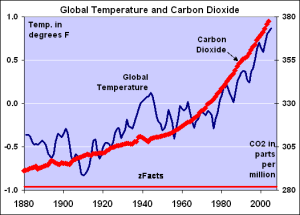
  • We have all heard that some warmist say that they "are certain" manmade CO2 caused the 20th century temperature rise.
  • They mean CO2 levels rise was "correlated" with global temperature rise (Fig1).
Enerconics1_html_m544c8644Fig 1: Caution: The match of the CO2 and temperature graph above is somewhat deceptive. Since one is temperature and one is CO2
  • this is not exactly convincing.
  • Much of the global temperature change such as the 1940 bump is unexplained by changes in CO2.
The graph is bogus
  • graph is in fact entirely bogus.
  • no reliable CO2 data before 1958, so that portion of the graph is entirely fiction.
  • Effect of CO2 is much smaller than suggested.
  • Actual rise due to CO2 greenhouse warming is as shown below (blue line).
  • The graph breaks down after 1998 as shown by my graph #3.
Enerconics1_html_m7a832eb9Fig 2: Real relationship - not known before 1958 and much less after
Enerconics1_html_41d9e56Fig 3: ... and relationshop breaks down after 2000
GDP is energy
  • World GDP and world energy show a much higher degree correlation.

Enerconics1_html_m68263661Fig 4: World Energy. (in exajoules) versus worldGDP (scaled to fit)

Enerconics1_html_73710a2
Fig 5: Change in world GDP against change in energy usage
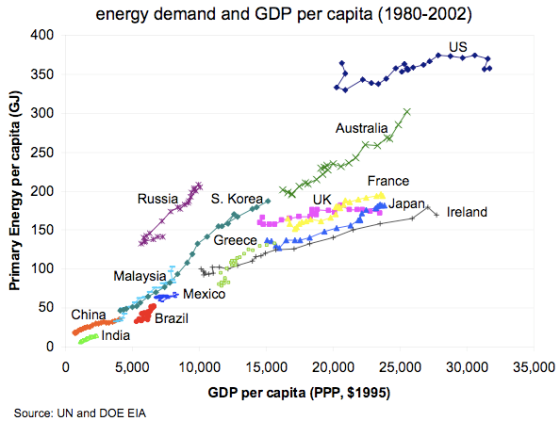
Enerconics1_html_2fc8ea1bFig 6: GDP per country versus energy usage
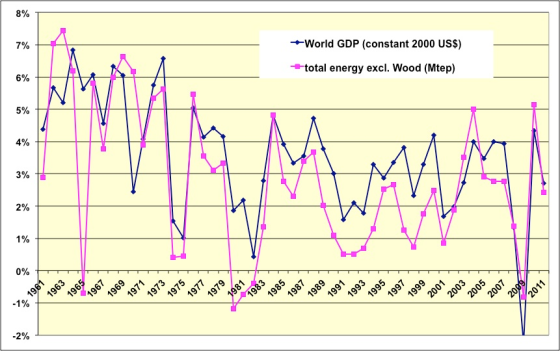
  • As world GDP (blue) rises and falls, total world energy use (pink) also rises and falls in sync.
  • And if we look at Fig 6 we see that GDP per capita rises the more energy each country has.
  • This shows that for all reasonable purposes Energy is a proxy for world GDP. In other words if GDP rises, energy rises, or if energy usage rises then we should expect GDP to rise.
Enerconics1_html_629264eFig 7: Changing energy use and GDP for selected countries
  • As fig 7 shows, there is a natural increase in energy use as countries increase GDP.
  • Or is it the other way around? Does rising energy availability lead to rising GDP?
Enerconics1_html_43888f0e
Fig 8: Cost of meterials against energy in production
  • graph shows energy used in producing materials is very closely linked to the cost.
Energy use does not increase as a result of rising GDP,
but rising GDP and rising energy use are the same thing!
The problem with Green economics - destroy the economy to "Save the planet"
  • Long known that we cannot have GDP growth without growing the availability of energy.
  • Usually, argument is: we must reduce economic activity to "save the planet".
  • What happens when we reduce energy usage?
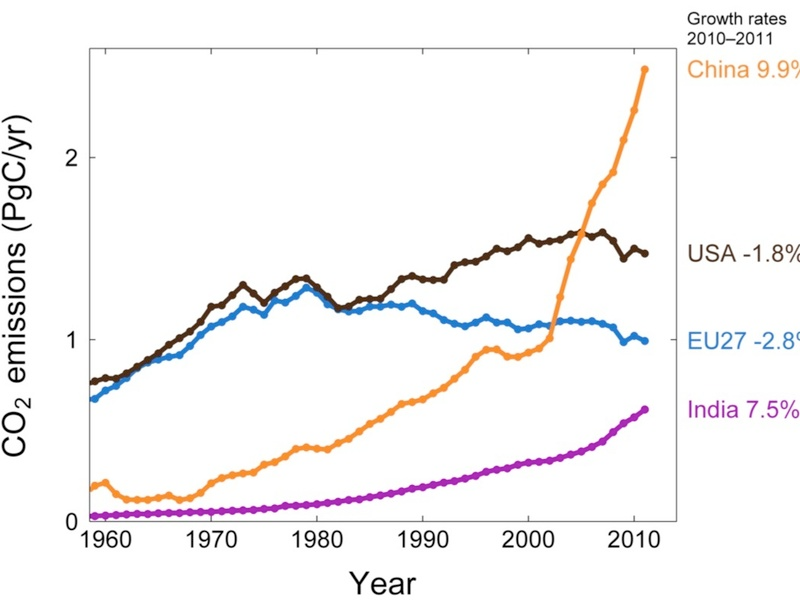
  • Looking at energy use of the USA, China, India and the EU from 1980, only the EU has seen a drop in energy usage
Enerconics1_html_1141c965
Fig 9: Energy Usage of USA (brown) EU (blue) China(Orange) India (purple)
  • And what has been the effect on GDP?
  • GDP has gone down
Enerconics1_html_m4289fcb2Fig 10: GDP (inflation adjusted) for USA (blue) & EU (orange Kyoto signatory) and India (yellow) & China (green) which were not obliged to cut CO2 under Kyoto
The problem with green economics - CO2 is not a problem
  • Global temperature has not risen in last 16 years
  • Severe weather has not increased
  • CO2 is an essential plant food which increases agricultural output
  • Moderate warming as we expect from the greenhouse effect of the small increase in CO2 is overwhelmingly beneficial ... as anyone with a greenhouse will know! ... particularly in Scotland.
  • So, the anti-capitalist argument of "destroy the world economy to save the planet" is just hogwash.
The problem with green economics - Energy saving schemes don't work
  • The reason for this is obvious when we understand that energy and money are two sides of the same measure.
  • However in practical terms, all saving money from e.g. insulating our homes does, is to save us money.
  • What do we then do with this extra money?
  • We spend it .... on goods which have taken just as much energy to produce as the energy saved.
  • So ... just the same amount of energy is used ... just in a different place.
The reality of energy and economics - money is stored energy
  • Rising GDP means we can all afford to buy a bigger and bigger basket of the typical goods.
  • Those goods take energy to produce. For food, that energy is largely natural. For manufactured goods, most of that energy is from fossil fuels.
  • The energy used to produce goods - the "stored energy value" of e.g. a "Mars bar" or an apple, or even a simple steel knife, set by energy costs in manufacture.
  • Whilst energy use may vary between manufacturers.
  • In a free market, all other things being equal we choose the lowest cost goods.
  • The cost of goods is largely determined by the energy use
  • In free market we choose the goods using the lowest energy to produce.
From this I think we can draw three conclusions:
  • In a free market, the cost of any good largely reflects the energy used in producing that good.
Therefore because free markets encourage the lowest priced goods.
  • In a free market, the energy used in producing any good is minimised.
The cost of energy, whether food like wheat, oil, coal or wind is mainly determined by the goods used in producing the means to harvest the wind and the process of harvesting it. And as the price of those goods like steel for windmills is largely determined by the energy used in their production it is almost certainly true that:
  • If any energy source per KWH costs more than the average market price for energy in KWH, then the energy consumed in producing that energy is greater than that produced.
  • Rather than a free market being wasteful ... free markets are the best way to ensure maximum energy efficiency.
  • Distortions to the market tend to reduce energy and economic efficiency.
  • The result is economic decline as we have seen in Europe.
How to revitalise the Scottish Economy:
  1. Stop politicians interfering with the cost of energy. Even if CO2 were a problem, because wind is so expensive, it is almost certain that more CO2 is produced as a result of this policy than without it.
  2. Stop wasting our money on wasteful wind.
  3. Stop trying to reduce energy usage
  4. Encourage fracking
  5. Encourage nuclear fusion.

Labels: , , ,


This page is powered by Blogger. Isn't yours?

British Blogs.