
Saturday, June 28, 2014
Scottis Tories Unpopular Because of the Callous PM Who Deliberately Destroyed Our Industry & Killed Communities

At the start of this Scotland gave the Tories just over 50% of the vote, more than Labour has ever achieved. By comparison Wales was always dodgy ground for them and in fact if you bear in nmind that neither main party hopes to get above 40% of the UK vote now a Tory drop of 4% from 30% to 26% there proportionately counts as a gain - certainly so compared to Labour.
The first Tory drop here is from 50% to just under 40% over the 15 years between 1955 and 1970. That loss is serious. It covers the period of the Conservative councillors, who used to fight under the name Progressives (a title the left now claim so I assume they think it is attractive) largely dropped that name and became Conservative. This was the end of a particularly Scottish, anti-socialist, political institution which didn't suit the vision of Tory "modernisers" of the time and which incidentally suited the Unionist vote - basically the group of, mainly protestant Liberals who at the end of the 19thC or later, split from them over Irish home rule. They were willing to work with the Tories but were never really were comfortable being them. The protestant unionist vote was a group Tory "modernisers" were embarrassed to have supporting them. Even so, while losing 12% of the vote is a bad fall, remember that this was the period when the SNP first won Hamilton and became something more than a fringe and when the Liberals were rising from the edge of non-existence to 7.5% in 1970 so probably half of this drop can be put down to these factors.
The 36 years from late 1974 to 2010 shows a drop from 24% to 17%. Again bad but not a disaster, at least as counts the amount of change. There was a UK wide drop up to 2005 of 4% (though they recovered elsewhere in 2010 - Gordon Brown was not as unpopular here as elsewhere). There was a greater fall here during Thatcher's 2nd and 3rd elections but it was certainly not the "electoral poison" she is claimed to have been. I think some of that can be blamed on their opposition to devolution and some (though the better than UK recovery in 1992 suggests not much) to the coal industry being bigger here.
The real disaster in Scottish Conservative voting was from 1970 to late 1974. A 4 year period that saw them fall from 38% to 24%. 37% of their voters gone. Now that is the definition of electoral disaster.
So what was the cause of this. I am going to say it was Ted Heath's selling out of the fishing industry to join the EU. The EU's common fisheries policy, that the fish belonged to the whole EU not the countries in whose waters they were, was cynically cobbled together hours before negotiations with would be new members started. Heath and his supporters made it absolutely clear that they were willing to sell out our industry. It was, after all, an industry concentrated in far away Scotland, in small towns and villages where the metropolitan media never go. In his calculation of the political balance of power these people, their livelihoods and homes were expendable to achieve Heath's dream of membership of the EEC.
Since fishing was a largely a small business, with captains owning their ships, it was not unionised. These towns and villages, didn't have the support of massive union power (much more massive then than now) and their PR and machines and flying picket thugs. Their fate has barely stirred the surface of the UK political and media class. While media pundits still lament how Thatcher destroyed mining communities (she didn't, economics did) they are simply ignorant of how Heath, quite deliberately and with no economic justification at all, murdered (murder being deliberate planned killing) Scottish fishing communities. But it stirred Scotland into considering that not only were we being ignored by London (we always knew that and being ignored by Westminster is not so bad) but that we were actively expendable and betrayable.
It may be 40 years on and the party may, or may claim to be, offering us the chance to leave, but the Scottish Tories deserve every single lost vote.
But the SNP don't deserve any better. The Tories may have murdered the industry but the self styled "Scottish National Party" have kept on mutilating the body. Nobody, not even the LibDems, are more enthusiastic for us staying in the EU. Nobody, certainly not the present Tories, are as keen to pay our membership of the EU in Scotland's fish. Though it is certain the terms of membership of a their "independent" Scotland would involve far more than what the EU already have from Britain. The SNP know the people of Scotland would never support another such sell out - that is why this most unpatriotic of parties has said it would not allow us a vote on rejoining the EU.
Yet the fishing fields are still there. A fair proportion of the fish are too, despite EU overfishing and they should recover if there were a few years of only the current UK landings taking place. If there were the political will to do so.
What the people of Scotland, and particularly the coastal fishing regions, need is a genuinely patriotic Scottish party (Scottish and British patriotism being entirely compatible) putting forward a Scottish programme which would include quitting the EU and allowing the British fishing industry to be as good as ever. Or better.

Labels: ', EU, Scottish politics, scottish progress, UKIP


Friday, June 13, 2014
A Scottish Constitution Should Liberate Us Not Enslave Us II - Emulating the Swiss Example
What the Constitution Should Provide
I wrote recently about the leftist Holyrood consensus for a Scottish constitution designed to lock in the permanent power of the state to dictate to us over global warming, high taxation, foreign "aid", and general busybodying, even if we voted for something different. This is the SNP "aspiration we have for our country". We won't get any referendum to say whether we approve this straitjacket.
So I am putting in my twoppenceworth. This is my list of things that should be in a Scottish constitution designed to maximise freedom; to encourage economic growth; and to limit the overbearing power of government. This is the true Scottish tradition, going back to the Enlightenment. It may not appeal to our current apparatchiks but David Hume, Adam Smith, Gladstone and Sir John Cowperthwaite (the Scots civil servant revered in Hong Kong for letting them build a wonderfully successful city with no resources - simply by keeping government out of the way).
I'm assuming we remain part of the UK but quit the EU. Its my party and I set the rules.
In which case I expect a federal or indeed confederal UK to emerge. That suits me. I believe the separation of powers that such states have restrict arbitrary power and have been consistently the most stable and prosperous of states. As "confederal" means that power rests with the locals who can decide whether to be part of the unit, Britain has already become a confederal state. The very fact of Westminster accepting our right to a referendum confirms this (whereas Spain, Italy and Turkey are unambiguous in saying their citizens have no such right and the USA once fought a war against the principle). Even though it is not in the interests of either side in the current referendum to say so I am quite surprised that the enormous constitutional importance of this event has gone essentially unmentioned.
The basic mechanism of this constitution will be to limit the power of the state to bully us (rather than increase it as the SNP propose). Freedom and free markets work - this has been demonstrated across the world and throughout history.
Scotland should have a right to cantonal government. Areas where the locals can decide to suspend Holyrood legislation and costs (but not to institute new ones). Scotland is culturally far more diverse than England and from Orkney to the Borders there are regions which would like to be a little looser. Compare the freedom and success the isle of Man has compared to the culturally similar, marginally larger and historically more important Islay and you will see what opportunities they could have. (My guess would be we would have Glasgow and Edinburgh based cantons in the central belt, perhaps Lanarkshire to, Stirlingshire, Borders, Fife, Aberdeenshire, 2 or 3 Highland ones, Orkney, Shetland and several Islands or collections of Islands.
This recent academic study of the way Switzerland has been able to maintain a multi-ethnic society for 700 years, with a consistently remarkable level of internal peace and economic success (& a lack of empire building) concludes that it is a result of "Good Fences" ie that cantons can live together because they have the maximum level of devolution and were drawn on fair ethnic lines. Scotland has similar geographical divisions - not as clear as between Glasgow and Edinburgh but much clearer between the islands and mainland. In some ways we have less history of unity than Switzerland with only a couple of centuries between Orkney, Shetland and the Lordship of the Isles uniting with Scotland before the Kingdom united with England.
I am also going to suggest that, like Switzerland, we should have a right of referendum at both the Scottish and Cantonal level.
This is how they describe it:
....popular vote called to challenge a piece of legislation already approved by the Federal Assembly. If any person or group opposed to the new law manages to collect 50,000 signatures within 100 days of the official publication of the proposed legislation, the voters as a whole are given the chance to decide.
In most cases, a referendum is only called if those who feel strongly about the issue manage to collect enough signatures.
However, the authorities are obliged to hold a referendum if the legislation involves an amendment to the constitution initiated by the government, or any proposal for Switzerland to sign a major international agreement which cannot be rescinded.
In the case of an initiative or a mandatory referendum, there has to be a "double majority" for it to pass, meaning a majority of the people as a whole, and a majority of the cantons must approve it.
I'll make no bones of the fact that, as a supporter of small government being more efficient than big, I believe strong cantonal government that cannot be overturned without constitutional change (which would require strong popular support) would mean that much of the country would initially show both market freedom and economic success and thus, in time, all of it would. This is what Switzerland shows.
Vital to this is that borders of Scots cantons would have to be fair and thus initially approved by plebiscite and a constitution process existing which would allow new cantons to come into existence in future if the desire is there.
I don't propose a 2nd chamber - we have more than enough full time politicians here. I would be happy to see the MSPs and MPs folded into 1, all elected by a PR system. 60 odd people doing both jobs would not have the copious free time to come up with new bans that has been the preeminent feature of Holyrood. Obviously this can only happen when the rest of the UK adopts proportional representation too.
I suggest our Council of Economic Advisers should consist of 5 members appointed not by Holyrood but by the 5 Commonwealth nations that have, over the last 5 years, achieved fastest growth. That would be both independent and guaranteed to provide good advice. Their reports should be public.
Constitutional Limits on the Power of Government
* A rule stopping the state imposing price and wage controls (this is lifted from Milton Friedman in the 1980s and while the argument here has been largely won political fashions do come round again.)
* Citizen juries, chosen in the same way as normal juries to take over some of the job of Holyrood committees, particularly when any constitutional proposals are aired.
* Over regulation - "Holyrood shall make or maintain no law which, under reasonable cost benefit analysis, imposes a cost benefit ratio more than 4 times greater than allowed in a significant & similar situation." It would be nice to be able to apply this to Westminster too. I am assuming we have resolved the EU problem.
* Failure standards - "Any government proposal shall have to contain failure standards including time to achieve, cost, employees required & pre-set performance standards. The right of citizens to see these standards in civil programmes shall not be infringed and in the event of failure the project manager and proposing Minister shall be made ineligible for public employment." This one is lifted from an episode of Yes Minister where it was agreed it would work and thus the civil service would bury it. It has never been heard of since.
* One of the major problems of government is the way criminal or incompetent governments can not just loot the state of the people's money but heap future governments with a "contractual" liability to pay more to their friends and them. Whether this is PFI or long term contracts for windmill power or indeed nuclear power or fraudulent contracts for aircraft carriers we don't need and haven't aircraft for.
I suggest a constitutional bar on one government contracting liabilities for 2 parliaments ahead in any circumstances and if contracting liabilities during the next parliament must get 2/3rds approval from the current one so that the probable winner of the next election (except in unusual cases like UKIP) would have accepted the liability in advance. That would also have to apply to increases in the national debt.
Wouldn't stop it when both government and opposition were idiots (as with our windmillery and a forth crossing that costs 8 times more than it ought) but should slow it down. Accountants will tell you that, due to compound interest, anything that takes more than 10 years (2 Parliamentary terms) to pay for is going to largely interest payments.
* Initially 10% of all government funding of science and new technology shall be by prizes, with specific winning conditions, available to any citizen rather than grants to approved persons without failure conditions. That if such prizes are independently shown to be more cost effective any increases in spending will go to prizes until they at least equal grants. (This is a simplified requirement for X-Prizes and thus a present to myself.)
* Government expert appointees - any applicants for posts requiring predictive advice must, for 3 years, have made such predictions, publicly reported, and been among the 3 most successful predictors and must continue to do so. So no more Chief Science advisors or economists who always agree with what the politicians want, always get it wrong and thus keep their jobs.
* Wasteful government - Establish two commissions whose job is to recommend practices that ought to be eliminated on the grounds that we can’t afford them, or never needed them in the first place.
1 - The commissioners should not be government employees, and ought to be paid no more than £100 a day consulting fee and £30 a day expenses. Let it be a typical commission, with 2 members appointed by the Prime Minister, 1 each from the 3 most important parliamentary committees, 1 by the house of |Lords and one by the finance minister of the fastest growing Commonwealth country (aka Singapore). The whole thing shouldn’t cost more than $2 million a year. Any federal position that a majority of the commission recommends for elimination is automatically unfunded unless explicitly refunded by Parliament. If Parliament doesn’t restore the position, that position is redundant and that task is no longer performed.
2 - A second Jobsworth Commission. This one is to consist of 100 persons, the first 50 chosen to match the population distribution and other fifty to be selected with no such loading. They are to be selected by lot from a pool of volunteers who have high speed Internet connection. The Commission meets on-line once a week for four hours. Once a year it meets in London, expenses to be reimbursed. Each commissioner gets a laptop computer and conferencing software, and the government pays for high speed Internet connectivity for the year. Same rules: if 51 Commissioners agree that a government regulatory activity is needless, then that activity is defunded, and those who perform that service are declared redundant. (Civil service rules for redundant employees apply.) Parliament can restore any of those activities and positions, but if it does not, it goes.
The Commissions probably won’t do a lot, but they will at least get rid of the ridiculously obvious, and over time the various government activities will be examined and debated.
Because so much of the benefit is over time it must be a permanent feature of our constitution.
* 17 right of referendums at both Scottish and cantonal levels, as discussed above.
* The right of referendums to include a vote, at each election, to raise or lower by up to 5% the maximum proportion of gdp the Holyrood state is allowed to spend. Currently the entire state is nearly 60% of gdp. If we are really the socialists the political class insist, we would vote to raise it. My guess is that we would vote to lower it until income tax fell to zero.
Might be difficult to cut it more unless this rule were also adopted at UK government level - but then if this system works as successfully as I think we would be an example to the whole UK (instead of an 'orrible warning as at present). The principle that the most successful cantons would be an example to the rest of Scotland implies a successful Scotland would be an example to the UK.
* No government funding of Sockpuppets - Illegal for government to give any money to any charity that, in the last 5 years, has advertised for more government. That isn't a charity's job and the conflict of interest is clear. Similarly make a legal requirement that any funding from outside the Scotland of any "charity" that has pushed a political opinion be registered and subject to a 50% windfall tax - half of this money to be earmarked for organisations committed to reducing the size of government. In the same way, over the next 5 years, be 10% as much money as our state donated to pro-government charities should be donated to organisations promoting smaller government.
The same ban should apply to any government department, quango or council and they should be limited to spending not more than 1/2% of their budget on PR/press liaison /raising awareness or such activity under other names.
Government funding of "charities" that lobby and advertise for more money and power for the ministries funding them are one of the great and growing problems of modern society. Unfortunately they bare a problem that the press, who regularly use "news" produced by them, virtually never mention the existence of the problem.
* I would like to see a defence in Scots law to the licence fee for the BBC government broadcasting monopoly. The BBC Charter specifically requires that they be "balanced". The ECHR requires that people not be forced to pay for propaganda they disapprove of. If it can be shown that the BBC is censoring my party (UKIP), censoring and lying to promote the "catastrophic global warming" scare or spinning to promote whatever new pointless war is being pushed then I should, at the very least, not be forced to pay for it.
There is undisputed academic evidence that the more of a state broadcasting monopoly exists, the more governmental failure, corruption and nepotism is likely to exist, worldwide.
* There is a historic Scots extension of civil law - that a law which has been in abeyance for many
years falls. I approve of anything that reduces the size of our legislation and would like to see that is some form.
* To an extraordinary and almost entirely unreported extent the pressure groups and political "charities" in Britain have been nationalised. ASH is 98% funded by the state. The catastrophic warming supporting Royal Society gets a £50 million bung. Almost every lobbyist that gets airtime on the (state funded) BBC, or most newspapers, turns out to be a government funded "sock puppet".
The Scottish government should be constitutionally forbidden to use our money to fund propaganda campaigns. Further than that - any organisation using money from other governments (for example almost all "environmental" campaigners are 70% funded by the EU) should be legally required to say so in all productions (as Limited companies are currently required to identify themselves) and pay a levy of 10% of what they spend here to be given to private organisations promoting alternative views.
* The Scottish government should fund broadcasting of genuine political debates (ie ones where both sides get to speak and the subjects are chosen by popular demand). To be broadcast weekly in hour long programmes, rather like Question Time but considerably cheaper and not limited to approved speakers. Since the time of ancient Greece, free debate has been a necessary and perhaps even sufficient condition of a free society. Unfortunately the British broadcasting monopoly has left the gatekeepers deciding what opinions may and may not be publicly discussed, to our great detriment.
* A duty on the Holyrood government to ensure any grants or payments to the cantons are proportionately either within 15% of its proportionate tax contribution or of its population. (The ability to withhold cash by central government, or of the politically connected to lobby for extra has been the bane of local politics.)
* And I would also add these from the original 10 amendments making up the Bill of Rights to the US Constitution, a document signed by a disproportionate number of people of Scots extraction and which reflected the views of the Scottish Enlightenment. Some are no longer relevant (quartering troops) and some I would not defend (arms) but these are necessary:
4 no Warrants shall issue, but upon probable cause
5 Trials by due process and no double jeopardy
6 the right to a speedy band public trial
7 the right of trial by jury shall be preserved
10 The powers not delegated to the Scottish and UK governments by the Constitution, nor prohibited by it to the Cantonal law, are reserved to the smaller tier of government respectively, or to the people - and unlike the USA here this right comes from but is constantly ignored, we really mean it.
=======================
I'm sure others will have other suggestions. My bottom line is that a constitution is there to restrain government power not to give them more, as the SNP's proposals do. I would not pretend that this will create a Utopia. Indeed I'd hate a Utopia (at least anybody else's idea of it as I suspect others would hate mine).
On the other hand, while we have achieved miracles in the physical sciences over the last couple of centuries, government seems no more competent than then. Indeed it is much more parasitic, spending nearly 50% of gdp now as against under 10%, 150 years ago and regulating out of existence far more of the nation's wealth than is actually left. Clearly the potential for improvement is enormous and a Scotland which achieves even a small part of that potential will be an example to all of Britain, indeed all of the world. Countries which, over the long term, manage to role back the macroparasitism that is big government, while not encouraging the microparasitism that is common banditry, have historically always found the world to be their oyster.
Orson Welles came up with the single most memorable, wrong, line in movie history:
"In Switzerland they had brotherly love - they had 500 years of democracy and peace, and what did that produce? The cuckoo clock."
- In fact they are extremely rich with the world's highest per capita rate of scientific citations per capita, matched by only 1 other. They also had peace because they were too tough to mess with.
Scotland, is the other country matching Switzerland's world's highest, per capita, rate of scientific citations. Potential other nations would kill for. However Switzerland has politicians nobody has ever heard of because their Constitution doesn't allow them to do anything, whereas Scotland has a surfeit of preening politicians trying to bestride the world stage like midgets. Politicians who think it is their job to dictate every aspect of our nanny state.
Not coincidentally Switzerland is much richer than us and arguably (I would argue it) freer and more democratic. Lets change that.
Labels: constitutional amendments, scottish progress, ThinkScotland
Saturday, June 07, 2014
Scottish UKIP
http://scotip.wordpress.com/2014/06/05/ukip-anti-democratic/comment-page-1/#comment-87
I have also written a letter to 30 papers supporting David Coburn's gentle taking of the piss out of the SNP over their Borg-like lack of dissent or even internal debate(which has caused our Fat Controller to lose the heid), but will give them a chance to publish first. David is setting a good example/
Labels: Scottish politics, scottish progress, UKIP
Thursday, May 01, 2014
Big Engineering 63 Using Nuclear Electricity
I have also put up the proof, undisputed by any factual argument from anybody, that such mass produced reactors could cut electricity prices to around 2% of what they are (at least at the production end).
The correlation between energy use and gdp growth is 1:1 and undisputed. If energy use went up close to 50 fold so would national wealth. (Though it may well be that the existing energy companies think it would go up less so they make more if they go along with windmill Luddism - another example of the fact that big business is not inherently the friend of market freedom, nor the poor losers from such freedom.)
But, as always, there are political problems. Would politicians allow such a productive factory to be built - well only UKIP ones. Would politicians both here and abroad allow such reactors to be sold and installed worldwide, otherwise the factory might not be able to sell enough? That is a more difficult one, though small, mobile reactors that can be installed quickly (& sold and removed) are vastly less vulnerable to regulatory parasitism than large static ones that take a long time to build.
However, when you are talking about building a factory that will cost £10s of billions to build and need to sell many 10s of them annually just to break even the fact that it would be able to turn out hundreds, still makes it an enormous gamble, albeit one with a theoretical return in the hundreds of billions.
What we need is an almost unlimited market for power.
Of course there is an almost unlimited economic demand for power but for 40 years the politicians have suppressed it. We need industries that themselves have almost unlimited demand for their products and need energy but no other inputs not readily available.
So here are 2 1/2.
Fertiliser - ammonium nitrate, the nitrate of ammonia with the chemical formula NH4NO3, is a white crystalline solid at room temperature and standard pressure. It is commonly used in agriculture as a high-nitrogen fertilizer
Nitrogen is available from air, hydrogrn and oxygen from water, all in literally unlimited quantities.
This is normally done through the Haber process which is more complex but energy efficient but the Birkeland Eyde process is also used which uses just water and air. In the end the nature of the universe means that chemical reactions always use a set amount of power. With cheap enough power an unlimited market can be supplied.
Magnesium
In the United States, magnesium is obtained principally by electrolysis of fused magnesium chloride from brines, wells, and sea water. At the cathode, the Mg ion is reduced by two electrons to magnesium metal.
Most of it is made in China where electricity is cheaper ;-)
So the only input apart from electricity is seawater.
"Magnesium is the third-most-commonly-used structural metal, following iron and aluminium. It has been called the lightest useful metal". It is far more expensive than those other 2 and would be used far more if it was cheaper. So once again demand is virtually unlimited and since the process is being done now it can clearly be done at far lower prices if the wholesale price is 50 fold lower (assuming production is close to the generator so grid transport cost is close to zero.
Hydrogen
H2O can be divided into oxygen and hydrogen and the latter burned in air to regain the power, just as we do with oil and natural gas. I am counting this as only the "1/2" because we would need some technical changes for gas pipes, cars and planes to work on hydrogen but it is certainly feasible. Methane could be manufactured by using carbon (CO2, wood) which is instantly usable but that is introducing an input, albeit a common one.
========================================
So if, for example, permission was given for a reactor factory (I have suggested North Jura which is almost uninhabited and could, with tunnels, be an hours drive from Glasgow, but any such coastal place anywhere in the world where there is a reservoir of educated people can and will someday do it, even a floating artificial island).
In which case that can also be the site of manufacturing of unlimited quantities of valuable materials.
In fat the situation is better than it seems. One advantage/disadvantage (ok feature) of nuclear is that it produces 100% of its power all the time. Mostly we don't want that because we use more during winter than summer (except in countries that use air conditioning) and more when we are awake than asleep. However this process can use the unlimited off peak energy we don't. Such power is not available at such virtually zero cost from normal coal/gas generators. Peak UK power use is about 70GW but we rarely use more than 40GW. 70 GW would produce, over 1 year 613 terrawatts of power - about 5 times what we normally use but costings are based on what we normally use so this previously unusable amount is close to free.
I do not know how much fertiliser, magnesium or hydrogen we could make or its value but taking that power at 2p per kwh, well below current costs, that 80% pare would be worth [80% X 613,000,000,000 X £0.02] £9.8 bn a year. With the AP1000 reactor available for £800 m individual and much less if you get 70 of them that would, even at this remarkably low price, pay off the investment, even without selling any actual reactors and without even charging for the 20% of the power put into the grid, in 3 years 7 months (though granted this is from when the reactors go online and we are assured by our politicians that it takes 10 years to build a reactor in Europe or 3 in China ;- I don't believe even the Chinese figure).
Somebody is going to do it.
Labels: Big Engineering, nuclear, scottish progress
Friday, March 14, 2014
Scottish Government, Ruling Parties and Hangers On Confirm By Silence - 98% Of Your Electricity Bill Is Their Theft
At the end I expressed a willingness to consider doubts:
I'm not standing by that exact figure though I would hold to each part as being either firm or a reasonable estimate. Nor does it matter much. If we can say at least 90% of electricity costs are state parasitism and can, over a number of years, be removed it doesn't immediately matter if another 80% reduction is ultimately possible. But if some supporter of windmillery feels the figures can be factually disputed I am sure they will do so.
If nobody in Scotland's political class feels able to point to any error, after it has been aired here on ThinkScotland, it would be difficult to conclude these figures are in error. I am sure the editor would be willing to publish a serious critical article (unlike, for example, the BBC, which virtually never allows a balancing of opinions on such subjects).
At the same time I emailed Patrick Harvie, Green Party leader, the Green, SNP, Labour, Conservative & LibDem party organisations, Scottish Renewables, and the BBC, both as an organisation and their "environmental" expert, Roger Harrabin notifying them of this and asking if they, in any way, disputed that 49/50ths of every bill is governmental parasitism. That was pretty much belt and braces because politicians do take notice of the media if they have horse sense and it is inconceivable that those responsible for the government of Scotland in this field would not either have seen it or had it drawn to their attention.
If one of them chose not to disagree it was because they could not produce a credible disagreement. If all of them chose not to disagree it is because all of them know it is true and that the most credible dispute they could make would simply prove my case.
As I commented on the ThinkScotland article
it is obvious none of them are able to dispute the math. So undisputed then that 98% of our electricity bills are indeed governmental parasitism. Nice to have it settled.
Neil Craig
All the fuel poverty and all of the recession. They know it proving they did it deliberately,
Labels: nuclear, scottish progress, ThinkScotland
Friday, October 04, 2013
Scottish X-Prizism & How To Improve Our Standard Of Living
They have a number of relatively small prizes on offer. The biggest one seems to be the Google lunar lander one. Worth $30 million. They have 4 other active ones. So in total it is offering under $50 million (£30 million).
So a very small action on the British government's part would be to offer to award an extra 50% to any winner that was a British company. In theory that could cost £15 million but in practice odds of all 5 being won by British companies or organisations would be to small to measure even if we were the world leader in most sciences.
It is even something Scotland alone could do. The odds of us having to pay out anything would be up there with the odds of a windmill running 24/7.
But it would encourage scientists to move here.
And it would encourage countries worldwide to look at prizes as a concept.
I haven't changed my mind about wanting to spend 4% of gdp (app £65 bn) on prizes. But start where you are.
--------------------------------------------------
This comment on John Redwood. He had asked for ideas on how to reduce the cost of living for ordinary people. Although he didn't put a comment on it, it took 2 days for it to be posted which usually means it was severely critical of somebody (not in this case) or that he was looking closely at it:
http://johnredwoodsdiary.com/2013/10/01/the-cost-of-living/#comments
"I agree about cutting electricity costs (90% is possible) and housing (at least 3/4 state parasitism).
Nursery care in Britain costs 40.9% of average wages, an enormous burden. In Estonia, a very libertarian nation (also an EU member so for once they aren’t to blame) it is 6.6%. This can only be our regulatory parasitism. How about allowing an unregulated “child minding” industry and let parents choose whether they want regulated or not.
There are 200,000 elfin safety mafia. The rule of thumb is that each state inspector cost industry 20 times what they cost government so that is 4 million worker’s work destroyed. 18% of gdp. In turn, since wealth is correlated to safety that means they kill 1,000 times the 100 odd people they save annually.
I assume the government has at least another 200,000 regulators in other fields like environment.
A legal right to challenge regulations if they have a cost benefit ratio 4 times higher than in some comparable industry would exercise downward pressure on parasitism.
Automated rail would cut cost by about 1/3rd and more than double capacity, reducing fares and goods transport costs.
Go for land value tax with owner’s valuation and the right to buy at 3 times owner’s valuation. That would grease the wheels of progress.
All together that looks like it would more than double the individual’s disposable income even without cutting the 40% of gdp the state spends or making an allowance for increasing growth."
Labels: Fixing the economy, scottish progress, X-Prizes
Thursday, July 25, 2013
Why Florence Works & Can It Be Copied
However what I really loved, more even than the statues and paintings, was the city itself. It is still the medieval city with houses crammed together and plied on top of each other with a number of piazza communal areas of about 130 x 220 feet. The medieval city, where we were, is only a couple of km across so you can walk anywhere in a few minutes yet in the Middle Ages had a population of 100,000.

You can see how, over the centuries, floors have been added and new houses piled in every corner. The effect is chaotic but full of life.


OK so here's where I'm going. The flats are themselves not large and, except on a few roofs, people don't have gardens. The flat we were in was about 10ft x 25, but the advantage of being able to go anywhere in a few minutes walk is well worth it. Clearly it works or Florence would not be one of the world's greatest cities in the history of both science and art.
I have previously written of container houses. Containers being 8 1/2 feet in height and width. On ships they get stored up to 8 high, but these are full containers on a rolling ship whereas houses are mainly air and static. Not sure what the safe height limitation of container flats would be but it must be several multiples of that.
However it is permissible to transport single units a bit bigger than that.
"The authorities need to be notified if a road vehicle is over 3m wide and/or if a vehicle is over 18.75m long" (10ft x 62ft) 20ft high, which means 2 stories, would be OK as long as you have a note in your cab not to drive under lower bridges.
If there was a market for cheap housing and the only reason there isn't is because of regulations, there would be enough demand for manufacturing of lots of 10ft x 60ft by 2 floor housing, which is 1,200 square feet which is actually a substantial modern house.
So far such container housing has been built out of old shipping containers. This is another function of us not being allowed a mass production housing system but if you think about it the inherent cost of making a shipping container, designed to take the knocks of travelling the world and then cutting all the necessary holes for windows, doors etc, is bound to be considerably greater than mass producing these boxes to fit the more stationery role of housing. It is the savings in mass production that make the current difference. Also I can say from my holiday experience that a 10ft width is fine but 8 1/2 is a little tight. All in all we could have good housing units capable of being delivered by lorries any time it is allowed.
So lets try a little chaotic free marketism. Allocate an area of 1 - 4 square km. Put in drainage and electric connections and a fair bit of paving. Designate some areas as piazzas - in Scotland I would suggest some sort of movable clear plastic roof.
And then get the regulators out of the way.
It could be done by arranging it all in terraces all organised in advance like Keetwonen in Amsterdam but I rather like the idea of them being heaped up wherever the customers want - well within the limits of what a factoring organisation will allow to be safe and profitable. There must be a factoring organisation or better yet, several, each, say 1/2km on a side, but if we want it to be innovative and chaotic it had better not be governmental.
The history of Florence suggests this would be a lot better than normal housing schemes. A side advantage is that it is an experiment. I am certain architects would find out a lot more about what people actually like from watching them doing it than from all the mass planning we have had.
Now all we need is some island, with under 200 inhabitants to be discomfited and enough space that a few km of development would have no effect - say 367 km, about 2/3rds the size of the Isle of Man, 70 miles by road and tunnel from Glasgow and with the potential for the establishment of a major new industry.
Labels: Science/technology, Scottish politics, scottish progress
Wednesday, July 24, 2013
Cheap Nuclear - How To Get There From Here
But there is a massive (largely government funded) scare industry against nuclear and thus considerable public fear. So how can politicians safely advocate change without being publicly pilloried.
Well to some extent they can't - if you stand for something you must expect opponents to oppose.
Still there are ways to make it easier.
Despite the media hype the evidence is that everywhere there is more support than opposition to nuclear. For example this recent UK poll shows 43% in favour of subsidising nuclear power and only 23% against. The more remarkable since I, as a nuclear enthusiast, don't think subsidy is either desirable or necessary and would have to be one of the 23%.
Professor Cohen's book - chapter 4 - Is the Public Ready - confirms that popular opinion has long been on the pro-nuclear side, as is professional opinion. Indeed it is only journalists, the less they know of the subject and the less used to actually writing they are, who are against.
So the way to safely get approval is to ask the public. UKIP is committed to popular referendums and this would be an ideal issue. Remember that the people are sovereign and if we were to lose we would have to accept that and prepare for blackouts. But even then, simply by asking and accepting it, we would gain respect (and when the lights go out, not be blamed which is a major issue currently facing all those in power).
Note that it is also probably advisable to get more than just the law on our side. Building new nuclear plants is going to send the eco-fascists apeshit. We need clear popular support when they start real sabotage. The widespread deployment of inexpensive modular nuclear reactors with none of the scare stories coming true would totally undermine and discredit the current pseudo-environmental Luddite movement and we should prepare for not just lies but violence.
This is my proposed question:
"Having received expert opinion that nuclear power is the safest generating system there is and that 90-98% of electricity cost is political rather than engineering, HMG/UKIP/this government wishes to radically reduce regulation of nuclear power, and invest, where there are high profits to be made, in the mass production of modular reactors. Do you concur?" with possible answers Agree/Disagree.
This is actually more impartial than the independence referendum where Yes is inherently a more cheerful option.
I would give it a 4 month period with the government funding recording of 18 weekly, impartially moderated, 3 a side speakers, in an hour long formal debates offered to broadcasters. I would also set up a committee to oversee coverage by state owned media and report whether they have kept to the legal duty of "balance". If they are found to have violated their Charter they will automatically lose their rights, including the right to licence fees, under it. If it were a Scotland only poll the vitiating of the BBC Charter would apply to Scotland alone. The BBC will want to be biased but under that watch and having no control over who speaks on the debates, they would not be able to do much.
I am actively trying to make this a fair referendum and seen to be fair. If we progressives lose then so be it. Anybody in politics should remember that the people should be sovereign when they have made up their minds after getting the facts - even when you think they are wrong. So long as it is seen to be done fairly, even losing, would earn us respect.
But I am convinced we wouldn't lose. As pointed out public opinion is already far more favourable to nuclear power than that of the ruling class; people very much do not like rising energy bills and would be open to any convincing debate and I have no doubt that, as with the warming scare, all the sensible arguments would be on the progressive side. Having handed out energy UKIP leaflets at the Coatbridge by-election, that nobody was one the side of higher electricity bills.
If the past is any guide I suspect the anti-nuclearists could be guaranteed to be against the very concept of formal debate, as the alarmists are, and would thus tend to discredit themselves from the start. I have long been of the opinion that open political debate (the sort where both sides get to debate not the BBC sort where only 1 side is invited) is a necessary and almost sufficient condition for a free society. we3 obviously do not have that today and a side benefit of this proposal would be to make it much easier to get it on other subjects.
Not only do I think we would win I think, that after 18 weeks of genuine debate, a well informed public would vote by something like 90:10 for inexpensive power and an end to recession.
This referendum could be run as a UK one, or by the Scottish, Welsh or Northern Irish (or English) assemblies, depending on where building is proposed.
----------------------------------------------------------------------------------
My proposal, assuming Scotland votes to agree - if we don't Sellafield or Wales probably will, but this looks like the best option:
Jura.
An island off the coast of Scotland. 142 square miles, 2/3rds the size of the Isle of Man but with a population of 188.
If the Scottish Tunnel Project is carried out it will be 70 miles, by fast road from Glasgow. Being an island it is relatively easy to stop people getting on and by people I mean eco-fascist saboteurs. Being that close it is virtually in commuting distance of Glasgow.
The government can set up a factory to mass produce nuclear reactors there, probably a joint stock company partly owned by Westinghouse, Hyperion or some other manufacturer with a design ready, churning them out at about $200 million (£140 m) a shot each every few days selling them at about $800m. Looking at Boeing's investment in aircraft I think this factory would cost £10-20 bn.
It could be done entirely by overseas investors but it looks to me to good an investment not to take a share, particularly with UKIP committed to end windmill subsidy which would save us more than that in the 2-3 years before it is making profits.
Put the first 4 on the island, with cable connection to Lowland Scotland and we double Scotland's electricity capacity and greatly reduce the price. Technically power generators should be closer to the customer to save in transmission costs but with power this cheap that doesn't matter and the political advantage of isolation does.
My guess is that in a few years not only would we be supplying all the power the UK wants, at 10% of current costs but gearing up a doubled production line, possibly including of thorium reactors to supply the world too. Jura and next door Islay would become as much the major world centre for the industry as Everett, home of the Boeing factory, is to America's iconic industry. My other guess is that if modular reactors were available for instant installation and clearly working, all the kicking and screaming by Luddites across Europe and some of North America wouldn't stop demand outstripping supply. Indeed that Luddite kicking and screaming would cease be seen as the childish tantrum of those scared of human progress that it is.
Labels: Cheap Energy, nuclear, Science/technology, scottish progress
Wednesday, July 17, 2013
Scottish Space Policy Options 2
Following up the previous blog on a Scottish space policy here are a couple of ideas to enhance #6 the Scottish X-Prize foundation:
1 - I previously said that with £150 million a year put into the fund (half of Scotland' share of taxes paid by the industry) and assuming it would take a minimum of 5 years for all the prizes be won, we could immediately offer £750 million.
However this assumes the prizes are simply for the first Scots company to do something. Suppose, instead it becomes for an achievement, if and only if first achieved by a Scottish company. Scotland makes up about 0.2% of world gdp so the assumption should be that only 0.2% of all prizes offered would then be won. Even assuming we are particularly smart (which our record of scientific citations says we are) it is still not likely we would, on current conditions, get more than 0.5%. In which case the optimum would be to put up prizes totalling (£750m X 200) i.e. £150 billion. Which would basically be enough to fund the exploration and settlement of the entire system with solar power satellites, orbital industry and asteroid mining thrown in.
OK not that simple. Those are the odds but we are gambling on getting results close which are not particularly unusual. That is only a safe gamble if the £150bn is made up of a lot of small prizes. If our funs is £750 million in the 1st 5 years we can't afford to have somebody win £6 bn (Pournelle's proposed prize for a Lunar settlement). But there are a lot of smaller achievement prizes, like the $20 million Google Lunar Rover prize which we can do and each one of these may be smaller steps to space development but they are a lot more of them.
With that much money on offer we also have to be much more careful about making sure a foreign company can't just set up a shell company here and claim - but that is a matter for lawyers.
One thing which is not a problem is that it is likely offering prizes would encourage inventors here or indeed get companies to genuinely relocate here. I expect and hope that would happen. If it does the size of space industry here would automatically rise, as would its tax payments, and as we are only taking half for prizes, if the number of prizewinners rose fairly closely in line with the development of the industry here that would pay for the extra prizewinners - indeed, because only half the tax paid goes to the prizes the Exchequer comes out well ahead, and the country far moreso.
I suspect what would happen is that the prize liability would be split 3 ways between prizes for building something here (eg launch sites) and for prizes simply for the first Scot (eg first Scottish company to have a 5 ton satellite launched); prizes for the first achievement (1st landing on a specified asteroid as long as it is a scots company; and prizes for 2nd, 3rd and so on (£300 million for 1st commercial shuttle if Scots, £150 m for 2nd, £80 for 3rd etc. in which what is actually won is 7th up there for £20 m. As long as the odds are properly calculated and the single item risk kept fairly low that would still allow about £50 bn on 1st place prizes, and £500 m on the lower prizes. Still world changing.
2 - Following on from that we could offer a commercia international agreement (i.e. not a treaty so both soverign states and provinces can join) whereby any other country, or province willing to put up the same proportion of gdp that we do can join our fund. Keep the fund run from here - the advantage of coming up with the idea and while everybody else would want the HQ nobody would agree on moving it to a 3rd country.
Suppose Scotland, Ireland, Singapore, Texas, California, Germany, Switzerland, Japan, Canada, Australia, Sweden, Finland, Israel and the UAE sign up, all contributing proportionately to their gdp. I wouldn't say all of those would be interested but equally I wouldn't say interest would be limited to these. That looks like about 70 times our current gdp with a prize fund of £54 billion over 5 years.
Which is certainly world changing.
Labels: scottish progress, space, X-Prizes
Tuesday, July 16, 2013
Scottish Space Policy Options 1
Scottish space policy options
1 - Zero business rate for any firms over 75% of whose business is space. (Virtually zero cost since there are relatively few.)
2 - 50% refund on corporation tax for space industries (using the Professor MacDonald "Scotland's hidden tax cutting power" option). (ref #4 on link)
3 - Set up a Czar (either civil servant or junior minister) to help any company get through regulations, both in Holyrood and Westminster and to annually draft a bill to cut regulations that discourage investment - Virgin initially wanted to set off their suborbital Aurora Borealis viewing trips from Kinross airport but nobody in Holyrood or the bureaucracy was willing to make the effort to ease the regulatory path so they went to Sweden.
4 - Set up a zone of our airspace where orbital and suborbital launches have priority. Probably north of Glasgow airport and west of the east coast cities i.e. the Highlands and islands.
5 - My previous Space Prize motion at £10 million for the first Scottish space probe to soft land on an asteroid (probably an "Earth grazing", i.e. within the orbit of Mars, one).
6 - Scottish government to put the equivalent 1/2 of ALL taxes (ie inc VAT & income tax and national insurance from employees too) from space industry from companies located in Scotland (ie 8% of 35% of £10 bn = £140 million a year) into a Space X-Prize Fund, licenced to offer prizes worth up to the money expected in the next 5 years (£750 mn) available to Scottish companies.
Defining when a company is Scottish and not merely a name plate on a door fronting a foreign company is a problem but one which legislators have routinely faced in other situations. I suggest those registered and paying taxes here and spending at least 65% of their money and having 65% of employees here would be Scottish.
The calculation of money available is the total space industry here, £10 bn this year X our share of population, 8% times the 38% of gdp the state takes in tax, times 1/2 comes to £150 million. Extending that over 5 years since there is no way, no matter how successful that all prizes will be won in less, indeed no way they all will be within that period, comes to £750 million.
7 - Space science prizes - awarded by Scotland. 2 prizes, one for anybody and the other for Scots only, for the rest of the world's scientists - exactly matching the cost of Nobel prizes (app £100K each), for the greatest individual scientific breakthrough enhancing space development.
8 - Invite and donate to the Danish loonies who want to send up a manned suborbital rocket to launch from the east coast of Scotland
9 - Space Law Institute - established in Glasgow, centre of Scottish engineering and cheaper office space than Edinburgh with the purpose, in conjunction with academic organisations around the world, to establish a framework of property rights in space designed to maximise entrepreneurial opportunities.
10 - Space Law Institute to run annual conferences in Glasgow
11 - Road from the isles hovercraft race 12 - Space burial storage facility. Government run site where ashes of those dead who pay £200 fee, may be stored until it is possible to disperse them in deep (ie non Earth orbital, space). Other fees for other ways, up to full body disposal beyond the solar system at £1 million to be offered. This is to be a fully commercial venture taking advantage of the fact that launching prices will come down drastically making such burial possible at cheap rates in the future. The fee will be to maintain storage and dispose of the ashes only when such deep space disposal is as cheap as to be covered by the £200.
This will probably be when we have space elevators which, can let objects "fall" down the outer end of their tethers into deep space with no energy costs. That is likely to take some time and anybody wishing to make arrangements for earlier space burial should be encouraged.
My assumption is that a state owned and guaranteed facility may be more trusted than a purely commercial one. Nonetheless it should be run on commercial lines and the takings invested in blue chips
13 - £100 each to every kid who gets a band A physics higher
14 - Issue contract specification for an orbital based navigation grid covering Scotland's sea waters and allowing instant phone contact to boats anywhere in these waters, thereby enhancing our tourist industry.
.
15 - Relocate River City to a future L5 colony (this will require a digital programme to fill in the sky with the other side of the L5 colony, but it will give the programme more atmosphere).
16 - Scottish science fiction book prize (£10,000 awarded only to hard science books/films/TV in Scotland
17 - Half of Scottish lottery fund (ie 4% of UK total) to be donated to Scottish Space prize fund (est £40 million)
18 - Make donation to the space prize fund, or separate technology prizes 50% deductable against, if allowed, income tax or, if not, against council tax. 50% rate to be varied by up to 4% annually until recepts from this match those from tax in option 5. Fund organisers to be required to consider prize suggestions from donors and if rejected, to give reason.
19 - Every newborn in Scotland is given star named after them and a letter sent to them giving locarion and picture. Also available to adults for payment.
20 - Ascension Island to be put under direct Scottish control and Scotland to build port and power infrastructure and implement spaceport plan.
..............................
Total cost
#1 currently probably a few hundred thousand. If we attract more business this would nominally increase but such increase doesn't cost us extra since the business wouldn't be here anyway.
#2 I estimate at about £8.4million
#3 Czar's pay and office expenses - est £200K;
#4 nil ; #5 £10 million one off when/if won;
#6 £150M a year initially - if this attracts new industry the cost will go up but obviously only by 50% of the extra tax take from attracting new business. Equally obviously if this is not wildly succesful in developing space industries that win the prizes the money will not be spent and the fund will be wound up (I suggest give it 10 years to work) and no money, apart from minimal admin costs, will have been spent;
#7 £200K;
#8 £50K;
#9 est £1M annually;
#10 £1M annually;
#11 £100K annually est;
#12 Profit-making, use some underground bunker;
#13 £100K est;
#14 est one-off £10 million, all recoverable by expansion of tourist industry;
#15 humour but the BBC could hardly lose more than they are doing at present on River city;
#16 £10K;
#17 £40 million but none from direct government account;
#18 £75M or half of #6;
#19 £3 per ie £400k annually;
#20 £200M one off, which should be funded by bonds payable from port and electricity charges thus actually zero.
= £150M going into the X-Prize Fund which is returned if it doesn't work so no cost if it fails, This is 1/15th of what the Forth crossing costs, 3/4 of the subsidy to Scottish water or 1/3 the Scottish Enterprize budget. Some of the proposals overlap and where they overlap with the X-prize fund (#17,18) would probably reduce the cost of the original. The rest is small change by government spending standards/
Or government hedge their bets by putting a smaller amount into the Fund, at least, to get massive, rather than spectacular results. For example on #6 make the donation merely 10% of all the money paid in tax by space industry (i.e. £30 million) while making it 60% of all increased tax paid by the industry in subsequent years. Obviously that increased money is something we would otherwise not expect to get and thus, even after investing 60% of the excess we are still ahead by 40% and a lot of jobs and exports.
I have another couple of options for the Scottish X-Prize that could make it a world changer but I'll
discuss that tomorrow.
Labels: scottish progress, space, X-Prizes
Saturday, July 13, 2013
Getting Automated Rail Running In 6 Weeks
I have praised the DARPA road X-prize of $3 million which developed the first automated road system (and which they said would have cost $100 million and not necessarily been successful if done by conventional funding) so if you can't beat them, join them.
I suggest offering a £3 million prize to whoever can retrofit a conventional train with automated or remote controls and run it on current track to the commercial timetable for 6 weeks safely and late no more than 75% as much as is average for that line. Note, for example, the recent Oxford University experiment which decided they could retrofit a car for about £5,000. Since trains don't have to worry about lane discipline or indeed tailgating an automated train should be much simpler. Making it simpler yet is the ability to remotely transfer information (as with the dongle currently connecting me to the net). While controlling and monitoring all road traffic would be impractical all trains total a far lower number.

In addition when the prize has been won and the train run for 6 weeks the carrier shall be under an obligation to do it with 2 trains for another 6 weeks, at negotiated commercial rates (which would entail them not being committed to using the same system if a competitor seriously undercut). And so on, so long as the 6 weeks trials were successful, at least as fast as retrofitting can be done. Thus after 54 weeks we could have 512 trains automated, if we had that many in Scotland.
In addition to this there is a particularly valuable place for X-prizes in rail technology. This is because, while road transport is run bottom up, which facilitates innovation, rail has to be run from the top. This is why a car today is nothing like one in 1900 while trains are visibly very similar. Thus I suggest that 1% of annual public subsidy of rail, currently £3.73 billion , be devoted to technology prizes to catch up with the over a century of technological backlog. That would be £37 million.
"Public subsidy in 2011-12 was £2.27 per passenger journey in England, £7.67 in Scotland, and £9.15 in Wales."
Labels: Big Engineering, Science/technology, scottish progress
Saturday, February 16, 2013
Vitamin D links
http://www.vitamindwiki.com/Diseases+which+are+related+due+to+vitamin+D+deficiency
Abstract of "An estimate of the economic burden and premature deaths due to vitamin D deficiency in Canada." from Canada's National Centre for Biotechnology Information
http://www.ncbi.nlm.nih.gov/pubmed/20352622
Vitamin D deficiency has been linked to many diseases and conditions in addition to bone diseases, including many types of cancer, several bacterial and viral infections, autoimmune diseases, cardiovascular diseases, and adverse pregnancy outcomes. ......
It is estimated that the death rate could fall by 37,000 deaths (22,300-52,300 deaths), representing 16.1% (9.7-22.7%) of annuals deaths and the economic burden by 6.9% (3.8-10.0%) or $14.4 billion ($8.0 billion-$20.1 billion) less the cost of the program. It is recommended that Canadian health policy leaders consider measures to increase serum 25(OH)D levels for all Canadians.
Canada's population is 34 million so on a population basis that would average around just over 5,000 deaths annually. I assume the economic costs are based on welfare spending not GDP but proportionate to population that would be over £1 bn.
Actually the vast majority of Canadians live within 100 miles of the US border (54th parallel) which goes through ---- so Scotland is worse off, indded with, because we, particularly the west, are warmed by the Gulf Stream, which creates clouds, quite a bit worse off.
The citizens of Scotland have a very poor health record and a life expectancy that is one of the lowest in the Western world. This poor health record holds true for all social classes. It is now known that living in Scotland also results in extreme Vitamin D deficiency due to chronic lack of sunlight. (164) While deficiency in the UK is widespread the situation in Scotland is worse than for the rest of the country.
Scotland receives 30-50% less ultraviolet radiation (UVB) from the sun than the rest of the UK due to its high latitude and persistent low cloud cover. Vitamin D levels are consistently found to be even lower in Scotland than the rest of the UK. (168)(165)(166) (167)
Indeed, Glasgow, with one of most cloudy climates receives a similar amount of UVB as Kiruna in Northern Sweden which is way above the Arctic Circle.....
Experts in Vitamin D now suggest that Scotland's poor health record is a direct consequence of Vitamin D deficiency particularly in childhood.
To maintain an adequate level of vitamin D in Scotland there is little choice but to take supplements. Normal levels of Vitamin D cannot be achieved through diet alone.
http://www.vitamind3uk.com/VitaminD_Scotland_deficiency.html
book length pdf by Doctor Oliver Gillie
Scotland's Health Deficit: An Explanation and a Plan
http://www.healthresearchforum.org.uk/reports/scotland.pdf
in Australia only, manufacturers must add vitamin D to edible oil spreads (e.g. margarine); http://www.foodstandards.gov.au/consumerinformation/fortification.cfm
I had previously suggested adding it to salt, to which iodine has been added in several countries for similar purposes. Also salt is something that every human eats to roughly the same extent so that it would seem appropriate if you want to reach everybody. However this is a technical matter and I would be perfectly willing to accept some other staple food.
"We found a highly significant relationship between MS patient-linked admissions and latitude (r weighted by standard error (rsw) = 0.75, p = 0.002). There was no significant relationship between smoking prevalence and MS patient-linked admissions.
This metasurvey (ie combining all the results from all published surveys) of mortality amonng people taking supplements showed "The summary relative risk for mortality from any cause was 0.93 (95% confidence interval, 0.87-0.99)" http://www.ncbi.nlm.nih.gov/pubmed/17846391 ie a 7% reduction in mortality. Note, however, that this is for all published research, relatively little of which will have taken place in anywhere nearly as sunless as Scotland so the effect in the country with the highest MS rate in the world is virtually certain to be greater.
There is a definite latitudinal effect on MS risk across Scotland"
http://www.plosone.org/article/info%3Adoi%2F10.1371%2Fjournal.pone.0014606
MS prevalence worldwide http://www.whilesciencesleeps.com/pdf/354.pdf
Canada a prevalence of MS averaging around 90 per 100,000
Rochdale, close to the 54th paralle that forms Canada's southern border - 112 per 100,000
Scotland "highest anywhere in the world for large populations" - 187 per 100,000
Orkney 193 per 100,000 - world's highest
Taking the estimate that 37,000 deaths could be saved in Canada by D supplements, based on Canda's 34 million and Scotland's 5 million population, and assuming the full range of harm caused by lack of vitamin D is proportional to the MS rate, we come to the best estimate that adding sufficient supplements would save 11,000 lives annually.
Labels: Reading, Science/technology, scottish progress
Saturday, February 02, 2013
Vitamin D in Prehistory
The gene for light skin evolved 50,000 years ago (we can tell by the amount of chnge in the "junk" sections of the DNA.
That means that in roughly 2,000 generation (or less, pehaps much less) it has spread from its originator to the entire European continent and more.
If we take that as a millionfold increase (actually considerably more but at the time of the first evolution Europe's population was probably under a million) we can take the bonus in each generation, that is for each next generation, as the root to the power 2,000 of 1 million.
1.069 or a 0.69% evolutionary advantage.
Remember not only that this is a minimum but that throughout almost all of this period life was far shorter and more dangerous than now. Prostate cancer, when sabre tooth tigers were around, was not the major threat it is now.
Moreover this is not how it affects individual's longevity but only how it affects them while they are still bringing up children.
Taking both of those intom account it seems to me that the effect on mortality now cannot reasonably be taken as less than 2.8% (0.69 X 4), though it may well be much larger.
This is the benefit of having white skin at average European latitudes, In Scotland we already have white skin but
"Scotland receives 30-50% less ultraviolet radiation (UVB) from the sun than the rest of the UK due to its high latitude and persistent low cloud cover. Vitamin D levels are consistently found to be even lower in Scotland than the rest of the UK. (168)(165)(166) (167)
Indeed, Glasgow, with one of most cloudy climates receives a similar amount of UVB as Kiruna in Northern Sweden which is way above the Arctic Circle"
Which suggests excess mortality of Scots should be comparably greater than that of the European average - and we have no evolutionary mutation to help us.
Ending 2.8% of mortality may not be spectacular for society as a whole but it is a hell of a lot of people.
Labels: History, Science/technology, scottish progress
Thursday, January 31, 2013
Saving the Scottish Fishing Industry - And A Few Whales
----------------------------------------------
"Give me half a tanker of iron and I'll give you the new ice age"
So said John Martin when introducing a method of ending the "threat" of global warming. Indeed it is 1 of 4 separate ways of doing so, that do not involve closing down human progress - all of which would work and all of which are anathema to the "environmental" movement.
But like so many new ideas, they are found to be useful for reasons other than the problem first thought of .
Martin's plan was to use that iron, in solution, in deep ocean waters, as fertiliser. The oceans are, except in areas where nutrients are carried near the surface, relatively empty of life because the nutrients, being heavier than water, sink to the bottom. Trace elements of iron can allow the growth of many thousands of times its own weight of plankton. Martin' realised that this plankton, like all plant life, is created from carbon from CO2. That if it is grown it will tend to sink to the bottom itself and thus that the carbon will will be kept out of the eco-system down there for at least 10s of thousands of years. If you think we have too much CO2 that would be a good thing. Eventually, despite an enormous amount of foot dragging from the alleged believers in global warming a relatively small scale experiment was done and the portion of sea used did turn from blue to green.
However a Red Indian tribe, the Haida, on Canada's west coast came up with another use for this. They harvest salmon which had been scarce and small recently and they figured that a massive increase in the plankton the fish feed on might help. So they paid scientist Russ George $2.5 million to try. Even, or perhaps particularly, the "environmentalists" most opposed to trying the experiment admitted
"his actions created an algae bloom in an area half of the size of Massachusetts that attracted a huge array of aquatic life, including whales that could be “counted by the score.” . . .

The Indians weren't taking that big a gamble because they already had reason to believe it would work
The runs of sockeye salmon that were expected to return to the Fraser River in 2010 were forecast to be the lowest numbers in all of history. Out of the blue, instead of the dwindling 1 million sockeye expected the world watched in amazement as 40 million of the fish returned, the largest sockeye return in all of the historical record. . . .
What we know now [to be] the reason for the historic 2010 sockeye run is that during the summer of 2008 as the young salmon swam to their ocean pastures a volcano erupted in the Aleutian Islands of Alaska. For a few days the volcano erupted throwing a vast cloud of volcanic dust into the air. ....As the dust drifted in the wind and settled onto the Northeast Pacific the life-giving mineral micro-nutrients it carried [were] . . . nourishing and restoring the ocean pasture as vast blooms of plankton turned the ocean from blue to green. The young salmon of 2008 arriving on these rich pastures were nourished, survived in great numbers, and gained strength and endurance to continue the all-important ocean cycle of their life. If there were question that the fortuitous volcanic dust was responsible for the apparent cause-and-effect benefit to the sockeye salmon one only needs to look to the second-largest sockeye-salmon return in history. That second-largest run of sockeye was the 1958 return which followed two years on the heel of another rare Aleutian volcanic eruption.
And like them we would now have their example if we did the same. The circled seeded area in the map above is about 300 by 100 miles. That would be about 1/3rd of Scotland's coastal waters so we should expect seeding it annually would cost about £4.5 million. Simply repeating the experiment to prove it works again here would be £1.5 milion. Scotland's current fishing industry is worth about £500 million a year to us so even on that basis it is an investment well worth making. Bearing in mind what used to be caught, the potential is many times that
 Who should pay for it. Well firstly it would clearly be a good investment for Scotland even if we paid it all. But though about half the non-Mediterranean fishing territory is in Scottish waters
  the results are different.
  So on that basis the EU should be doing it as part of the Common Fisheries Policy. Indeed the CFP administrators had a budget of E931 million back in 2004. One might expect that something that could get stocks back to what they were in 1970 when the first CFP rules were established (18 months before Britain joined, making them a fait accompli then) would be the very highest priority for some of that money. Possibly I am cynical but I suspect that the EU won't do it. Partly that might be simple bureaucratic inertia. Part of it might be the general pseudo-environmentalist objection to anybody doing anything. Their opposition to doing anything that might cut CO2 without restraining human progress has already been alluded to. It may turn out that those who wish to save whales will, in this instance, support a process whose side effect would indeed be feeding them. It may turn out that they don't. If the second, Brussels bureaucrats might well be more susceptable to the Greens than to the fisherman - this is an inevitable consequence of power being localted far from those involved. We might even find that, though the Haida have enough independence from Canada to do this themselves, the Scots would be prevented by EU "environmental" rules from doing the same.That would be shocking. Technologically it is clear that the Scottish & UK fishing industry could be revived, That we could save the Scottish fishing industry - probably not increasing it 40 fold but certainly bringing it a long way back to where it used to be. If that were to mean Britain quitting the EU, or indeed, if Britain remained in, A Scottish indpendence differing from Mr Salmond's sort by not being within the EU might be a price worth paying.
 Labels: eco-fascism, scottish progress, ThinkScotland
Saturday, January 05, 2013
Big Engineering 53 Restoring Fish Stocks
British Columbia–based Haida native-American tribe ... voted to form the Haida Salmon Restoration Corporation, financed it with $2.5 million of their own savings, and used it to support the efforts of American scientist-entrepreneur Russ George to demonstrate the feasibility of open-sea mariculture through the distribution of 120 tons of iron sulfate into the northeast Pacific to stimulate a phytoplankton bloom.
While massive amounts of data collected from this extraordinary experiment have yet to be analyzed and published, the first indications are that it may have been successful. NASA satellite images taken from orbit show a powerful growth of phytoplankton in the waters that received the Haida’s iron. It is hoped that these will serve as a food source for zooplankton, which in turn will provide nourishment for multitudes of young salmon, thereby restoring the depleted fishery and providing abundant food for larger fish and sea mammals as well. Furthermore, those diatoms not eaten will sink to the bottom, sequestering large amounts of carbon dioxide in their calcium-carbonate shells.
Looks like a result to me. At $2.5 million (£1.5m) this wouldn't put a dent in Scotland's budget.
Growing plants/plankton naturally absorb CO2 from air and water making this not merely "carbon neutral" but carbon negative.
Lets try another step.
Putting iron in the water stimulates growth. Putting nitrates (aka fertilizer) does too.
Deep sea water, 3000ft, contains nitrates and general formally living material. At that depth the water is its maximum compressibility (ie 4 C) and material that falls from higher elevations tends to lie there. This is why the deep oceans tend to be a desert for life - all the materials needed to sustain it have reached the ocean floor. I have described this before in relation to using Ocean Thermal Energy Collectors at the equator which draw deep ocean water to the surface.
In non equatorial areas, like Scotland, the temperature differential with the surface would probably not be sufficient to generate power and it would require an energy input to draw up water. On the other hand as soon as we allow the free market to produce electricity, from nuclear power, we will have off peak power to spare. This shows water depths around the UK & there are clearly significant depths close to the western shore.
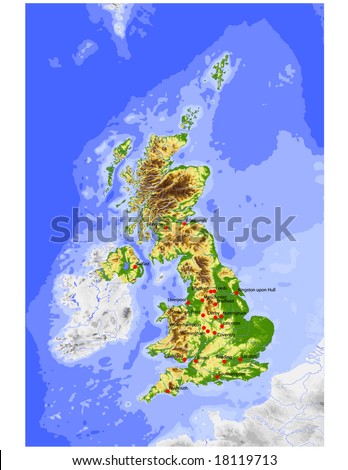 Actually the depth may not be so important if you are looking for nutrients rather than temperature differential since nutrients can't fall any lower than the sea bottom.
Most of the world's greatest fishing grounds are areas of natural upwelling where currents bring these nutrients to the surface.
Put the 2 together and the amount of plankton able to support shoals of fish would be greatly increased. So far more fish to be caught.
Even just doing the iron seeding would obviously have a significant effect and that could be done right now.
Well it could be done as soon as we leave the EU. I suspect the EU would ban it, at the very least they would take ages to allow it - despite the fact that with the Common Fisheries Policy they would be the prime beneficiaries as long as we were still in the EU.
The circled area in the first picture looks about 450 miles long by 200 wide so the entire Scottish coastal waters would be about 3 times that. This means it the normal cost would be not more than £4.5 million though it would have to be repeated regularly. This looks like a reasonable cost benefit ratio - equivalent to 340 yards of Aberdeen bypass or 4 metres of Forth bridge.
So do the "Greens" believe in their own carbon scare and want to cut the amount of it in the ecosphere? It is to laugh.
Of course they don't - the pseudo-environmental movement care nothing for the environment, they are just people who are scared of human progress waving a false flag because they know "Stop Human Progress" is a less attractive banner than "Save the World", though an infinitely more truthful one. Thus the article continues:
Far from receiving applause for their initiative, the Haida and Mr. George have become the target of rage drawn from every corner of the community of those seeking to use global warming as a pretext for curtailing human freedom.
“It appears to be a blatant violation of two international resolutions,” Kristina Gjerde, a senior high-seas adviser for the International Union for Conservation of Nature told the U.K.’s Guardian newspaper. “Even the placement of iron particles into the ocean, whether for carbon sequestration or fish replenishment, should not take place, unless it is assessed and found to be legitimate scientific research without commercial motivation. This does not appear to even have had the guise of legitimate scientific research.”
Silvia Ribeiro, of the international anti-technology watchdog ETC group, also voiced her horror at any development that might allow humanity to escape from the need for carbon rationing. “It is now more urgent than ever that governments unequivocally ban such open-air geoengineering experiments. They are a dangerous distraction providing governments and industry with an excuse to avoid reducing fossil-fuel emissions.”
Nothing must be allowed to cause a "distraction" from the War on Fire, allegedly being fought to cut CO", most especially not something that cuts CO2.
But the eco-fascists get under 1% of the vote, despite enormous support from the BBC state broadcaster and other state instruments. All that is required for them to fail is that good men (and women) oppose such fascism.
Labels: Big Engineering, eco-fascism, Science/technology, scottish progress
