
Click to get your own widget

Sunday, June 15, 2014

Look Who Is Lying To Scare Us

   "According to recent data compiled by the U.S. Centers for Disease Control CDC), people who eat organic and "natural" foods are eight times as likely as the rest of the population to be attacked by a deadly new strain of E. coli bacteria (0157: H7). This new E. coli is attacking tens of thousands of people per year, all over the world. It is causing permanent liver and kidney damage in many of its victims. The CDC recorded 2,471 confirmed cases of E. coli 0157: H7 in 1996 and estimated that it is causing at least 250 deaths per year in the United States alone.

Consumers of organic food are also more likely to be attacked by a relatively new, more virulent strain of the infamous salmonella bacteria. Salmonella was America’s biggest food-borne death risk until the new E. coli O157 came along.

Organic food is more dangerous than conventionally grown produce because organic farmers use animal manure as the major source of fertilizer for their food crops.....

    The real surprise is that nobody is telling the public about the new dangers from organic food, or trying to persuade organic farmers to reduce these risks. Activist groups, government, and the press, all of which have shown no reluctance to organize crusades about matters such as global warming, tobacco addiction, and the use of pesticides are allowing organic farmers to endanger their customers without any publicity whatever."  continued

   And fairly recently we had an outbreak in Germany which proves it:

   "A novel strain of Escherichia coli O104:H4 bacteria caused a serious outbreak of foodborne illness focused in northern Germany in May through June 2011. ....

Epidemiological fieldwork suggested fresh vegetables were the source of infection. The agriculture minister of Lower Saxony identified an organic farm[2] in Bienenbüttel, Lower Saxony....

In all, 3,950 people were affected and 53 died...."  continued

    250 organic food deaths in the USA a year suggests 5,000 a year worldwide (this is pretty much seat of the pants because I am quite certain that far more people die that way in the 3rd world but don't realise they are eating "organic food" but merely think it is "food" so lets assume the same rate as the developed world. So over the last 25 years that is 125,000.

   Compare that to nuclear power - Fukushima zero deaths; previous Japanese accident 2 deaths Chernobyl 51 deaths.

   That makes organic food (125,000/53) 2,358 times more dangerous than nuclear. That should actually be "an absolute minimum of 2,358 times because (A) by including the date of Chernobyl we are bringing the average way up and we should also correct for nuclear providing 20% of the world's electricity while official organic is under 1% of its food so (125,000/2  X 20/1) 1,250,000 times more dangerous is equally defensible but lets not be churlish.

   So we can say for certain that any anti-nuclear "protestor" who hasn't spent at least 2,358 times longer protesting against organic food in equally hysterical terms isn't remotely concerned about any alleged health threat but simply a Luddite lying.

  Google on "Dangers of nuclear power" 4,360,000 items
        "       "  "Dangers of Organic Food" 2,500,000 items (I must admit surprise the discrepancy wasn't greater but still, the nuclear one should only have been one thousand and sixty worldwide.

Labels: , ,


Thursday, May 01, 2014

Big Engineering 63 Using Nuclear Electricity

   I have previously had Big Engineering articles on nuclear power. In particular on a factory mass producing small/medium reactors.

   I have also put up the proof, undisputed by any factual argument from anybody, that such mass produced reactors could cut electricity prices to around 2% of what they are (at least at the production end).

    The correlation between energy use and gdp growth is 1:1 and undisputed. If energy use went up close to 50 fold so would national wealth. (Though it may well be that the existing energy companies think it would go up less so they make more if they go along with windmill Luddism - another example of the fact that big business is not inherently the friend of market freedom, nor the poor losers from such freedom.)

   But, as always, there are political problems. Would politicians allow such a productive factory to be built - well only UKIP ones. Would politicians both here and abroad allow such reactors to be sold and installed worldwide, otherwise the factory might not be able to sell enough? That is a more difficult one, though small, mobile reactors that can be installed quickly (& sold and removed) are vastly less vulnerable to regulatory parasitism than large static ones that take a long time to build.

    However, when you are talking about building a factory that will cost £10s of billions to build and need to sell many 10s of them annually just to break even the fact that it would be able to turn out hundreds, still makes it an enormous gamble, albeit one with a theoretical return in the hundreds of billions.

    What we need is an almost unlimited market for power.

    Of course there is an almost unlimited economic demand for power but for 40 years the politicians have suppressed it. We need industries that themselves have almost unlimited demand for their products and need energy but no other inputs not readily available.

     So here are 2 1/2.

Fertiliser - ammonium nitrate, the nitrate of ammonia with the chemical formula NH4NO3, is a white crystalline solid at room temperature and standard pressure. It is commonly used in agriculture as a high-nitrogen fertilizer

    Nitrogen is available from air, hydrogrn and oxygen from water, all in literally unlimited quantities.

     This is normally done through the Haber process which is more complex but energy efficient but the Birkeland Eyde process is also used which uses just water and air. In the end the nature of the universe means that chemical reactions always use a set amount of power. With cheap enough power an unlimited market can be supplied.

Magnesium

In the United States, magnesium is obtained principally by electrolysis of fused magnesium chloride from brines, wells, and sea water. At the cathode, the Mg ion is reduced by two electrons to magnesium metal.

  Most of it is made in China where electricity is cheaper ;-)

  So the only input apart from electricity is seawater.
 
   "Magnesium is the third-most-commonly-used structural metal, following iron and aluminium. It has been called the lightest useful metal". It is far more expensive than those other 2 and would be used far more if it was cheaper. So once again demand is virtually unlimited and since the process is being done now it can clearly be done at far lower prices if the wholesale price is 50 fold lower (assuming production is close to the generator so grid transport cost is close to zero.

Hydrogen
 
H2O can be divided into oxygen and hydrogen and the latter burned in air to regain the power, just as we do with oil and natural gas. I am counting this as only the "1/2" because we would need some technical changes for gas pipes, cars and planes to work on hydrogen but it is certainly feasible. Methane could be manufactured by using carbon (CO2, wood) which is instantly usable but that is introducing an input, albeit a common one.

========================================

   So if, for example, permission was given for a reactor factory (I have suggested North Jura which is almost uninhabited and could, with tunnels, be an hours drive from Glasgow, but any such coastal place anywhere in the world where there is a reservoir of educated people can and will someday do it, even a floating artificial island).

   In which case that can also be the site of manufacturing of unlimited quantities of valuable materials.

   In fat the situation is better than it seems. One advantage/disadvantage (ok feature) of nuclear is that it produces 100% of its power all the time. Mostly we don't want that because we use more during winter than summer (except in countries that use air conditioning) and more when we are awake than asleep. However this process can use the unlimited off peak energy we don't. Such power is not available at such virtually zero cost from normal coal/gas generators. Peak UK power use is about 70GW but we rarely use more than 40GW. 70 GW would produce, over 1 year 613 terrawatts of power - about 5 times what we normally use but costings are based on what we normally use so this previously unusable amount is close to free.

   I do not know how much fertiliser, magnesium or hydrogen we could make or its value but taking that power at 2p per kwh, well below current costs, that 80% pare would be worth [80% X 613,000,000,000 X £0.02] £9.8 bn a year. With the AP1000 reactor available for £800 m individual and much less if you get 70 of them that would, even at this remarkably low price, pay off the investment, even without selling any actual reactors and without even charging for the 20% of the power put into the grid, in 3 years 7 months (though granted this is from when the reactors go online and we are assured by our politicians that it takes 10 years to build a reactor in Europe or 3 in China ;- I don't believe even the Chinese figure).

   Somebody is going to do it.

Labels: , ,


Friday, March 14, 2014

Scottish Government, Ruling Parties and Hangers On Confirm By Silence - 98% Of Your Electricity Bill Is Their Theft

    Recently (24th Feb) I did articles here and on ThinkScotland giving my calculations showing that electricity costs could be reduced to 97.92% (well call it 98%) of what it currently is.

    At the end I expressed a willingness to consider doubts:

I'm not standing by that exact figure though I would hold to each part as being either firm or a reasonable estimate. Nor does it matter much. If we can say at least 90% of electricity costs are state parasitism and can, over a number of years, be removed it doesn't immediately matter if another 80% reduction is ultimately possible. But if some supporter of windmillery feels the figures can be factually disputed I am sure they will do so.

If nobody in Scotland's political class feels able to point to any error, after it has been aired here on ThinkScotland, it would be difficult to conclude these figures are in error. I am sure the editor would be willing to publish a serious critical article (unlike, for example, the BBC, which virtually never allows a balancing of opinions on such subjects).


     At the same time I emailed Patrick Harvie, Green Party leader, the Green, SNP, Labour, Conservative & LibDem party organisations, Scottish Renewables, and the BBC, both as an organisation and their "environmental" expert, Roger Harrabin notifying them of this and asking if they, in any way, disputed that 49/50ths of every bill is governmental parasitism. That was pretty much belt and braces because politicians do take notice of the media if they have horse sense and it is inconceivable that those responsible for the government of Scotland in this field would not either have seen it or had it drawn to their attention.

   If one of them chose not to disagree it was because they could not produce a credible disagreement. If all of them chose not to disagree it is because all of them know it is true and that the most credible dispute they could make would simply prove my case.

    As I commented on the ThinkScotland article

 it is obvious none of them are able to dispute the math. So undisputed then that 98% of our electricity bills are indeed governmental parasitism. Nice to have it settled.

  Neil Craig


     All the fuel poverty and all of the recession. They know it proving they did it deliberately,

Labels: , ,


Saturday, March 01, 2014

Nuclear - Safest Power Source In Existence

    This is a decent article attempting to find ways to counter anti-nuclear hysteria. Including this on the LNT theory proving even governments promoting it don't believe in it except when they want:

"If one assumes a linear relationship between dose and cancer risk, it follows that total health impacts (cancers, deaths) scale directly with collective exposure, i.e., the integral of dose times the number of people exposed (in units of man-Rem). If government policy is ostensibly based on LNT today, you would think that said policy would treat all man-Rems the same. In a clear sign that policies and standards are not objective or science based, that is not true, by many orders of magnitude.

The fact of the matter is that, while LNT, along with a 10‑4 to 10-6 lifetime cancer risk criterion, will be applied to cleanup standards after any nuclear plant release, vastly larger sources of public collective exposure are simply ignored. These include all exposures from natural background (e.g., radon), air travel, and medical exposures to some extent. Exposures to naturally occurring radioactive materials from all other industries (such as coal plant emissions or old oil pipes off the California coast) are also generally ignored.

Radon is estimated to expose on the order of 100 million Americans to hundreds of millirem annually, resulting in an annual collective exposure on the order of 25 million man-Rem. According to the LNT, this results in on the order of ~10,000 annual deaths. Medical exposures are also a huge source of collective exposure (with CAT scans alone causing ~29,000 annual deaths, according to LNT), and the medical community is only starting to pay attention to the issue, with patients and many practitioners hardly thinking about it at all. Both of these sources of collective exposure are orders of magnitude larger than the collective exposure that would result from a worst-case nuclear accident, even if no cleanup efforts were made.

And yet, nothing is being done about them. Little to no money is being spent. People aren’t even being warned (not saying they should be). In all those areas (radon, medical), collective exposures could be reduced at a cost (in dollars per man-Rem avoided) that is many orders of magnitude lower than the amount we’re planning on spending cleaning up affected areas after a nuclear plant accident. If we really believed in the LNT, and really (and objectively) cared about reducing collective exposure, we would focus on those areas instead.

The LNT is not the problem. Its selective application is the problem."

   I commented:

I agree about LNT, indeed I suspect the opposite theory, hormesis, that low level radiation is beneficial is correct. I have done a collation of links of evidence against LNT http://a-place-to-stand.blogspot.co.uk/2010/03/low-level-radiation-evidence-that-it-is.html I did intend to also include scientific evidence for it but there is literally none.

I have suggested a legal right (possibly constitutional amendment) to allow any regulation to be challenged in court on the grounds that it requires actions at least 4 times more onerous per life saved than other regs in comparable industries. This cost benefit analysis would certainly allow nuclear industries to overthrow most of its regulatory burden and it would be difficult for politicos to explain why they were against it.

But what we really need is a rottweiller charity willing to go all out at anti-nuclear campaign. To sue anybody good cases of lies about the industry. To advertise that newspapers that give coverage to false scare stories and don’t give at least as much coverage to the truth (ie almost all of them) are, by definition, corrupt, lying, fascist scum who cannot be trusted to tell the truth on anything else.

And that governments that give money to promote “environmental” issues, they approve of, are engaged in totalitarian fraud if they don’t give an equal amount to technology promoters – just as much as a Democrat (or Republican) Governor who gave money to his own party would be criminally liable.

All of which unfortunately needs a bit of money to start it rolling.
=============
      Meanwhile Colin McInnes has an article in the Herald
 
Nuclear power is largest generator of electrical energy in Scotland
 
Colin McInnes
 
While the focus of the UK nuclear sector is on the new-build programme,
recent results from EDF remind us that existing nuclear capacity is still a
major player in the UK energy scene.
 
Their nuclear fleet is now delivering more electrical energy than at any
time during the past eight years, resulting in a boost for operating
profits. And with a 10-year life-extension for Dungeness B due to be
finalised later this year, nuclear investments from the 1970s and 80s will
still be paying dividends for many years to come.
 
Nowhere is the contribution of the UK nuclear fleet more apparent than in
Scotland, with two reactors at Hunterson and Torness. Though a little-known
fact, through these two compact plants, nuclear is the largest generator of
electrical energy in Scotland by some margin, as it has been for many
years. Indeed, the output from the single nuclear plant at Torness alone (9
TWh) comfortably exceeds the combined output of every wind, wave and solar
generator in Scotland (8.3 TWh). This clearly illustrates the benefit of
energy-dense fuels used in compact and efficient thermal plants, which can
provide continuous output over a plant life of many decades.
 
While Scotland is pitched as the Saudi Arabia of renewable energy, it's
steadfastly nuclear-powered.
 
In contrast, the arbitrary government target of generating the equivalent
of 100% of Scotland's electrical energy consumption from diffuse and
intermittent renewable resources by 2020 is perplexing. While climate
change targets are mooted as one of the primary motivations, Scotland's
electrical energy generation is in fact already 100% low carbon, as
measured against the government's own metric.
 
In 2012, Scottish electrical energy consumption was 30.8 TWh, while
production from our two compact nuclear plants was 17.0 TWh, all wind, wave
and solar production was 8.3 TWh, hydro 4.8 TWh and other renewables 1.6 TWh.
 
Output from low carbon sources therefore exceeded domestic consumption, a
fact that is rarely noted, or indeed celebrated by government and
environmental NGOs. To do so would be to acknowledge the reality of the
immense contribution of nuclear energy to Scotland's electrical energy
production, and indeed its exports to the rest of the UK.
 
Colin McInnes is Professor of Engineering Science at the University of
Strathclyde
=================================

  And The Register points out what Fukushima proves:

Analysis


It's worth noting here that the Daiichi reactors and cooling pools were not particularly safe as nuclear powerplants go: they were a very old, long outmoded design. They were hit by earthquakes and tsunamis wildly beyond what they were rated to withstand, in the second worst nuclear power disaster that has ever happened anywhere.

And as a result ... absolutely nobody's health has been or will be measurably harmed. That's a pretty impressive safety performance.

We stand by our original headline: Fukushima was a triumph for nuclear power, not a disaster. If there's one lesson to learn from it, it's that nuclear power is very safe indeed. ®


Labels: , ,


Monday, December 30, 2013

A Few Facts

      Three links to useful facts.

UKIP on the EU:
  • The EU’s accounts have not been signed off by the European Court of Auditors for 19 years in a row.
  • Germany exported almost half a million (474,000) more cars to the UK in 2011 than she imported from the UK, exporting 3.7 times as many cars to the UK than she imported from the UK.  It’s not in Germany’s interest to see tariff’s go up on German cars when we leave the EU – there will be a free trade deal.
  • In September 2013 the overall trade in goods balance with the EU reached a record deficit of £6.0 billion.  They sell so much more to us than we do to them.
  • Professor Tim Congdon has calculated in his 2013 Costs of the EU to be 11% of GDP, roughly £170bn to the whole economy.  This includes:
    • Direct Fiscal cost of the EU 1.25% of GDP.
    • Cost of Regulation 5.5% of GDP.
    • Cost of misallocating EU resources/grants etc 3.25% of GDP.
    • The EU spends £2bn on advertising, more than Coca Cola did in 2008.
    • The EU lost £1.2bn of foreign aid last year
    • The Common Fisheries Policy has cost the UK economy £2.8bn.  In 1970, there were 21,443 fishermen in the UK, about one in seven working part time. As of 2008, there were 12,700.
    • The EU Large Combustion Plant Directive is forcing the closure of a third of our coal and oil fired power stations in 2015.
    • The Government admits its policies (and the EU) add 14% to energy bills.
    • MEPs earn 740% more than the average EU citizen.  In the UK it’s 695% more.
    • Baroness Ashton’s EU External Action Service was set up with a £5.8m budget, employing over 7,000 people.
SONE (Supporters of Nuclear Energy):

WORLD ENERGY USE %

Global energy consumption grew strongly by 5.6% in 2010 – the latest figures available – to 12bn tonnes of oil equivalent (toe). It was the biggest annual growth since 1973 and took consumption to well beyond its 2008 peak. (5.6% is within random variability of the 4.8% world economic gtowth, confirming how closely they are related)
The contributions were: oil 33.5%; coal 29.5%, natural gas 23.8%; hydroelectricity 6.5%; nuclear 5.2%; and renewables 1.3%. Less useful energy was delivered because of losses in converting fossil fuels to heat and light. The main shares were: oil 28%; coal 23.8%, natural gas 19.2%, hydro 16% and nuclear 13%.

UK ENERGY SOURCES %

The UK now has to import coal, oil, gas and even biomass (wood) and within a decade could become dependent on gas imports for 80-90% of demand. In 2010 we used 227.5mtoe, up 3.4% on 2009. The useful energy supplied came from natural gas 38%; oil 32%, nuclear 14%; coal 13% and renewables 3%.

UK ELECTRICITY DEMAND %

UK electricity demand varies from around 24,000MW in summer to 61,000MW in winter. Its peak was 60,893MW in the middle of a cold spell in December 2010. Electricity generation, including pumped storage, rose 1.2% on 2009 to 381TWh and total supply, including net imports, by 1.1%. It was generated by natural gas (46%); coal (up 1% to 28%);. nuclear 16% (down 2% because of maintenance) and renewables marginally up at 6.8%. Households accounted for 31% of total demand; industry 27% and transport and services 27%; fuel industry 7% and losses 7%.

UK CARBON EMISSIONS BY FUEL

Nuclear is the cleanest fuel used in the UK today. It emits next to no CO2, taking account of uranium mining and decommissioning and waste management. Expressed in terms of grams per unit of electricity (kWh) the score is nuclear 4gm; wind 8; hydro 8-9; energy crops 17; geothermal 79; solar 133; gas 430; diesel 772; oil 828; and coal 955gpkWh.
Nuclear is 200 and 100 times “cleaner” than coal and gas respectively. It is crucial to achieving the Governmentʼs ambitious carbon reduction emissions targets.

NUCLEAR ACROSS THE WORLD

Britain led the world into the nuclear power age at Calder Hall in Cumbria 55 years ago. Now there are 440 reactors in operation in 30 countries, another 61 are under construction, 156 are planned (for the next 8-10 years) and another 343 proposed longer term. Current total capacity is 377,000MW, roughly equivalent to 370 large power stations. Sixty-one new reactors are under construction in 13 countries – 26 of them in China – and 156 are planned in 27 countries. Of these the leaders are China 51 reactors, India 17 and Russia 14. Longer term another 343 reactors are proposed in 37 countries with the same nations leading the way – China 120, India 40, Russia 30 and USA 27.

The vast bulk of global nuclear generation is still in Europe and North America – Europe 44%; North America (USA and Canada) 34%; Asia Pacific 21%; South America and Africa 1%. In 2010 nuclear generation across the world saved the equivalent of 620m tonnes of oil and 5bn tonnes of CO2 emissions.

Uranium is as prevalent in the worldʼs crust as tin and there is no shortage. With recycling of so-called “spent fuel” and the fast reactor, now being revived, it is estimated there is enough nuclear fuel to last for 1,000 years.

NUCLEAR IN THE UK

The UK has 19 commercial reactors in operation at ten power stations – two Magnox, seven AGR and one PWR (at Sizewell, Suffolk). Nuclear power station sites (going round the coast anti-clockwise ) are Dungeness, Sizewell, Hartlepool, Torness, Hunterston, Heysham, Wylfa, Oldbury and Hinkley Point.

 The Government has identified 8 potential sites for use up to 2025 – all the above, apart from Torness, Hunterston and Dungeness, plus Bradwell (Essex) where the power station has closed.

NUCLEAR WASTE

Nuclear power puts into the environment only about one-thousandth of the radiation dose received each year by the public. Some 85% comes from natural background radiation – from the soil, rocks, the sun and chemicals within our bodies. Medical X-rays are responsible for 140 times more radiation in the environment than nuclear power.

The nuclear industry has been handling its waste for 55 years and produces only about one-thousandth of the UKʼs annual toxic waste. It comes in three categories: low-level, intermediate and high-level waste. Ninety per cent of it is low level and is disposed of at Drigg in Cumbria. The remaining 10% needs treatment. but the annual amount of high level waste produced by a large nuclear station would only fill a London taxi. New designs of reactor will generate only one-tenth of the amount of the intermediate and high level waste from todayʼs reactors

And a "Factcheck" on Osborne and other's recent claims that Britain is the "fastest growing country in the developed world":

"depends upon the time frame we look at.

If by 'major advanced economies' the Chancellor meant the G7 group of nations, then it is certainly true that the UK's growth of 0.8% in the most recent quarter was faster than any of its competitors, pipping the US, whose economy grew by 0.7%. The economies of both France and Italy contracted over this period.

However the opposition claims that this isn't very revealing, arguing that the fact that the economy is growing swiftly now owes much to the low baseline set by "three damaging years of flatlining".
In total, the UK economy has grown by just under 3% since the Coalition took office in the second quarter of 2010, and this compares rather less favourably to other G7 countries: only France (which has grown 2.5%) and Italy (which has shrunk by nearly 4%) have fared worse, while the US has clocked growth of 6.7% over the same period.

To put these figures into context, the OECD data suggests that over the course of 2013 so far, China has seen growth of over 9%, while other developing economies such as Argentina and Indonesia have seen growth of over 6%."

   So it isn't for the developed world, merely for 7 slow growing countries, 4 of them in the EU and only for 3 months and to a level of 0.1% which is far below the accuracy, let alone meaningfulness of the figures.

   I find the medium and long term trend, that we are the slowest growing English speaking nation in the world (though that requires saying that a couple of Caribbean islands with populations in the 10s of thousands aren't really a nation).

Labels: , ,


Friday, November 29, 2013

Orion Revisited

    These are some excerpts from a review of George Dyson's book Project Orion about the Orion nuclear space ship project that could have done "Mars by 1965, Saturn by 1970".
################################################

The magnificent Orion ship of the 1960s would have cruised the solar system with a crew of hundreds of scientists living and working in large and luxurious rooms. On the first tour there would be a two-year stop at Mars before reaching Saturn in 1970. It was all so close.

Orion was space travel as imagined in the expansive 1950s. A big ship, with a crew of hundreds, exploring the entire solar system. Weight and size were not particularly pressing issues, miniaturization was not needed. In all the crew compartment designs there was always room for a dedicated barber’s chair – it was the designers way of indicating luxury. No one was going to be bolted into a chair and have to urinate in their spacesuit. Orion had all the comforts. Instead the issues were heavy engineering and nuclear science.

In George Dyson’s excellent 2002 book “Project Orion” he quotes Brian Dunne, the team’s lead experimentalist: “It was a crazy era. All our values were tweaked because of the cold war. It was a closed society and all kinds of strange ideas were able to grow.” (The author, George Dyson, is the son of the team’s leader, Freeman Dyson).

The idea of the Orion ship was fundamentally simple: Explode an atomic bomb behind a spaceship and the force of the explosion will push the ship forward. The idea was first proposed by Los Alamos mathematician Stanislaw Ulam at the end of World War II. Small scale tests were carried out using regular explosives to prove the concept.

The Orion project was started by a young colleague of Ulam, Ted Taylor, who was also the designer of both the smallest and largest fission bombs in the US atomic arsenal. It was calculated that it would take about 600 detonations, totalling 100 megatonnes, to boost a generous 20-story spaceship into a 300-mile Earth orbit. Said Taylor: “I used to have a lot of dreams about watching the flight, the vertical flight. The first flight of that thing doing its full mission would be the most spectacular thing that humans had ever seen.”

......to get the ship into orbit would still require detonating 100 megatonnes in Earth’s atmosphere. That was a drawback of course, although supporters pointed out that it was no more than was already been detonated every year in routine above-ground nuclear testing,

......The scientists imagined a new Darwin-like “Beagle voyage” through the solar system with a two-year stop on Mars and visits to the moons of Saturn in 1970. General Thomas Power, head of Strategic Air Command saw a slightly different mission, the ability to deliver massive bombs on any target from orbit: “Whoever controls Orion will control the world.”

The team then began talking with Von Braun about putting a very small Orion atop a Saturn V rocket. The new plan would mean a 125-tonne Orion spaceship would be used only when lifted to orbit by the Saturn V. A crew of eight astronauts could reach the Moon in 1964. Never daunted by issues of scale, the team then calculated that a much larger conventional booster, such as a 4000-tonne “Super Nova”, might still get their beloved original 4000-tonne Orion into orbit as originally planned.

It was all getting too big and too challenging for the newly created NASA. Officials were daunted by its scale and worried how the system could ever be tested. NASA declined to fund the project. Only the Air Force remained in support. Their representative to NASA, Don Prickett, told the review committee: “There are always two philosophies encountered during the research phase of new concepts. One which says that if the concept has potential for a significant step forward it is worth a considerable effort to solve the problems even if this effort involves high risks. There is the other philosophy which approves only of research in which there are no real fundamental problems to be solved but rather improvement of established technology. What we need is more people working on novel ideas to solve some of the problems rather than viewing the problems as unsolvable.”

The outstanding engineering problems included the issue of how to get a bomb behind the pusher plate at exactly the right place, then a moment later another, and another, and another. While it might seem simple to send them straight out the back of the ship, that means creating a hole in the massive pusher plate which in turn leads to obvious safety concerns if the hatch was open when a bomb detonated on the plate. The there was the question of the pusher plate itself and whether the proposed ablative coatings would survive repeated atomic detonations.

Despite all this it was generally recognized that only the Orion program had the needed specifications for crewed missions in the solar system. The project was finally terminated in 1965 because, according Orion’s James Nance, NASA had “…no requirement for manned planetary missions.”

Freeman Dyson wrote the final report wrapping up the Orion Project in 1965. In it he wrote: “The men who began the project in 1958 aimed to create a propulsion system commensurate with the real size of the task of exploring the solar system, at a cost which would be politically acceptable, and they believe they have demonstrated the way to do it.” he went on to note that: “there was no more brave talk of Mars by 1965 and of sampling the rings of Saturn by 1970. What would have happened to us if the government had given full support to us in 1959, as it did to a similar bunch of amateurs in Los Alamos in 1943?”

Finally, Dyson told Ulam (Orion’s founder) that: “My concern is to make sure that the public knows what has happened, so that they will be ready to come back to these ideas when the time is ripe.”

########################################

   I have written of this before.

   With modern technology (ie neutron bombs) we can launch with far less radioactivity. The LNT theory that low level radiation has been as thoroughly disproven as is possible (the opposite, hormesis, that low level radiation improves health is clearly at least often true). Moreover launched from South Georgia or the South Sandwich Islands, with wind patterns circling the Antarctic almost no radiation would reach land. Taken all together radiation risk would be at least 3 orders of magnitude, and probably more, less than thought at the time.

    Bombs are certainly a quick and practical way to provide the massive power to get to orbit. I suspect that something more sophisticated, like an atomic powered ion engine, would be better for travelling across the solar system - though its thrust is far lower it can produce a steady thrust and a steady acceleration, even when it is very small, can cover a lot of space in a surprisingly short time. And acceleration on such an ion jet would be easily controllable, allowing it to match orbits with asteroids or even dock with other craft - something impossible for a craft powered by bombs.

Labels: , ,


Thursday, November 28, 2013

Big Engineering 56 Thorium Reactors

         I am not convinced that reactors using thorium are going to answer all the alleged problems of current nuclear reactors. Still less am I going to say that "environmentalists" who now say nice words about thorium reactors would do so if they were ready to deploy.

         On the other hand thorium is 4 times more common than uranium and reactors produce less plutonium, a matter of importance in a world where proliferation is a fear and appears to be considerably easier to design passive safety systems for.

"Thorium reactors would be cheap. The primary cost in nuclear reactors traditionally is the huge safety requirements. Regarding meltdown in a thorium reactor, Rubbia writes, “Both the EA and MF can be effectively protected against military diversions and exhibit an extreme robustness against any conceivable accident, always with benign consequences. In particular the [beta]-decay heat is comparable in both cases and such that it can be passively dissipated in the environment, thus eliminating the risks of “melt-down”. Thorium reactors can breed uranium-233, which can theoretically be used for nuclear weapons. However, denaturing thorium with its isotope, ionium, eliminates the proliferation threat.
 
Like any nuclear reactor, thorium reactors will be hot and radioactive, necessitating shielding. The amount of radioactivity scales with the size of the plant. It so happens that thorium itself is an excellent radiation shield, but lead and depleted uranium are also suitable. Smaller plants (100 megawatts), such as the Department of Energy’s small, sealed, transportable, autonomous reactor (SSTAR) will be 15 meters tall, 3 meters wide and weigh 500 tonnes, using only a few cm of shielding."

     Note the admission that most nuclear costs are regulatory rather than engineering.

    I am actively not saying that we should hold back deployment of the reactors we can currently build by one day to push these on but we don't have to.

   Designing thorium reactors should pose no insuperable difficulties, after all

"The liquid-fluoride thorium reactor, developed at Oak Ridge National Laboratory in Tennessee during the late 1960s, ran successfully for five years before being axed by the Nixon administration. The reason for its cancellation: it produced too little plutonium for making nuclear weapons. Today, that would be seen as a distinct advantage. Without the Cold War, the thorium reactor might well have been the power plant of choice for utilities everywhere."

     If it could be done 50 years ago when world computer capacity was less than one good laptop today, it can easily be done now.

     I have previously suggested building a factory to mass produce small reactors. Such could easily be retooled to build thorium ones when available (or perhaps better, a second assembly line built alongside). Reactors described above as 3m wide (width of a shipping container) and 15m long are road transportable (or by airship) and could be sold for immediate turnkey operation. If they do not produce plutonium they could be sold to virtually anybody which would help make the entire world wealthy (and the country churning out such reactors on a production line, distinctly rich).

Labels: , ,


Monday, November 11, 2013

Either Technology Has Delined Or Political Parasitism Massively Increased Since 1951

    Roger Helmer pointed out that the world's first commercial nuclear power station took 5 years to go from starting the design to working (1951-56) and checking further I find that building started in 1953 - a 3 year build time.

    That was for something that had never been built before.
    In an era before computer aided design (indeed only shortly after we had been told that the "world market for computers is about 6")

    Yet Hinckley Point, an already existing design, after 60 years of technological progress, will take 10 years.

    But also 60 years of growing political parasitism
 
    Further proof that at least 90% of the cost is political parasitism. 

Labels: , ,


Thursday, October 31, 2013

The True Cost of Electricity & How The "Debate" Is Being Dishonestly Restricted

From the estimable Register

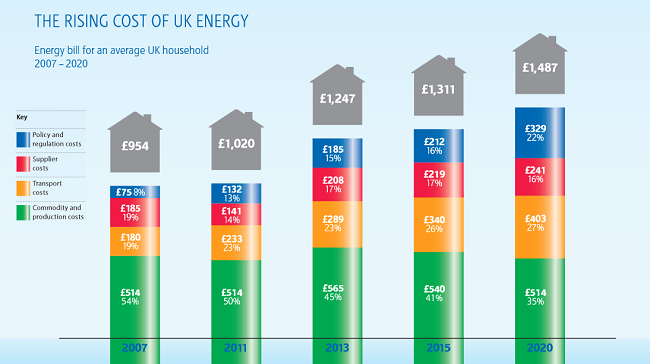
Graphic showing past and predicted domestic energy price rises. Credit/source: RWE npower

   Shows how the electricity price rises from 2007 is largely "policy and regulation costs" ie direct state parasitism. The other is "transport costs" ie the grid, which is basically to pay for extending the grid so that windmill electricity produced in the outer isles can be transported to London. This is a hidden "green" subsidy and an extensive one.

   By comparison actually producing the stuff is barely up and by 2020 will be back down to 2007 costs. I presume this is the benefit of shale more than offsetting windmill parasitism. VAT appears not to be included.

   The alleged corporate greed of the "big 6" monopolists means supplier costs will go from 19% DOWN to 16%.

    So clearly, even within the terms of the official "debate" the fault lies with political price raising.

    But the official debate ignores the political effect of preventing the cheapest power sources (nuclear, coal & shale) being used.
   
    This is how the ruling class normally frame any "debate". The only thing discussed is a few percentage points made up of either profit or government levies according to villain. The graph above shows that the levies are rising fast and the profits, as a % of cost, falling.

    Unmentioned is that Hinkley Point is costing 4 times a much (and taking 7 years longer which pushes up interest payments) than comparable Chinese ones, and nuclear is considerably cheaper than average power.

   Undebated is that 90% of electricity prices (perhaps more) are government regulatory parasitism - you will never know it from BBC "news".
   Even the "big six" would much rather be damned for the largely false charge of price gouging than be shown to be running expensive obsolete equipment that could not compete with engineering cost nuclear, thus they do not call the MPs the liars they certainly are. This is common among dominant companies with fixed assets.
 
    Lets go for a best possible cost:
 
Nuclear is currently 40% of the average cost of our power basket.
China is building at 0.27 our costs.
Because China is building in 3 years and us in 10 we have 7 years foregone income while paying interest - assuming the normal 10% return that is 1.10^7 = 1.95
Assume China is not entirely without state parasitism - say 10% 
VAT 20%
How much could cost be reduced if it was allowed to mass produce reactors - 3 fold seems a conservative estimate.
 
60% X 0.27 X 1/1.95 X 90% X 1/1.20% X 1/3 = 0.0208 or 2.08% of current costs.
 97.92% parasitism.
 
   Way below current standing charges = "electricity to cheap to meter". Though this does not include transportation costs. However if the amount of power we use goes up anything like proportionately, handling costs will go down, not quite proportionately.
 
   I'm not standing by that exact figure though I would hold to each part as being either firm or a reasonable estimate. Nor does it matter much. If we can say at least 90% if electricity costs are state parasitism and can, over a number of years, be removed it doesn't immediately matter if another 80% reduction is ultimately possible.
 
   But if some supporter of windmillery feels the figures can be factually disputed I am sue they will do so ;-)

Labels: , ,


Monday, October 21, 2013

Hinkley Point - £16bn For 2 Generators That Would Cost £4.5bn If The Politicos Would Let It

Hinkley Point C: £16bn nuclear power plant gets go ahead despite criticism over 'strike price'   
    
THE plant in Somerset will begin operating in 2023 but ministers faced criticism over the £92.50 per Megawatt hour that will be paid for electricity produced - around double the current market rate.


Hinkley Point
Hinkley Point


BRITAIN'S first new nuclear power station in a generation is to be built under a £16 billion project which will create thousands of new jobs.
The move followed an agreement between the Government and French-owned EDF Energy, which will see Hinkley Point C in Somerset begin operating in 2023.
-----------------------------

   That's how the Daily Record put it, neatly combining enthusiasm for the project with anti-nuclearist concern for the price and an absence of any mention of who is responsible for the price.

   This is a rather long post I put on John Redwood today and which is also going out, slightly edited,  as a letter to all and sundry. We will see if any sundry part of the press is less obedient in censoring the facts than I expect:

This is not a good day for the supporters of nuclear because the government have negotiated all their parasitism in place.

The reactor will take 10 years to build. In China they are building them in 3. This means it has no effect on the previous politicians' promises of electricity bills of £2,000 a year by 2020.

It will cost £16 bn. An equivalent pair built by European firms in China is costing $7.5bn (£4.5 bn). http://nextbigfuture.com/2013/09/european-nuclear-reactors-are-three.html 

The difference in cost is entirely government regulatory parasitism. Thus so is the need for a price guarantee.

But it allows the Luddites to scream "subsidy" (though they are on a sticky wicket in that they approve far greater subsidy on windmills).

Also there is less to the eye on the price guarantee than appears - in 10 years prices will have increased about 40% so the guarantee is the equivalent of about £60. 60 years later, when it closes prices will have increased  8 fold so the "guarantee" will be equal to £12.

This suggests the builders are working on the assumption that they will make back their money in 10 years and hoping that Miliband or some successor doesn't break the contract before then (as Labour bankrupted BNFL by regulatory fiat and forced them to sell off Westinghouse, probably the world's leading reactor builder, at a fire sale price to Japan). This distrust of government and the state parasitism obviously both push up prices beyond reason.

There is no honest debate against the proposition that 90% of our electricity costs are state parasitism (the price differential mentioned above proves it again). Unfortunately there is no honest debate allowed on the subject in our state owned broadcaster or most of the obedient press.

Because of the 1:1 correlation between gdp and energy use it is obvious that the recession is entirely the fault of the political class who make electricity 10 times more expensive than it should be. The 25,000 pensioners who die of fuel poverty every year are also on their consciences.

I am quite sure the Chinese would have been willing to build on purely commercial terms if the government had agreed to remove their parasitism (or to pay them for it). It might be worth a question in the House on that.

A bad day for Britain because state parasitism has been welded even more strongly in place.

UPDATE
The price guarantee situation is considerably worse than I thought. John's new post today says

"However, the guaranteed price at twice today’s wholesale market price, to come in in 2013 when they start generating power, is also indexed to general prices."

I don't know if this means the indexing starts in 2010, in which case we are stuck with paying the equivalent of £60 forever, or tomorrow in which case it is the equivalent of £92 forever.

In either case an abysmal "deal" at least for the people, designed to hide the amount of government theft (about 90% of total cost) going on.

Labels: , , , ,


Friday, September 20, 2013

The Way The Future Was

   This is a spin off from a serious discussion on the von Mises Institute which I am going to summarise later. As part of it I suggested a scenario whereby Einstein went into some more profitable business and atomic power was delayed by 5 years. Bob replied with my quote and I counter replied.
===========================================
Bob_Robertson
"but had it been even 5 years later think how different history would have been"

Not different in the slightest.

Well, ok, very different for some million Japanese who would not have been irradiated, but the firebombings did more damage and cost much less.
 
=============
 
 
Scenarios:

- Knowing they would have to invade Japan the allies accept peace without occupation

- Japanese fight to the last man
- No atom bomb by 1945 means Soviets are able to attack western Europe.
- No atom bomb by 1945 means Soviets do not need to keep troops in Eastern Europe to counterbalance Bomb threat (these 2 depend on which side you think was the initial threat in the cold war - I incline strongly to #2)
- During peacetime the money for the Manhattan project is not secretly available (& the US is a relatively open society and in peacetime could not have built it without massive popular debate) so the US Bomb is at least 10 years later and the Soviets get it first
- Nuclear hysteria is not a factor so cheap nuclear electricity brings worldwide prosperity
- Since nuclear is a completely unknown quantity greater hysteria develops and it never becomes common
- Because there is no anti hysteria the Orion atomic rocket is built reaching "Mars by 1965, Saturn by 1970"
Don't know which, or others, would have happened but it would have been different.
This really only takes changes up to early 1970s. Further changes and indeed further branchings from those would certainly have happened.
 
I think this shows that historical extrapolation must be an extremely chaotic system. butterfly's wings and all that producing unpredictable secondary, tertiary, quadriatic(?) results.
 
But fun, if you are into that sort of thing and strictly logical.          

Labels: , ,


Thursday, September 19, 2013

Pseudo-Liberals Conference - Lies and Fraud

     Following up the LudDim conference.

     The big "news" was that they had come out "in favour of nuclear power". Unfortunately, since this was one of the issues on which they officially left the liberal movement by splitting from me, the motion passed is less than supportive.

   The motion is among the agenda papers here. Among a 114 line motion, all about subsidising and enforcing windmillery are lines 51-4:

"i) Accepting that in future, nuclear power stations could play a limited role in electricity supply, provided concerns about safety, disposal of radioactive waste and cost (including decommissioning) are adequately addressed and without allowing any public subsidy for new build."

"could", "limited", "provided" & "adequately" are some new definition of support. I would be willing to support the LudDims if they could get rid of all the fascists, for the very limited roles of dogcatchers, provided they adequately proved that they now opposed genocide, child rape, recession and alleviated the justified concern that they are all thieves, but none of them feel to believe that qualifies me as a supporter.

    Actually that is a little unfair to me since my concern that they are genocidal, child raping, poverty promoting thieving fascists is entirely justified and could thus be ameliorated if facts changed whereas their alleged fears aren't and thus couldn't.

     Their "policy change" is obviously no such thing but a purely PR change because polls show 60% of the public strongly in favour of nuclear and they want to say "wisnae me" as they put the lights out.
======================================

     The other news is Clegg promising school dinners for all "worth £400 m a year" (though I suspect a lot of parents could make lunches for rather less). This was the basis of the BBC Radio sales pitch for them today (there has been an awful lot of BBC support during this conference & I look forward, since the BBC are legally "balanced" to UKIP, based on the ratio of popular support, getting about 2 1/2 times as much.  The total cost is said to be £600 million.

    I sent this email but, for some reason it was not read out:

  Clegg has said this will save parents £400 a year which means, bearing in mind that everything has to be paid for and that there is always the cost of collecting extra taxes and of administrating the payout, this means about £200 extra taxes every year for all employed households.
 
   To be fair to the LDs, Clegg has said he intends to raise taxes but when the BBC is reporting this honesty should require you to spend as much time discussing the tax rises needed as the spending.
 
    Obviously honesty did not get much of a look in, though they did have somebody from the TPA who made that point and was only interrupted by the Beeboid throughout. Other than that the "balance" was almost entirely "wouldn't you like more government money" without any "wouldn't you like to pay more taxes".
 
   My estimate is that collecting taxes and then disbursing the money adds about 60% to the total so spending £600 million means raising £1 bn or about 0.3p on income tax. I look forward to the LDs acknowledging either that this is their intent or saying what other specific tax they will raise to get another £1 bn.
 
   It is conceivable that this would be a good use of society's resources - I would be willing to spend more on education if it was going to provide more education - but if we aren't allowed to discuss both sides of the equation it is impossible to confirm it.
-------------------------------------
PS I note that not a single party member has felt able to defend the proposition that they are in any way liberal.

Labels: , ,


Thursday, September 12, 2013

We Are Building The Second Layer Of "Environmental" Parasitism (or worse)

The estimable Professor John Brignall from Numberwatch on fracking:
"Fracking is an awkward and inconvenient business, ironically only made viable by the success of the watermelons in cutting off other supplies of reliable energy. If you make such energy (the greatest essential for modern civilisation) scarce then its price rises until other sources become competitive."
So what we are seeing is second generation ecofascist parasitism. We have already been deprived for 40 years of the easiest and most affordable new power generation; we are now being deprived of the next new one, less easy and affordable than nuclear but still cheaper than coal and traditional gas and far cheaper than windmills.
Clearly the restraining effect on human progress is mounting but equally clearly this is an increasingly unstable situation in that any country promoting progress is inevitably going to find it ever easier to embrace progress and will get ever greater benefits from doing so. Thus providing an example to the rest of the world.
The only counterforce to this instability is increasing elements of world government. Only a totalitarian government of the world (and inhabited space) could keep prevent any nation choosing progress and providing the example. Once space is significantly inhabited I cannot see a world government being technologically capable of enforcing totalitarianism there - indeed a space habitat almost automatically couldn't be run by Luddites.

    "Civilization might recover from the damage of a nuclear war, but judging by past static empires in Egypt and China, it might never recover from world government, there being no chance of external intervention. As it is, present governments are only prevented from becoming dominated by crazy ideas that will suppress all opposition by the existence of other governments. The only way a people can be sure that their government is substandard is that it does worse than those of other countries."   late Professor John McCarthy

Labels: , ,


Saturday, August 24, 2013

Unmanned 140,000 ton Atomic Spaceship Launch For £650 million in 2 Years

   This an old article from Next Big Future detailing a proposal for a cheap and not dirty version of the Orion atomic rocket. Unlike the original version it launches at a peak acceleration (probably for under a second) of 1,000 G. So it is only suitable for launching raw materials or simple parts. But it can launch a lot of them.

    The secret is to launch it from a really deep hole in the ground. Thus the blast is funnelled up, under the craft all the way to the surface. Thus also, by putting a closable cover over the top the radiation (of only 1 nuke) is contained.

A 10 megaton nuke (large but we have quite a few) can launch 140,000 tons

 Summary *This is a modification of the old underground nuclear tests. Repeating the old 5-10 megaton tests. But reconfigure to optimize conversion to kinetic energy. Radiation containment for underground tests is a known problem and has proven tests.
* The Project Orion configuration and directed nuclear blasts had the Orion work and the Casaba-Howitzer work. So 85% conversion of nuclear explosion to directed propulsion is known.
* Sacrifice one salt dome or an area under an island. Using natural geological feature mostly reduces cost of containment.
* Actual out of pocket cost less than one billion. (£650 million) Can be done within 2 years.
* Can do some supercomputer modeling and tweaking and optimization to be sure.
* Very limited technical risk for the launch. Nuclear bombs work.
* Leverages the trillions spent on the arms race for good. (sunk costs)
* Negotiate for the exception to the test Threshold test ban and only ratify the Comprehensive test ban with an exception for space launches. Maybe allow Russia, China, UK and France and other to share the payload that is delivered or for each to be allowed to launch one.

This proposal is simpler, cheaper and safer than Project Orion. The proposal is not to build a manned space vehicle but an unmanned projectile that contains cargo. There are not two hundred atmospheric explosions but one underground explosion. the pusher plate does not need to withstand multiple explosions but survive one while not losing the cargo. The cargo is selected and designed to survive the forces that it will encounter.

There are petaflop class supercomputers now that were built for the sole purpose of modeling nuclear explosions in a precise way as an alternative to live tests. There are powerful lasers and other high energy machines created to validate the precision of the computer models.

......

 The Pascal A nuclear test "launched" a blast door at six times earth escape velocity.
---------------------------

" it would seem that it would have to be on the order of 10,000 gs, which is getting pretty extreme for the delivery of any interesting cargo other than fuel. Or am I wrong?                 

You are correct. The acceleration is extreme. But I would argue that being able to deliver refined metal, water, fuel and other material that can take the acceleration is worthwhile if it can be done cheap enough $1-20/kilogram.Water and fuel and food are heavy supplies that a colony would need.
Water and fuel and metal are needed for industrial projects. Nasa Constellation plan is to spend $20+ billion developing a 125 ton to LEO chemical rocket that could deliver about 10 tons to the moon."
----------------------------------
    So only as part of an existing space development programme able to machine

Labels: , ,


Friday, August 02, 2013

Windmills Thousands of Times More Dangerous Than Nuclear

   Delingpole recently covered the issue of the low frequency sound which windmills create:

"the industry has known for at least 25 years about the potentially damaging impact on human health of the impulsive infrasound (inaudible intermittent noise) produced by wind turbines. Yet instead of dealing with the problem it has, on the most generous interpretation, swept the issue under the carpet – or worse, been involved in a concerted cover-up operation.

A research paper prepared in November 1987 for the US Department of Energy demonstrated that the "annoyance" caused by wind turbine noise to nearby residents is "real not imaginary." It further showed that, far from becoming inured to the disturbance people become increasingly sensitive to it over time.

This contradicts claims frequently made by wind industry spokesmen that there is no evidence for so-called Wind Turbine Syndrome (the various health issues ranging from insomnia and anxiety to palpitations and nausea reported by residents living within a mile or more of wind turbines).

....the 1987 report, based on earlier research by NASA and several universities, tells a .
It found that the disturbance is often worse when indoors than when outside (a sensation which will be familiar to anyone who has heard a helicopter hovering above their house)....

Last month the Department of Energy and Climate Change  (DECC) published a report by the Institute of Acoustics examining whether ETSU-R-97 was still adequate to the task. Remarkably, instead of stiffening regulations, it made them more lax, not only continuing to ignore the Low Frequency Noise and infrasound issue, but actually giving wind farms leeway to make more noise at night and to be built even closer to dwellings.....

“We’re often hearing these weird and wacky reports on the effects of wind. It seems anyone can stand up and say anything, which we find somewhat worrying because it gives a false impression. We don’t accept the suggestion that there are any health impacts caused by wind turbine noise, though we welcome any new research into the issue," a spokesman for Renewable UK told me.

However this is contradicted by the author of the original reports Neil Kelley. Kelley has told Graham Lloyd – the environment editor from The Australian who (uncharacteristically for an environment editor puts truth before green ideology) broke the story – that research has shown that it is still possible for modern wind turbines to create "community annoyance."....

US acoustics expert, Rick James – who thinks it somewhat unlikely that the wind industry is unaware of the problem:
 The “Kelly paper” is just one of many studies and reports published in the period from 1980 to 1990 by acousticians and other researchers working under grants from the US Dept. of Energy (DOE), NASA, and other agencies and foundations. All of these papers are still available on web sites open to the public.... few acousticians in that period would have discounted the premise that for some people these types of sounds posed serious issues.
Can anyone imagine a potential scandal of this magnitude in the fossil fuel industry going uninvestigated by the green lobby – and hitting the front pages of all the newspapers?

I can't."
----------------------------------------------------------------------------------

    He is clearly right on this indeed more than right as a comparison with the nuclear radiation "no lower threshold" shows.

   This is from one of these papers mentioned:
The low frequency sensitivity syndrome includes: feelings or irritation/unease/stress/undue fatigue; headache; nausea; vomiting; heart palpitations; disorientation; swooning/prostration.

     If, in examination of a small group you find real people suffering from heart palpitations and swooning you are talking about something which over time and a large population is undoubtedly going to result in death on a significant scale. Certainly a scale thousands of time worse than passive smoking, which was "discovered" only by a statistical variability in a population of many millions which was well within the limits of statistical error.

      Almost all the government funded scare stories we see (salt/weight/passive smoking/mobile phones/watching TV/margarine/butter/salmon/GM etc etc) are of that nature (or for mobile phones and GM less than that in that there is no claim of statistical evidence they are harmful, or as our state broadcaster says "the jury is out" as to whether they are harmful). Windmill low frequency noise is clearly a genuine proven threat to health and killer - these others are at best, speculative.

     This goes further for another scare I have discussed before. The linear no threshold (LNT) theory that nuclear radiation, no matter how low the level, even when it is under 2% of natural background radiation is dangerous. There is no evidence for LNT whatsoever - even supporters of the theory (technical actually a hypothesis at best) or scare story acknowledge this. Indeed there is a large amount of data proving the opposite theory, known as hormesis, that such radiation is beneficial to health.

      With the disparity in evidence we can say with certainty that windmills are, at the very least, thousands of times more dangerous to outsiders than nuclear plants. For those working on them the fact that Britain has had 4 industrial deaths from windmills in 5 years whereas the entire world has seen 2 nuclear deaths (Japan but not Fukushima) in 20 years. Nuclear provides about 15% of world electricity and windmills under 1%.

      Which in turn means that any honest broadcaster or newspaper must have spent thousands of times more promoting scare stories about windmills than nuclear plants.

     Or any which is 1/1,000th part (0.1%) honest must have spent an equal amount on each.

    Anybody able to name any MSM broadcaster or journalist that is not at least 99.99% corrupt?


Labels: , , ,


Wednesday, July 24, 2013

Cheap Nuclear - How To Get There From Here

   Yesterday I put up the evidence that 90-95% of the cost of nuclear power (96-8% of the cost of our basket of power) is ultimately government regulation.

   But there is a massive (largely government funded) scare industry against nuclear and thus considerable public fear. So how can politicians safely advocate change without being publicly pilloried.

   Well to some extent they can't - if you stand for something you must expect opponents to oppose.

   Still there are ways to make it easier.

      Despite the media hype the evidence is that everywhere there is more support than opposition to nuclear. For example this recent UK poll shows 43% in favour of subsidising nuclear power and only 23% against. The more remarkable since I, as a nuclear enthusiast, don't think subsidy is either desirable or necessary and would have to be one of the 23%.

   Professor Cohen's book - chapter 4 - Is the Public Ready -  confirms that popular opinion has long been on the pro-nuclear side, as is professional opinion. Indeed it is only journalists, the less they know of the subject and the less used to actually writing they are, who are against.

   So the way to safely get approval is to ask the public. UKIP is committed to popular referendums and this would be an ideal issue. Remember that the people are sovereign and if we were to lose we would have to accept that and prepare for blackouts. But even then, simply by asking and accepting it, we would gain respect (and when the lights go out, not be blamed which is a major issue currently facing all those in power).

   Note that it is also probably advisable to get more than just the law on our side. Building new nuclear plants is going to send the eco-fascists apeshit.  We need clear popular support when they start real sabotage. The widespread deployment of inexpensive modular nuclear reactors with none of the scare stories coming true would totally undermine and discredit the current pseudo-environmental Luddite movement and we should prepare for not just lies but violence.

This is my proposed question:

   "Having received expert opinion that nuclear power is the safest generating system there is and that 90-98% of electricity cost is political rather than engineering, HMG/UKIP/this government wishes to radically reduce regulation of nuclear power, and invest, where there are high profits to be made, in the mass production of modular reactors. Do you concur?"   with possible answers Agree/Disagree.

    This is actually more impartial than the independence referendum where Yes is inherently a more cheerful option.

    I would give it a 4 month period with the government funding recording of 18 weekly, impartially moderated, 3 a side speakers, in an hour long formal debates offered to broadcasters. I would also set up a committee to oversee coverage by state owned media and report whether they have kept to the legal duty of "balance". If they are found to have violated their Charter they will automatically lose their rights, including the right to licence fees, under it. If it were a Scotland only poll the vitiating of the BBC Charter would apply to Scotland alone. The BBC will want to be biased but under that watch and having no control over who speaks on the debates, they would not be able to do much.

    I am actively trying to make this a fair referendum and seen to be fair. If we progressives lose then so be it. Anybody in politics should remember that the people should be sovereign when they have made up their minds after getting the facts - even when you think they are wrong. So long as it is seen to be done fairly, even losing, would earn us respect.

    But I am convinced we wouldn't lose. As pointed out public opinion is already far more favourable to nuclear power than that of the ruling class; people very much do not like rising energy bills and would be open to any convincing debate and I have no doubt that, as with the warming scare, all the sensible arguments would be on the progressive side. Having handed out energy UKIP leaflets at the Coatbridge by-election, that nobody was one the side of higher electricity bills.

    If the past is any guide I suspect the anti-nuclearists could be guaranteed to be against the very concept of formal debate, as the alarmists are, and would thus tend to discredit themselves from the start. I have long been of the opinion that open political debate (the sort where both sides get to debate not the BBC sort where only 1 side is invited) is a necessary and almost sufficient condition for a free society. we3 obviously do not have that today and a side benefit of this proposal would be to make it much easier to get it on other subjects.

      Not only do I think we would win I think, that after 18 weeks of genuine debate, a well informed public would vote by something like 90:10 for inexpensive power and an end to recession.

    This referendum could be run as a UK one, or by the Scottish, Welsh or Northern Irish (or English) assemblies, depending on where building is proposed.
----------------------------------------------------------------------------------
     My proposal, assuming Scotland votes to agree - if we don't Sellafield or Wales probably will, but this looks like the best option:

Jura.

   An island off the coast of Scotland. 142 square miles, 2/3rds the size of the Isle of Man but with a population of 188.

    If the Scottish Tunnel Project is carried out it will be 70 miles, by fast road from Glasgow. Being an island it is relatively easy to stop people getting on and by people I mean eco-fascist saboteurs. Being that close it is virtually in commuting distance of Glasgow.

    The government can set up a factory to mass produce nuclear reactors there, probably a joint stock company partly owned by Westinghouse, Hyperion or some other manufacturer with a design ready, churning them out at about $200 million (£140 m) a shot each every few days selling them at about $800m. Looking at Boeing's investment in aircraft I think this factory would cost £10-20 bn.

      It could be done entirely by overseas investors but it looks to me to good an investment not to take a share, particularly with UKIP committed to end windmill subsidy which would save us more than that in the 2-3 years before it is making profits.

   Put the first 4 on the island, with cable connection to Lowland Scotland and we double Scotland's electricity capacity and greatly reduce the price. Technically power generators should be closer to the customer to save in transmission costs but with power this cheap that doesn't matter and the political advantage of isolation does.

   My guess is that in a few years not only would we be supplying all the power the UK wants, at  10% of current costs but gearing up a doubled production line, possibly including of thorium reactors to supply the world too. Jura and next door Islay would become as much the major world centre for the industry as Everett, home of the Boeing factory, is to America's iconic industry. My other guess is that if modular reactors were available for instant installation and clearly working, all the kicking and screaming by Luddites across Europe and some of North America wouldn't stop demand outstripping supply. Indeed that Luddite kicking and screaming would cease be seen as the childish tantrum of those scared of human progress that it is.

Labels: , , ,


Tuesday, July 23, 2013

What does it cost to build a nuclear plant? What could it cost?

       For some time I have been saying that at least 90% of the cost of our electricity is political parasitism. This article shows that, once again, I have been overly generous to our traditional political class (edited here but worth reading in full):

What does it cost to build a nuclear plant? What could it cost?

March 2nd, 2008


.... when the capital costs of nuclear energy is examined, it becomes apparent that current policies are far from generous to any potential plant constructors. In fact, the way things are currently set up, the costs due to regulatory reasons are enormous.

Note: This post applies to the United States, because obviously the laws and regulations will vary from country to country, and therefore it’s necessary to limit things to one jurisdiction. However, the basic principle that administration cost more than materials and that the actual construction costs are not necessarily very high applies in to almost every nation.

Current Nuclear Plant Construction Cost:
 
The current theoretical overnight cost of constructing a nuclear power plant is about 2 to 2.5 billion dollars for a plant with two conventional reactors and generating about two gigawatts – a nominally sized plant. This compares favorably with fossil fuel plant. Westinghouse has estimated the cost of four power plants, each containing two AP1000 reactors and generating more than 2 gigawatts each to be about 8 billion US dollars. General Electric has stated that their new ESBWR design could reduce costs to below $1000 (£660 m) per kilowatt of installed capacity....

Over half of the cost of nuclear power plant construction is directly related to the cost of licensing, approval and other bureaucratic expenses. A recent proposal for plant construction by NuStar is expected to cost 520 million dollars for licensing. In other words, if everything goes according to plan, the company will have to spend half a billion dollars before they even break ground on the new plant. Although the license fees for any given power plant are only a few million dollars, the process requires numerous studies, surveys, hearings and can take many years. Each and every plant must be certified and each reactor on the site must go through the process, even if the plan is to build multiple identical reactors. Public hearings are conducted and petitions are accepted against the planned plant. Injunctions, hearings, contesting of studies and other such measures can add months or years.
 
Each plant is independently designed and each design is studied and approved as if it were the first of its kind, even if it is identical to others. Additionally, the reactor design must be licensed before it can be used in any plant. GE has been working on the certification process for the ESBWR for nearly ten years and is just getting to the final steps of the design certification process. Despite not selling a single reactor, they have already invested $400 million in the licensing process alone. The French firm Areva has stated that it will cost at least a quarter billion dollars for the design work needed to get one of their reactors approved in the United States, despite being approved in the European Union which has equally comprehensive safety standards. They also estimate the cost of designing a nuclear power plant at half a billion dollars. FOR EACH PLANT!
If this same procedure were applied to aircraft, then every Boeing 747 to roll off the assembly would have to go through the extensive flight testing and design certification that the original prototype went through in 1969, even if it was just an updated version of an existing aircraft. The process would also need to be repeated each time an existing aircraft received an engine upgrade or had the seats reupholstered.
 
By comparison to fossil fuel power plants:
Fossil fuel plants are not that much cheaper than nuclear plants, even despite the massive regulatory expenses in nuclear power plants......
 
So what is the actual cost a nuclear power plant can be built for?
In order to determine the minimum cost of a nuclear power plant, it is necessary to separate the regulatory and governmental costs and determine simply what the physical cost is for the materials needed and the labor to construct the plant. This is not as easy as it sounds, since many of the components of the nuclear power plant have

The estimates are derived from reported costs of construction of general purpose structures and items and the contracts which have been issued for major components of thermal power plants or related systems to various companies. The estimate are based on real world costs as they are now, although some might argue that these costs could be lower if the mass-production approach were applied to other components of a power plant, as might be the case in a large nuclear energy initiative.
One of the costs which is the most difficult to pin down is the cost of the reactor and reactor systems, since the regulatory costs and other administrative fees are built in. In this case, the cost represents integral boiling water or pressurized water reactors in the Generation III+ family. Newer reactor designs, such as the Pebble Bed or the Molten Salt Reactor could be considerably less costly (or more costly) to construct, but as such reactors have not yet been deployed commercially, this is more difficult to be certain of. The estimates are based primarily on information from Westinghouse relating to the construction and installation costs of reactors as well as some of the cost and feasibility studies done for the IRIS reactor.
Some have suggested that a modular reactor system could be built for under a few million dollars. In theory, this might be possible, and some of the smaller experimental reactors such as the Aircraft Reactor Experiment and Project Pluto were able to construct working reactors for, by modern standards, extremely low costs. A nuclear reactor is not necessarily as complicated a piece of equipment as one might think. Most of the design considerations are related to control systems and other incidental factors. The actual reactor, however, is basically just a big pressure vessel. Depending on the size of the vessel, it may or may not require specialized heavy industrial processes to fabricate. Modern power reactors can take up to two or three years from order to delivery, however mass production and modular fabrication has been demonstrated on comperable industrial equipment. Nuclear energy concepts which rely on multiple reactors of smaller size or do not need a single high pressure vessel, such as the CANDU reactor avoid this limitation.
Physical Cost Breakdown:
 

Non-Power Related:
Land Acquisition and Clearing: 0~5 million USD
Administrative office building: 20 million USD
Fixtures and other incidental: 2 million USD
Roads and parking: 500,000 USD
Other Misc: 500,000 USD

~25 million dollars

Security:

Perimeter security (fence, gate, systems): 2 million USD
Guardhouse, other security: 2 million USD
On-site emergency services: 4 million USD
Four One Megawatt diesel generators: 250,000 USD
Six 125 kilowatt diesel generators: 200,000 USD
Uninterruptible Power systems: 150,000 USD
Control Room Systems and Redundancy: 1 million USD

~10 million dollars


Power Generating:
Steam Turbine Generator Sets: 160 million USD

Piping, cooling, regulation: 30 million USD
Turbine building: 10 million UDS
Misc support and service equipment: 5 million USD

Transformers and switching: 15 million USD

~220 Million dollars
Based on these broad estimates, it appears that the non-nuclear aspects of a thermal power plant as well as the necessary security and administrative infrastructure will be of a cost of approximately a quarter billion US dollars. It may very well be less than this, as the estimates are generous. It may also be somewhat more due to other expenses. This cost does not include the infrastructure – the running of transmission lines to the plant site. Because nuclear power plants do not require constant fueling, pipelines or other fuel delivery systems are not necessary.
These costs, however, could be substantially less if the nuclear power plant is replacing an existing fossil fuel power plant. Electrical switching equipment, transformers and transmission lines can be reused in the new plant. Additionally, generators could be refurbished and reused for some or all of the power generation. Turbine-generator sets can theoretically be reused, however most fossil fuel plants run at a lower pressure than nuclear plants and therefore reusing some or all turbines may or may not be possible, depending on the circumstances.
Nuclear Related:
Containment Structures: 40 million USD
Fueling and Spent Fuel Handling: 20 million USD
Reactor and Reactor subsystems: 150-200 million USD


Therefore, the physical cost of constructing a nuclear power plant, using existing systems and generation III+ reactor technology could be reasonably estimated at as low as half a billion US Dollars for a two gigawatt capacity plant. In reality, however, there will always be some administrative costs. This only represents the "overnight cost" of the construction. In other words, it does not include interest on loans or bonds used to build the plant, which will vary depending on how much of the capital is borrowed. There will also be a need for insurance, taxes on items and some regulatory and licensing fees. It hardly seems unreasonable that the necessary inspections and design considerations could be accomplished for under one hundred million dollars, especially considering that this would be much higher than the approval costs of nearly any non-nuclear installation of equal or greater environmental hazard.
 
Therefore, our theoretical nuclear power plant can clearly be built for well under one billion US Dollars (£660m)and quite possibly under half a billion US dollars (£330m). It may even be as low as a quarter of a billion US dollars, if it were to replace an existing fossil fuel plant.

  Considering that nuclear power generation has a considerably lower fuel cost than other methods, even with the once through fuel cycle, and a substantially lower cost when advanced fuel cycles are employed, the return on such an investment would be enormous. Some of the advanced fuel cycles that make use of on-site reprocessing or even continuous reprocessing and can make use of alternative fuel cycles like thorium could cut the already low cost of fuel for reactors much further. And maybe, just maybe, could it someday be “too cheap to meter?” Perhaps we’ll find out.

Now, when can we get started on this?

 #####################################################

      So with the construction cost £330-660 million while we are being told new power stations here will cost about £5 bn we are running at 7-13% of current nuclear costs. But currently nuclear is about 40% of the average of the basket of power sources we use, driven up by windmills. So that runs between 5.2% and 2.5%.

    I am assuming prices unaltered since 2008 - which is reasonable, perhaps overly reasonable since cutting edge engineering tends to drop in cost over time.

   The 747 comparison is instructive.  Mass production is (as with house building) being prevented by the regulatory requirement of separate government approval for every one.

   Since nuclear plants have comparatively low fuel and running costs the price would not rise when that is included (it might fall).

   5.2% of current electricity bills is about £70 a year. That is far below standing charges so standing charges and "too cheap to meter" is clearly as practical as the other predictions made at the time despite all those politicians (eg Salmond) who claimed to have heard the nuclear industry promising that to be liars.

   Tomorrow I will discuss how to go about it.
  

Labels: , ,


This page is powered by Blogger. Isn't yours?

British Blogs.