Click to get your own widget

Friday, June 13, 2014

A Scottish Constitution Should Liberate Us Not Enslave Us II - Emulating the Swiss Example

 
My latest ThinkScotland article is up - thoughts on libertarian constitutional arrangements for Scotland as opposed to the SNP who would clearly like a Constitution which cements in place the leading role of the big state/anti-nuclear/windmillery/mass immigration/anti-enterprise party. Please put any comments there.
 
  Follow up to my previous Constitution article.
 
(Teaser - I have another one coming up there in a few days which is arguably the most important international news story of the decade. Don't expect our approved media to scoop me)
http://www.thinkscotland.org/thinkliving/articles.html?read_full=12648&article=www.thinkscotland.org

  What the Constitution Should Provide

    I wrote recently about the leftist Holyrood consensus for a Scottish constitution designed to lock in the permanent power of the state to dictate to us over global warming, high taxation, foreign "aid", and general busybodying, even if we voted for something different. This is the SNP "aspiration we have for our country". We won't get any referendum to say whether we approve this straitjacket.

    So I am putting in my twoppenceworth. This is my list of things that should be in a Scottish constitution designed to maximise freedom; to encourage economic growth; and to limit the overbearing power of government. This is the true Scottish tradition, going back to the Enlightenment. It may not appeal to our current apparatchiks but David Hume, Adam Smith, Gladstone and Sir John Cowperthwaite (the Scots civil servant revered in Hong Kong for letting them build a wonderfully successful city with no resources - simply by keeping government out of the way).

    I'm assuming we remain part of the UK but quit the EU. Its my party and I set the rules.

    In which case I expect a federal or indeed confederal UK to emerge. That suits me. I believe the separation of powers that such states have restrict arbitrary power and have been consistently the most stable and prosperous of states. As "confederal" means that power rests with the locals who can decide whether to be part of the unit, Britain has already become a confederal state. The very fact of Westminster accepting our right to a referendum confirms this (whereas Spain, Italy and Turkey are unambiguous in saying their citizens have no such right and the USA once fought a war against the principle). Even though it is not in the interests of either side in the current referendum to say so I am quite surprised that the enormous constitutional importance of this event has gone essentially unmentioned.

    The basic mechanism of this constitution will be to limit the power of the state to bully us (rather than increase it as the SNP propose). Freedom and free markets work - this has been demonstrated across the world and throughout history.

   Scotland should have a right to cantonal government. Areas where the locals can decide to suspend Holyrood legislation and costs (but not to institute new ones). Scotland is culturally far more diverse than England and from Orkney to the Borders there are regions which would like to be a little looser. Compare the freedom and success the isle of Man has compared to the culturally similar, marginally larger and historically more important Islay and you will see what opportunities they could have. (My guess would be we would have Glasgow and Edinburgh based cantons in the central belt, perhaps Lanarkshire to, Stirlingshire, Borders, Fife, Aberdeenshire, 2 or 3 Highland ones, Orkney, Shetland and several Islands or collections of Islands.

This recent academic study of the way Switzerland has been able to maintain a multi-ethnic society for 700 years, with a consistently remarkable level of internal peace and economic success (& a lack of empire building) concludes that it is a result of "Good Fences" ie that cantons can live together because they have the maximum level of devolution and were drawn on fair ethnic lines. Scotland has similar geographical divisions - not as clear as between Glasgow and Edinburgh but much clearer between the islands and mainland. In some ways we have less history of unity than Switzerland with only a couple of centuries between Orkney, Shetland and the Lordship of the Isles uniting with Scotland before the Kingdom united with England.

I am also going to suggest that, like Switzerland, we should have a right of referendum at both the Scottish and Cantonal level.

This is how they describe it:

....popular vote called to challenge a piece of legislation already approved by the Federal Assembly. If any person or group opposed to the new law manages to collect 50,000 signatures within 100 days of the official publication of the proposed legislation, the voters as a whole are given the chance to decide.

In most cases, a referendum is only called if those who feel strongly about the issue manage to collect enough signatures.

However, the authorities are obliged to hold a referendum if the legislation involves an amendment to the constitution initiated by the government, or any proposal for Switzerland to sign a major international agreement which cannot be rescinded.

In the case of an initiative or a mandatory referendum, there has to be a "double majority" for it to pass, meaning a majority of the people as a whole, and a majority of the cantons must approve it.

   I'll make no bones of the fact that, as a supporter of small government being more efficient than big, I believe strong cantonal government that cannot be overturned without constitutional change (which would require strong popular support) would mean that much of the country would initially show both market freedom and economic success and thus, in time, all of it would. This is what Switzerland shows.

   Vital to this is that borders of Scots cantons would have to be fair and thus initially approved by plebiscite and a constitution process existing which would allow new cantons to come into existence in future if the desire is there.

I don't propose a 2nd chamber - we have more than enough full time politicians here. I would be happy to see the MSPs and MPs folded into 1, all elected by a PR system. 60 odd people doing both jobs would not have the copious free time to come up with new bans that has been the preeminent feature of Holyrood. Obviously this can only happen when the rest of the UK adopts proportional representation too.

I suggest our Council of Economic Advisers should consist of 5 members appointed not by Holyrood but by the 5 Commonwealth nations that have, over the last 5 years, achieved fastest growth. That would be both independent and guaranteed to provide good advice. Their reports should be public.

Constitutional Limits on the Power of Government

* A rule stopping the state imposing price and wage controls (this is lifted from Milton Friedman in the 1980s and while the argument here has been largely won political fashions do come round again.)

* Citizen juries, chosen in the same way as normal juries to take over some of the job of Holyrood committees, particularly when any constitutional proposals are aired.

* Over regulation - "Holyrood shall make or maintain no law which, under reasonable cost benefit analysis, imposes a cost benefit ratio more than 4 times greater than allowed in a significant & similar situation." It would be nice to be able to apply this to Westminster too. I am assuming we have resolved the EU problem.

* Failure standards - "Any government proposal shall have to contain failure standards including time to achieve, cost, employees required & pre-set performance standards. The right of citizens to see these standards in civil programmes shall not be infringed and in the event of failure the project manager and proposing Minister shall be made ineligible for public employment." This one is lifted from an episode of Yes Minister where it was agreed it would work and thus the civil service would bury it. It has never been heard of since.

* One  of the major problems of government is the way criminal or incompetent governments can not just loot the state of the people's money but heap future governments with a "contractual" liability to pay more to their friends and them. Whether this is PFI or long term contracts for windmill power or indeed nuclear power or fraudulent contracts for aircraft carriers we don't need and haven't aircraft for.

I suggest a constitutional bar on one government contracting liabilities for 2 parliaments ahead in any circumstances and if contracting liabilities during the next parliament must get 2/3rds approval from the current one so that the probable winner of the next election (except in unusual cases like UKIP) would have accepted the liability in advance. That would also have to apply to increases in the national debt.

Wouldn't stop it when both government and opposition were idiots (as with our windmillery and a forth crossing that costs 8 times more than it ought) but should slow it down. Accountants will tell you that, due to compound interest, anything that takes more than 10 years (2 Parliamentary terms) to pay for is going to largely interest payments.

* Initially 10% of all government funding of science and new technology shall be by prizes, with specific winning conditions, available to any citizen rather than grants to approved persons without failure conditions. That if such prizes are independently shown to be more cost effective any increases in spending will go to prizes until they at least equal grants. (This is a simplified requirement for X-Prizes and thus a present to myself.)

* Government expert appointees - any applicants for posts requiring predictive advice must, for 3 years, have made such predictions, publicly reported, and been among the 3 most successful predictors and must continue to do so. So no more Chief Science advisors or economists who always agree with what the politicians want, always get it wrong and thus keep their jobs.

* Wasteful government - Establish two commissions whose job is to recommend practices that ought to be eliminated on the grounds that we can’t afford them, or never needed them in the first place.

1 - The commissioners should not be government employees, and ought to be paid no more than £100 a day consulting fee and £30 a day expenses. Let it be a typical commission, with 2 members appointed by the Prime Minister, 1 each from the 3 most important parliamentary committees, 1 by the house of |Lords and one by the finance minister of the fastest growing Commonwealth country (aka Singapore). The whole thing shouldn’t cost more than $2 million a year. Any federal position that a majority of the commission recommends for elimination is automatically unfunded unless explicitly refunded by Parliament. If Parliament doesn’t restore the position, that position is redundant and that task is no longer performed.
2 - A second Jobsworth Commission. This one is to consist of 100 persons, the first 50 chosen to match the population distribution and other fifty to be selected with no such loading. They are to be selected by lot from a pool of volunteers who have high speed Internet connection. The Commission meets on-line once a week for four hours. Once a year it meets in London, expenses to be reimbursed. Each commissioner gets a laptop computer and conferencing software, and the government pays for high speed Internet connectivity for the year. Same rules: if 51 Commissioners agree that a government regulatory activity is needless, then that activity is defunded, and those who perform that service are declared redundant. (Civil service rules for redundant employees apply.) Parliament can restore any of those activities and positions, but if it does not, it goes.


The Commissions probably won’t do a lot, but they will at least get rid of the ridiculously obvious, and over time the various government activities will be examined and debated.


Because so much of the benefit is over time it must be a permanent feature of our constitution.

*  17 right of referendums at both Scottish and cantonal levels, as discussed above.

*  The right of referendums to include a vote, at each election, to raise or lower by up to 5% the maximum proportion of gdp the Holyrood state is allowed to spend. Currently the entire state is nearly 60% of gdp. If we are really the socialists the political class insist, we would vote to raise it. My guess is that we would vote to lower it until income tax fell to zero.

    Might be difficult to cut it more unless this rule were also adopted at UK government level - but then if this system works as successfully as I think we would be an example to the whole UK (instead of an 'orrible warning as at present). The principle that the most successful cantons would be an example to the rest of Scotland implies a successful Scotland would be an example to the UK.

* No government funding of Sockpuppets - Illegal for government to give any money to any charity that, in the last 5 years, has advertised for more government. That isn't a charity's job and the conflict of interest is clear. Similarly make a legal requirement that any funding from outside the Scotland of any "charity" that has pushed a political opinion be registered and subject to a 50% windfall tax - half of this money to be earmarked for organisations committed to reducing the size of government. In the same way, over the next 5 years, be 10% as much money as our state donated to pro-government charities should be donated to organisations promoting smaller government.

The same ban should apply to any government department, quango or council and they should be limited to spending not more than 1/2% of their budget on PR/press liaison /raising awareness or such activity under other names.

    Government funding of "charities" that lobby and advertise for more money and power for the ministries funding them are one of the great and growing problems of modern society. Unfortunately they bare a problem that the press, who regularly use "news" produced by them, virtually never mention the existence of the problem.

* I would like to see a defence in Scots law to the licence fee for the BBC government broadcasting monopoly. The BBC Charter specifically requires that they be "balanced". The ECHR requires that people not be forced to pay for propaganda they disapprove of. If it can be shown that the BBC is censoring my party (UKIP), censoring and lying to promote the "catastrophic global warming" scare or spinning to promote whatever new pointless war is being pushed then I should, at the very least, not be forced to pay for it.

   There is undisputed academic evidence that the more of a state broadcasting monopoly exists, the more governmental failure, corruption and nepotism is likely to exist, worldwide.

* There is a historic Scots extension of civil law - that a law which has been in abeyance for many
years falls. I approve of anything that reduces the size of our legislation and would like to see that is some form.

* To an extraordinary and almost entirely unreported extent the pressure groups and political "charities" in Britain have been nationalised. ASH is 98% funded by the state. The catastrophic warming supporting Royal Society gets a £50 million bung. Almost every lobbyist that gets airtime on the (state funded) BBC, or most newspapers, turns out to be a government funded "sock puppet".

The Scottish government should be constitutionally forbidden to use our money to fund propaganda campaigns. Further than that - any organisation using money from other governments (for example almost all "environmental" campaigners are 70% funded by the EU) should be legally required to say so in all productions (as Limited companies are currently required to identify themselves) and pay a levy of 10% of what they spend here to be given to private organisations promoting alternative views.

* The Scottish government should fund broadcasting of genuine political debates (ie ones where both sides get to speak and the subjects are chosen by popular demand). To be broadcast weekly in hour long programmes, rather like Question Time but considerably cheaper and not limited to approved speakers. Since the time of ancient Greece, free debate has been a necessary and perhaps even sufficient condition of a free society. Unfortunately the British broadcasting monopoly has left the gatekeepers deciding what opinions may and may not be publicly discussed, to our great detriment.

* A duty on the Holyrood government to ensure any grants or payments to the cantons are  proportionately either within 15% of its proportionate tax contribution or of its population. (The ability to withhold cash by central government, or of the politically connected to lobby for extra has been the bane of local politics.)

* And I would also add these from the original 10 amendments making up the Bill of Rights to the US Constitution, a document signed by a disproportionate number of people of Scots extraction and which reflected the views of the Scottish Enlightenment. Some are no longer relevant (quartering troops) and some I would not defend (arms) but these are necessary:

4  no Warrants shall issue, but upon probable cause

5  Trials by due process and no double jeopardy

6 the right to a speedy band public trial

7  the right of trial by jury shall be preserved

10 The powers not delegated to the Scottish and UK governments by the Constitution, nor prohibited by it to the Cantonal law, are reserved to the smaller tier of government respectively, or to the people - and unlike the USA here this right comes from but is constantly ignored, we really mean it.

=======================
   I'm sure others will have other suggestions. My bottom line is that a constitution is there to restrain government power not to give them more, as the SNP's proposals do. I would not pretend that this will create a Utopia. Indeed I'd hate a Utopia (at least anybody else's idea of it as I suspect others would hate mine).

   On the other hand, while we have achieved miracles in the physical sciences over the last couple of centuries, government seems no more competent than then. Indeed it is much more parasitic, spending nearly 50% of gdp now as against under 10%, 150 years ago and regulating out of existence far more of the nation's wealth than is actually left. Clearly the potential for improvement is enormous and a Scotland which achieves even a small part of that potential will be an example to all of Britain, indeed all of the world. Countries which, over the long term, manage to role back the macroparasitism that is big government, while not encouraging the microparasitism that is common banditry, have historically always found the world to be their oyster.

     Orson Welles came up with the single most memorable, wrong, line in movie history:

"In Switzerland they had brotherly love - they had 500 years of democracy and peace, and what did that produce? The cuckoo clock."
                - In fact they are extremely rich with the world's highest per capita rate of scientific citations per capita, matched by only 1 other. They also had peace because they were too tough to mess with.

     Scotland, is the other country matching Switzerland's world's highest, per capita, rate of scientific citations. Potential other nations would kill for. However Switzerland has politicians nobody has ever heard of because their Constitution doesn't  allow them to do anything, whereas Scotland has a surfeit of preening politicians trying to bestride the world stage like midgets. Politicians who think it is their job to dictate every aspect of our nanny state.

      Not coincidentally Switzerland is much richer than us and arguably (I would argue it) freer and more democratic. Lets change that.
 

Labels: , ,


Friday, May 23, 2014

Any Scottish constitution should liberate us, not enslave us

New ThinkScotland article on the danger of us waking up with a collectivist constitution. Please put any comments there.

This is my Published UKIP Policy Proposal 1
-----------------------------------------------------------

   I have written on ThinkScotland before about the purpose of constitutions. I incline to the view that a constitution is necessary primarily to say what the limits on government power are.

   As Heinlein put it "Like fire and fusion, government is a dangerous servant and a terrible master. You now have freedom - if you can keep it. But do remember that you can lose this freedom more quickly to yourselves than to any other tyrant. Move slowly, be hesitant, puzzle out the consequences of every word. I would not be unhappy if this convention sat for ten years before reporting - but I would be frightened if you took less than a year....

But in writing your constitution let me invite attention to the wonderful virtues of the negative! Accentuate the negative" Let your document be studded with things the government is forever forbidden to do."

   The SNP and the Scottish political establishment seem to consider the opposite. That a constitution should exist to give the power to the state and indeed duty to do ever more, and to remove the possibility of us objecting. This is the precise opposite of the principles on which Anglo-Saxon politics have worked since at least Magna Carta. 

   This is what that SNP's blockbuster promises (Page 353) :

European Convention on Human Rights (ECHR), would be embedded in the written constitution.

Beyond those there are certain provisions that the present Scottish Government will propose for consideration by the constitutional convention:

 ■■ equality of opportunity and entitlement to live free  of discrimination and prejudice
 ■■ entitlement to public services and to a standard of living that, as a minimum, secures dignity and self-respect and provides the opportunity for people to realise their full potential both as individuals and as members of wider society
 ■■ protection of the environment and the sustainable use of Scotland’s natural resources to embed Scotland’s commitment to sustainable development and tackling climate change
 ■■ a ban on nuclear weapons being based in Scotland
 ■■ controls on the use of military force and a role for an independent Scottish Parliament in approving and monitoring its use
 ■■ the existence and status of local government
 ■■ rights in relation to healthcare, welfare and pensions
 ■■ children’s rights
 ■■ rights concerning other social and economic matters,  such as the right to education and a Youth Guarantee  on employment, education or training

   Now most of those sound nice, except the ECHR of which we have actual experience and we know how it means enforced votes for prisoners and interpretations of words which are both unusual and have extended government control of ordinary people, usually in the false name of "minority rights".

   Lets look at what they mean, and sometimes what they could well mean if interpreted enthusiastically by a European court that works as it has.

* Equality sounds good but it means the state has a constitutional duty to interfere in our lives any time somebody complains. Does that mean people being sued if results don't produce the "right" number of women or minorities - it does in the USA where their Constitution has been "reinterpreted" to find such a right even though it isn't written.

A few days ago an independent EU candidate was arrested for reading out a Churchill speech about Islam (don't worry you didn't miss it - its only news on the BBC when people get arrested in Russian churches for insulting Christianity - free speech arrests in Britain don't count). However at least in the current Britain this guy will have an opportunity of a trial. Under the SNP's constitution he could make no defence.

* This is even worse. What income, lower than the national average ensures "self-respect"?  In which case this is gives the state a right and duty to ensure absolute income equality - not even Mao managed that.

* This makes the catastrophic global warming lie and the SNP's promise of "100% renewable by 2020" the rigorously enforced, unshakable law. To call this economic suicide is greatly understating.

* I'm a bit agnostic about a separate Scotland having nuclear weapons so not to worried about this "leftist" shibboleth.

* Any independent state has this in some form. This is just a token blow against NATO. A separate Scotland would be silly to go to war with anybody anyway.

* Local government will "exist". what does that mean or guarantee?

* If the Scots £ fails to keep parity with the UK one, these rights would become impossible to maintain at parity with UK values. that would mean Holyrood would have no lawful alternative to increasing taxes or printing money. Both are obviously economic suicide but any lawful alternative is excluded.

* Current practice suggests this means the "every kid has a social worker with power over them" legislation and probably an extension of it. Scotland already has twice as many kids per capita in council "care" - the results of which consistently mean that when they grow up they are at the wrong end of any measure of human failure. "Children's rights" in this instance do not mean any rights for children but merely the right of social workers to build bureaucratic empires on their bodies.

* A catch-all. everything will be forbidden except where it is mandatory and subsidised.

      Elsewhere, just for political correctness, they promise that a requirement to give 0.7% of gdp, rising to a world beating 1% annually, will be another of these constitutional requirements "which alterith not". Though, as I wrote here previously, the evidence is that "aid" money is almost entirely wasted. Another example, like windmillery that the SNP's "nationalist pride" consists of being proud to be able to show eurocrats and the international apparatchiksthey can have the state remove the absolute maximum of wealth from the Scots people and nothing else. This has had virtually no discussion and unless I miss my guess, will be no more popular here than the Godfrey Bloom
incident proved it wasn't down south. But as with the scots media generally, the issue doesn't even get aired.

     I am afraid the statists have stolen a considerable march on this issue. ALL the discussion I have seen of constitutions has been by "leftists" within the political elite. This is a flat repudiation of the entire liberal Enlightenment tradition which was once, correctly, the glory and much of the reason for success of Scotland.

     Even if we vote No we may expect these to be raised as part of the "new powers" that Westminster has shown some inclination to give. That would be new powers purely for those in charge not for us.

     The paper is also imprecise about how this constitution would be set up. "One of the first and most fundamental tasks of the parliament will be to establish the process for preparing Scotland's first written constitution".  Others may be included but, certainly as long as one party has  majority, I assume it will be limited to those and such as those. As a member of UKIP (the street fascist attack on us having been publicly supported by Salmond & having been 100% censored by the BBC state owned  broadcaster from speaking in the referendum "debate") I am not anticipating even being asked what sort of constitution I would like. Even if, as polling on the upcoming EU election suggests possible, we replace the Tories as Scotland's 3rd party this May.

    Presumably between the independence vote and the adoption of the constitution Holyrood would vote through some Articles of Association (as the USA did) which would turn out to reflect what the SNP want anyway. The example there is Blair's evisceration of the Lords on the promise it was only provisional till they worked out how to create an effective second chamber - for which we are still waiting.

   Noticeably absent from the Scotland's Future guide is any mention of us getting a referendum on our constitution. That looks like stitch up. This is the same political class that boasts that the, after our pseudo0independence, Scots people will not be subjected to the worry of a referendum on our membership of the EU as the poor benighted English will.

   Free market proponents of separation generally say that after it happened Scotland would be forced into the real world. The lunacies of our current leaders would not be maintained. That without the safety net of Westminster the Scottish people would vote, sharply, for the sort of traditional liberalism that is working worldwide. The problem is that constitutions are designed to keep particular values in place.

   To remove the duty of ensuring we have the world's most expensive electricity and highest taxes would require junking the brand new document - probably requiring at least a 2/3rds majority and a lot of time. Meanwhile we would be stuck with an economy with all the freedom, charm and success of North Korea.

    Perhaps I should join the "debate" and say what sort of constitution I would go for to maximise freedom and growth. Any bets that I could come up with a constitution limiting government interference and maximising freedom and economic growth that would both represent "traditional Scottish values" (going back to the Enlightenment) rather better than windmill subsidies do, and would, after any genuine uncensored "debate" would get more voting support from the Scottish people than the SNP's selection of collectivist shibboleths would.
   

Labels: , , ,


Monday, March 24, 2014

How Science Fiction Introduced Me to Freedom

    Brian Monteith has put this up on ThinkScotland and also, with the speech edited as it uses a shorter format, on the Free Society blog Please put any comments there.


WHEN I AND THE WORLD were much younger than now and both of us thought we were more “leftist” than today I read a book, set on the Moon, about a revolution where the very lowest in society rise up and overthrow the corrupt imperialist running dogs of the ruling class. By throwing rocks at them.

With a fair bit of liberated sex thrown in, which played to one of my interests at the time, and an awful lot of slang dialogue, which was not such an interest, it definitely established itself as hip countercultural stuff.

The book is The Moon is a Harsh Mistress by Robert Heinlein (whose picture on the cover astonishingly showed him with a military style crew cut.) It took me some time to realise that the absolute free market regime this underclass live under was not “left wing”. It exists only because the oppressors, an EU style world state, are too lazy to run society and the lack of any popular democracy means people cannot oppress each other in the name of democracy as we do today.

As is normal with Heinlein the social engineering is as well thought out as the traditional sort of engineering. Only years later did I find out that the mentor character, Professor Bernardo de la Paz was closely based on the real life anarchist philosopher Robert LeFevre. There is no shortage of the action needed for an exciting story full of ideas from an intelligent computer to a remarkably simple and genuinely effective ultimate weapon - enough to satisfy anybody looking for such. Also, there are as many ideas per paragraph most writers give per book, but then that applies to most of the Heinlen’s  books.

The philosophical heart of the book is this speech from the professor made to the Lunar Constitutional Convention: 

“Like fire & fusion, government is a dangerous servant and a terrible master. You now have freedom - if you can keep it. But do remember that you can lose this freedom more quickly to yourselves than to any other tyrant. Move slowly, be hesitant, puzzle out the consequences of every word. I would not be unhappy if this convention sat for ten years before reporting - but I would be frightened if you took less than a year.

Distrust the obvious, suspect the traditional ...for in the past mankind has not done well when saddling itself with governments. For example, I note in one draft report a proposal for setting up a commission to divide Luna into congressional districts and to reapportion them from time to time according to population.

This is the traditional way; therefore it should be suspect, considered guilty until proven innocent. Perhaps you feel that this is the _only_ way. May I suggest others? Surely where a man lives is the least important thing about him. Constituencies might be formed by dividing people by occupation ... or by age ... or even alphabetically. Or they might not be divided, every member elected at large - and do not object that this would make it impossible for any man not widely known throughout Luna to be elected; that might be the best possible thing for Luna.

You might even consider installing the candidate who got the least number of votes; unpopular men may be just the sort to save you from a new tyranny. Don't reject the idea merely because it seems preposterous - think about it! In past history popularly elected governments have been no better and sometimes worse than overt tyrannies.

But if representative government turns out to be your intention there still may be ways to achieve it better than the territorial district. For example you each represent about 10,000 human beings, perhaps 7,000 of voting age - and some of you were elected by slim majorities  Suppose instead of election a man were qualified for office by petition signed by 4,000 citizens. He would then represent these 4,000 affirmatively, with no disgruntled minority, for what would be a minority in a territorial constituency would all be free to start other petitions or join in them. All would then be represented by men of their choice. Or a man with 8,000 supporters might have 2 votes in this body. Difficulties, objections, practical points to be worked out - many of them! But you could work them out ... and thereby avoid the chronic sickness of representative government; the disgruntled minority which feels - correctly - that it has been disenfranchised.

But whatever you do not let the past be a straitjacket!

I note 1 proposal to make this Congress a two-house body. Excellent - the more impediment to legislation the better. But instead of following tradition, I suggest one house of legislators, another whose single duty is to repeal laws. Let the legislators pass laws only with a 2/3rds majority ... while the repealers are able to cancel any law through a mere 1/3rd minority. Preposterous? think about it.

If a bill is so poor that it cannot command 2/3rds of your consents is it not likely to make a poor law? And if a law is disliked by as many as 1/3rd is it not likely that you would be better off without it?
But in writing your constitution let me invite attention to the wonderful virtues of the negative! Accentuate the negative. Let your document be studded with things the government is forever forbidden to do. No conscript armies ... no interference, however slight with freedom of press, or speech, or travel, or assembly, or of religion, or of instruction, or communication, or occupation ... no involuntary taxation. Comrades if you were to spend five years in a study of history while thinking of more and more things that your government should promise never to do and then let your constitution be nothing but those negatives, I would not fear the outcome.

What I fear most are affirmative actions of sober and well-intentioned men, granting to government power to do something that appears to need doing. Please remember always that the Lunar Authority was created for the noblest of purposes by just such sober and well-intentioned men, all popularly elected. And with that thought I leave you to your labours."

As a Scot, with our SNP government having made some comments about how, come the day, they will provide us with a constitution that will enshrine all sorts of rights (the second ‘draft’ is now available), not for us to restrain the state but giving the state a duty to restrain us in the name of the "environment", education or what have you, I wish any of them had as much understanding as the Professor's audience.

I don’t want to upset any fans of Ayn Rand, who is a libertarian icon (rather a contradiction in terms) but she isn’t a fraction as good as Heinlein. Possibly her leaden prose and hammering the ideas home makes her better guru material. More likely the fact that Heinlein plays with all sorts of social ideas in different books; bureaucracy Star Beast; military rule Starship Troopers; absolute monarchy Glory Road; constitutional monarchy Double Star; by secret conspiracy Friday; dictatorship Time Enough For Love; theocracy Stranger in a Strange Land and this made him too big and unpredictable to be buttonholed as anybody’s guru.

On the other hand his successful societies have at least as much freedom as we have seen in our lifetimes. What more should you ask for?

“Political tags — such as royalist, communist, democrat, populist, fascist, liberal, conservative, and so forth — are never basic criteria. The human race divides politically into those who want people to be controlled and those who have no such desire. The former are idealists acting from highest motives for the greatest good of the greatest number. The latter are surly curmudgeons, suspicious and lacking in altruism. But they are more comfortable neighbours than the other sort.”
Robert A. Heinlen 1907-1988

Neil Craig is proprietor of Scotland's largest independent science fiction bookshop http://futureshockbks.blogspot.co.uk/

Brian also found the "Lone Wolf" picture which is rather cool of him

Labels: , , ,


Friday, March 14, 2014

Scottish Government, Ruling Parties and Hangers On Confirm By Silence - 98% Of Your Electricity Bill Is Their Theft

    Recently (24th Feb) I did articles here and on ThinkScotland giving my calculations showing that electricity costs could be reduced to 97.92% (well call it 98%) of what it currently is.

    At the end I expressed a willingness to consider doubts:

I'm not standing by that exact figure though I would hold to each part as being either firm or a reasonable estimate. Nor does it matter much. If we can say at least 90% of electricity costs are state parasitism and can, over a number of years, be removed it doesn't immediately matter if another 80% reduction is ultimately possible. But if some supporter of windmillery feels the figures can be factually disputed I am sure they will do so.

If nobody in Scotland's political class feels able to point to any error, after it has been aired here on ThinkScotland, it would be difficult to conclude these figures are in error. I am sure the editor would be willing to publish a serious critical article (unlike, for example, the BBC, which virtually never allows a balancing of opinions on such subjects).


     At the same time I emailed Patrick Harvie, Green Party leader, the Green, SNP, Labour, Conservative & LibDem party organisations, Scottish Renewables, and the BBC, both as an organisation and their "environmental" expert, Roger Harrabin notifying them of this and asking if they, in any way, disputed that 49/50ths of every bill is governmental parasitism. That was pretty much belt and braces because politicians do take notice of the media if they have horse sense and it is inconceivable that those responsible for the government of Scotland in this field would not either have seen it or had it drawn to their attention.

   If one of them chose not to disagree it was because they could not produce a credible disagreement. If all of them chose not to disagree it is because all of them know it is true and that the most credible dispute they could make would simply prove my case.

    As I commented on the ThinkScotland article

 it is obvious none of them are able to dispute the math. So undisputed then that 98% of our electricity bills are indeed governmental parasitism. Nice to have it settled.

  Neil Craig


     All the fuel poverty and all of the recession. They know it proving they did it deliberately,

Labels: , ,


Thursday, March 13, 2014

SNP Childcare Promises

    My new ThinkScotland article - another in Brian's series on the SNP "White Paper". Please put any comments there:

SNP child care costings shown as pure fantasy

by Neil Craig

THE BIG money promise the SNP made in its White Paper was that if the Scots voted for separation the SNP would immediately provide:
  • Thirty hours of childcare per week in term time for all three and four-year-olds, as well as vulnerable two-year-olds.
As I mentioned in a previous ThinkScotland article  this means 150,000 kids or 200,000 hours so at least another £1 billion in extra taxes. That's 3p on income tax or equivalent the SNP is promising.
This promise was always something like the "bedroom tax"  – which the SNP already had the power legislate over if it thought doing something more desirable than using the issue as a totem, which obviously requires not doing anything because if it fixed the problem it couldn't denounce it).

As a promise it is very carefully targeted. Child carer costs are a dreadful additional expense for parents of young children and a serious disincentive to those who don't yet have them. The promise to wave them away with a little economic magic if only people vote for separation was likely to be greeted with relief by a particularly desperate demographic group. Which is, of course, why the SNP, so cynically, made the promise.

The particular economic magic it promised was that its figures showed that if the state simply took on the job of paying for child carer costs it promised enough mothers would join the workforce to bring in matching extra taxes to pay for it all. But only with independence – because otherwise the extra tax money would go to Westminster, and Westminster, being the wicked uncles the SNP say, would never consent to return any of it (even though under the Barnett formula the wicked uncles have always given Alex more per capita than they reserve for the English).

The logic all depends on the SNP being able to say, with certainty, that the tax rise would match the cost rise. Fortunately for the SNP, as we have repeatedly seen, it has no difficulty saying, with certainty, things which simply aren't true.

Scottishpol, the personal blog of the Sunday Herald political editor Tom Gordon  takes up the story.
"I've received a response to a Freedom of Information request I submitted to the Scottish Government asking for "the full results of any modelling which has been done" on the specific childcare proposals in the White Paper.

It turns out the Scottish Government didn't do ANY modelling of its own flagship policy.

"It modelled the impact of more women in the workforce...  "rather than directly modelling the impact of improved childcare itself".

To be fair, better childcare might bring lots more women into the workforce, and might raise lots more tax, but to advance a totemic policy on the basis of crossed fingers rather than rigorous analysis – and to give the impression it would be self-funding – seems pretty extraordinary to me.

If that's the standard for White Paper policies, folk may wonder what else is wishful thinking."

So the SNP made it up. Its "estimate" of the extra money just came out of thin air.

It is actually worse than that because the current cost of child carers is not something set in stone about which the SNP can do nothing. It is the direct and deliberate cost of government policy.

Here is a list of childcare costs around the OECD countries, calibrated in % terms of average wages which I think is a good comparison because, with little technology required, that really should be what makes up childcare costs.

SOURCE: OECD
Switzerland 77.7
UK  40.9
Ireland 45.2
USA 38.1
New Zealand 28.6
Canada 29.5
Japan 28.1
Australia 22.5
Slovenia 19.9
OECD, all 18.
Austria 16.8
Germany 14.1
Israel 18.3
Norway 10.8
France 16.5
Netherlands 13.2
Denmark 11.2
Korea  8.5
Finland 12.2
Czech Republic 10.6
Luxembourg 8.7
Iceland  7.9
Portugal 7.7
Poland 7.1
Spain 8.2
Belgium 5.8
Sweden 7.1
Hungary 6.2
Slovak Republic 7.4
Estonia  6.6
Greece  4.9

That is what I call a wide disparity. Note that Sweden, Belgium, Iceland, Luxembourg and Finland are all countries as wealthy as us or slightly more and all countries with good welfare systems so it is not credible that they are keeping costs down by dropping standards – even if the state were not to notice the parents would.

Note also that all of the least expensive 13 except Iceland are EU members so, for once, the EU regulatory regime cannot be to blame.

The basic rule here is that if something is being done abroad at a certain price it is possible to do it at that price here, and if it isn't being done cheaper here it must, other things being equal, be that our government is more restrictive than abroad's. This applies with costs of nuclear plants, housing, building projects, tunnelling. It must also apply to childcare.

The cost of the last 13 averages 7.7% of average income. With Britain at 40.9%, that must mean the level of state parasitism is 81% of the total cost.

Obviously not only is this cruel to parents it produces a strong discouragement to the birth of children, particularly among the middle class, who are neither rich enough to afford it, nor poor enough to be due it for free. It is difficult to think of something more likely to, over generations, destroy our nation. And  keeping a significant proportion of parents out of the workforce has major economic effects.

Note that Estonia, with virtually the lowest costs (6.6%), is also a deeply libertarian state (largely because after decades of Soviet rule the people are unimpressed with the promises of statists). I do not seek separation from the rest of Britain but if we were to be governed by politicians like Estonia's I would not fear the outcome. Unfortunately it is difficult to conceive of politicians less akin to the entrepreneurial, libertarian free market Estonians than the current Holyrood Numptocracy.

How to solve it:

Rather than spend a lot of time fighting over each regulation and slowly hacking away at the bureaucracy, why not simply introduce a new class of child care? Say that anybody is allowed to set up as a "Childminder" (as opposed to Child carer) so long as all their advertising includes "not government regulated" and that such childminders are allowed to include any sort of liability waiver. I assume liability law is why the US costs are almost as high as Britain's. Any parents are free to choose.

Current law on everybody includes the need for public liability insurance and that would remain and might well become the basis of a free market, just as France avoids most of our housing regulation by requiring builder's insurance on all new housing.

Note also that in Scotland, almost all regulatory powers are held by Holyrood. Thus this reform could be carried out here without any interference from either Westminster or Brussels.
 

Labels: , ,


Friday, March 07, 2014

 This article now up on ThinkScotland. Please put any comments there.

Ending foreign aid? What if we ended Scotland's "aid"?

by Neil Craig

I READ an article in Der Spiegel recently by an African economist calling for an end to “aid” to Africa, and it got me thinking.

"Huge bureaucracies are financed (with the aid money), corruption and complacency are promoted, Africans are taught to be beggars and not to be independent. In addition, development aid weakens the local markets everywhere and dampens the spirit of entrepreneurship that we so desperately need.

As absurd as it may sound: Development aid is one of the reasons for Africa's problems. If the West were to cancel these payments, normal Africans wouldn't even notice. Only the functionaries would be hard hit. Which is why they maintain that the world would stop turning without this development aid....

“A portion of the corn often goes directly into the hands of unscrupulous politicians who then pass it on to their own supporters to boost their next election campaign.

“.....our politicians were overwhelmed with money, and they try to siphon off as much as possible.

The late tyrant of the Central African Republic, Jean Bedel Bokassa (pictured), cynically summed it up by saying: "The French government pays for everything in our country. We ask the French for
money. We get it, and then we waste it."

Which, shamefully, strikes home here. Turning down money isn't exactly easy but the comparison between Emperor Bokassa and our own politicians is fairly obvious as is the demand that ever more money be available for the special interest groups that our ruling cartel support. If the billions spent on windmills, quangos, anti-smoking officers and campaigns – and on our NHS, which spends 25 per cent more per head than in England but with worse health outcomes – normal Scots wouldn't notice either.

Rather than the hairshirt option of turning it down, how about simply not letting it rest in the bureaucrat's hands and pass it on to the people? This would allow the economy to grow (only the Greens publicly admit they want recession). As Scotland grows to be the richest and not, coincidentally, lowest taxed part of Great Britain we would see accounts moving into balance.

Thinking of “aid” I also recalled this article in The Scotsman:

SCOTS enjoy £1,300 more spending per head on public services such as the NHS and schools than the average UK citizen, official figures have shown.

Which reminded me of that Der Spiegel article and how it could be adapted for Scotland.
"Huge bureaucracies are financed (with the aid money), corruption and complacency are promoted.... If [Westminster] were to cancel these payments, normal [Scots] wouldn't even notice.
Only the functionaries would be hard hit.”

It is a matter of fact that our education system is now, for the first time in 700 years, not better than the English. Our NHS has considerably worse results than the UK average.

Despite the Scotsman article automatically starting off invoking NHS and schools the fact is that we spend an awful lot on more per head on the quangos that Jack McConnell and others promised a "bonfire of" and on ecofascist parasitism.

£1,300 per head – to nitpick that is the UK average which contribute to - for a pure rest of the UK, without Scotland that is a £1,420 differential. With a population of 5.3 million that gives us £7.5 billion to spare if we decided, as a nation, that we could get along with the same state spending they do south of  the border.

There may be an argument that in some departments we need a bit more (pensions for example because we have a more aged population) but that should inevitably be generally balanced by correlated patterns (schooling because we have a more aged population), though the departments involved and their sock puppets never seem to make the latter arguments. Still - £7.5bn must be close to the mark.

We could do that simply by deciding that any Scottish department which costs more per capita than the southern average has a hiring freeze and a freeze in increased payments until the entire government is matching the UK average. That would mean a roughly 5% average cut in employees, as retirees are not replaced, and a cut in other costs matching inflation – we would get down to average costs well inside one parliament. This would also give those in the more competent government departments an incentive to point out wasteful spending elsewhere since the sooner waste is cut the faster the balance point is reached.

So what to do with £7.5 billion?

We will soon be able to cut income tax by 10p rather than the original 3p "tartan tax". That comes to
about £3.5 billion.

Though Scotland doesn't have the direct power to change corporation tax Professor R. Macdonald sometime ago wrote of "Scotland's hidden tax cutting power – that we do have the power to provide rebates on taxes. The UK raises £43bn in corporation taxes so Scotland must be about £3.6bn. Corporation Tax, because it is a tax directly on wealth creation (not for example on wealth possessed) is the most directly destructive of such creation. Giving a rebate of 50% would make our economy as attractive to investors as Ireland’s was during its two decades as a "Celtic Tiger" economy growing at 7% a year. That rebate would cost us £2 bn.

Let’s say a 20 per cent cut in business rates. Again that gives us a substantial economic competitive edge. About £500 m.

That's £6.0bn out of £7.5bn.

Maybe we don't cut completely to match UK averages. Maybe my figures turn out to be wrong but that still leaves wriggle room. Maybe we put it into a £200 per head payment (as Alaska does). Conceivably we put it into some of the technologically progressive things I have suggested before (X-Prizes, educational prizes, the Scottish Tunnel Project, automating railways).

Does anybody doubt that "normal Scots" would notice a 10p cut in their income tax. Or in being part of a successful fast growing economy? Or indeed, that we would not notice the decline in the number of governmental busybodies telling us what to do.

The one fly in this ointment is, as has sometimes been pointed out though not quite in such terms – that if we spend our bonus in a way which actually makes us better off and grows the economy the English would notice and take the Barnett formula bonus away from us. But who cares – if we had the successful fast growing economy that is being paid for we would be paying enough tax to match, or exceed the differential we now get via Barnett so there would be no "bonus" for us to fight over.

And by proving that even a little free marketism (this article says nothing about cutting the fuel poverty government has created or the massive costs of regulatory parasitism) we would give an example to the rest of the country and once again be admired as go-getting Scots, as we were for most of the last three centuries, rather than whinging Scots as our present political class have made us.

Labels: , ,


Monday, February 24, 2014

97.92% Of Your Electricity Bill Appears To Be Government Fraud

    This article costing nuclear power is now up on Brian Monteith's ThinkScotland online magazine.

                                 http://www.thinkscotland.org/thinkpolitics/articles.html?read_full=12538&article=www.thinkscotland.org

     It is derived from stuff I have preciously written here. The costings are unrestrained by any desire for them to be "consensual" or "moderate" and I would like to see if any anti-nuclearists can come up with the requested serious criticism of them. ThinkScotland is a major Scottish political site and if they don't answer it, it is because they can't. In which case it will be possible to say the calculation of 98% of  our electricity bills being political parasitism is "undisputed" and can only be presumed correct.

     If they do debate it I will let you know and respond.

-------------------------------------------------------------------------

High electricity prices are all down to state interference

by Neil Craig
IS 98 PER CENT of every electricity bill state parasitism? If so the average household electricity bill of £1,500 could be about £40. A matter of some importance when – we are in recession and the correlation between energy use and economic strength is as close as anything in economics; while last year excess winter deaths rose to 34,000. A few caveats:

• Even if it is correct we would not get there for some years – nuclear reactors take time to build and the economic growth that such a price reduction could bring would certainly greatly increase demand, slowing the fall in prices. "It would take time" however, is not a reason for not starting now.

• It may well be that some international regulations (not just the EU this time) require a certain amount of unnecessary regulation.

On the other hand these figures have been available for some time and I have used them online a number of times against anti-nuclearists. Not once have I had a serious arithmetical objection to them.

• Arithmetic always works.

• Each individual bit works.

When something is being done, by definition it is possible to do it – for example it is simple fact that the new Hinkley Point reactor is nearly four times more expensive than the closely comparable one, also being built by European contractors, in China.

On the third hand it doesn't really matter right now whether we can cut electricity bills to 2% of what they are. A 90% cut would be almost as nice. Or 80%. Or even half price. Even a 25% cut would be valuable. In fact all parties but UKIP, despite Miliband's cynical and murderous promise to enforce a short term price freeze, are committed to raising fuel bills. All are aiming to raise average bills to £3,000 a year by 2020. The SNP policy is that even after independence, England will subsidise Scottish windmills, otherwise our greater number of windmills would push prices well above £3,000.
Even if these figures prove to be significantly wrong – and no evidence has been produced that they are – it is certain that electricity costs can be massively reduced from what our ruling parties want and that this will save lives and produce economic success. For further historical information see these: The True Cost of Electricity & How The "Debate" Is Being Dishonestly Restricted and the estimable Register.
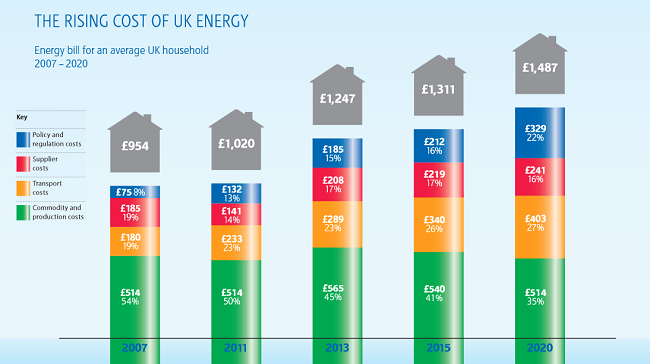
 Graphic showing past and predicted domestic energy price rises. Credit/source: RWE npower
This graphic shows how the electricity price rises from 2007 is largely "policy and regulation costs" ie direct state parasitism. The other is "transport costs" ie the grid, which is basically to pay for extending the grid so that windmill electricity produced in the outer isles can be transported to London. This is a hidden "green" subsidy and an extensive one.

By comparison actually producing the stuff is barely up and by 2020 will be back down to 2007 costs. I presume this is the benefit of shale more than offsetting windmill parasitism. VAT appears not to be included.

The alleged corporate greed of the "big 6" 'monopolists' means supplier costs will go from 19% DOWN to 16%.

So clearly, even within the terms of the official "debate" the fault lies with political price raising. But the official debate ignores the political effect of preventing the cheapest power sources (nuclear, coal & shale) being used.

This is how the ruling class normally frame any "debate". The only thing discussed is a few percentage points made up of either profit or government levies, according to which villain. The graph above shows that the levies are rising fast and the profits, as a % of cost, falling.

Unmentioned is that Hinkley Point is costing four times as much (and taking seven years longer,
which pushes up interest payments) than comparable Chinese ones, and nuclear is considerably cheaper than average power.

Undebated is that 90% of electricity prices (perhaps more) is government regulatory parasitism - you will never know it from BBC "news".

Even the "big six" would much rather be damned for the largely false charge of price gouging than be shown to be running expensive obsolete equipment that could not compete with engineering costs of nuclear, thus they do not call the MPs the liars they certainly are. This is common among dominant companies with fixed assets.

Lets go for a best possible cost:

Nuclear is currently 40% of the average cost of our power basket.
China is building at 0.27 our costs.
Because China is building in three years and us in ten we have seven years foregone income while paying interest – assuming the normal 10% return that is 1.10^7 = 1.95
Assume China is not entirely without state parasitism – say 10% 
VAT and carbon levies 20%
How much could cost be reduced if it was allowed to mass produce reactors - three fold seems a conservative estimate.

60% X 0.27 X 1/1.95 X 90% X 1/1.20% X 1/3 = 0.0208 or 2.08% of current costs.
97.92% parasitism.

Way below current standing charges = "electricity too cheap to meter". Though this does not include transportation costs. However if the amount of power we use goes up anything like proportionately, handling costs will go down, not quite proportionately.

I'm not standing by that exact figure though I would hold to each part as being either firm or a reasonable estimate. Nor does it matter much. If we can say at least 90% of electricity costs are state parasitism and can, over a number of years, be removed it doesn't immediately matter if another 80% reduction is ultimately possible. But if some supporter of windmillery feels the figures can be factually disputed I am sure they will do so.

If nobody in Scotland's political class feels able to point to any error, after it has been aired here on ThinkScotland, it would be difficult to conclude these figures are in error. I am sure the editor would be willing to publish a serious critical article (unlike, for example, the BBC, which virtually never allows a balancing of opinions on such subjects).
 

Labels: , , ,


Saturday, February 01, 2014

How Space Offers Hugh Economic Potential

   This is up on ThinkScotland. Please put any comments there


    The European Space Agency probe Rosetta was recently switched on and is going to land on a comet, a rock which was old when the planet Earth was new.

    The Chinese space agency recently landed its Jade Rabbit probe on the Moon, though it has now malfunctioned and it may well be unable to complete its mission.

    NASA's Mars probe continues to send back data from that planet.

    Less newsworthy but perhaps more important for opening up space to humanity generally is that SpaceX recently put their rocket in geosynchronous orbit. This is a much more difficult task than putting it in low Earth orbit, around 200km up, because geosynchronous is at a height of 36,000km. On the other hand it is commercially much more valuable because satellites in geo are constantly in the same spot in space and any spot on Earth it may want to transmit to is also on the same spot from its vantage. SpaceX has already resupplied the International Space Station and

    India has managed to annoy those British politicians and leader writers, of "left" as much as "right" by having the presumption to prepare a probe to Mars which their erstwhile British rulers can't, or at least can't be bothered, doing.

    A recent paper in Nature says that there are enormous amounts of water in Ceres the 2nd largest asteroid in the belt beyond Mars  perhaps more than in all Earth's oceans. If so, particularly since this is just 1 asteroid, we have enough water to supply a virtually unlimited human population in space, certainly larger than Earth's population.

    Richard Branson hopes, hopes by the end of the year to have taken himself and  his family into suborbital space., though to be fair this has been real soon now for some time.

    And companies have been set up to mine the asteroids and settle the Moon.

    Unlike the first space age of the 1960s the diversity is obvious. We have very expensive space programmes from NASA ($18 billion a year), ESA ($11.2bn including the closely connected French, German and Italian ones). The intermediate Chinese ($1,3bn) and British ($414million). And the commercial ones which come out ahead (or go bust). Even NASA is not spending remotely as much as it did in the 1960s and NASA and ESA appear to be getting rather poor value for money.

    Smaller countries may well have an advantage in the new space race because relatively little land area on Earth is needed as a launch pad to achieve an unlimited footprint in space. For commercial space smaller countries are ideally placed to set an attractive tax regime.

    Thus it is sometimes said the Isle of Man is going to be the 4th country to put a man on the Moon, through space companies registered there. But they have competition for that title from California who are also proposing such tax breaks. Also from Singapore and Dubai who have both built their own space centres. When we are dealing with an industry growing at least 10% a year the attraction of getting in on the ground floor and becoming an industry hub is obvious. Well obvious to some - Virgin chose to set their northern launch site in Sweden after finding nobody in the government of Scotland, their first choice, was interested.

    In the long term, permanent human settlement of space must make money or it is ultimately a fashion, subject to being closed down at any time by politics. However it long has made a profit. Space industries (mainly communication and weather satellites) were worth £160 bn a year in 2009 and has been growing at 10% a year.

     It is not now about making space profitable it is now about making deep space industry (ie not linked to Earth) profitable and with one asteroid, out of 10s of thousands containing $195bn worth of ores that looks unlikely to be a problem for long.

    The sky is considerably short of the limit for space industrialisation. The amount of cheap energy from solar power satellites is unlimited; mineral resources far beyond everything on Earth; real estate also unlimited; satellite TV and communications may look like a mature industry but in fact, since the amount of information is directly proportional to the signal power and communication satellites now are powered by a few metres of solar cells, transmissions can still be increased several 10s of times at least.

    That's the conventional stuff.

    Now I'd like to talk about a couple of fairly new ideas, which have the chance to take humanity, or at least our engineering, anywhere in the Solar System. And the major Scottish contribution to it.

    Over the last few years we have seen the development of very small modular satellites in a 10 cm cube. Known as cubesats these are the economic equivalent of shipping containers, except small. Units of self contained materials.


    These work because of Moore's Law. This is the observed fact that computer capacity, and thus also a lot of instrumentation, has been doubling every 2 years since the 1940s. That means a million times since the 1970s. You can buy a mobile phone now that has more capacity than all the computer programming available to NASA for the Moon landings. And you can put it in a device the size of a mobile phone - or several times more in a cubesat. The first Voyager spacecraft, which sent us the first pictures of the outer planets and moons, was launched in 1977. It was 9ft x 21 ft x 57 ft  (a mere 300,000 times the size of a cubesat, well actually much less because it doesn't fill most of that space). A box 4 inches on a side can now hold far processing capacity.

    And a Scottish firm (if I were being chauvinist I would say Glasgow firm) have a major component in 40% of the world's cubesats. Theoretically that is potentially comparable to the time at the beginning of the 20thC  when 90% of all the world's metal hulled shipping tonnage had been built on Britain and 90% on the Clyde. That was when such shipping was at the technological cutting edge.

CubeSats, with their advantages of modularity, are predicted to do for satellites what PCs have done for computing. It's now possible to buy components and assemble them as a kit, and Clyde Space already provides an online credit card purchasing system for items....

Clyde Space is also expert in the design of miniature power systems for CubeSats, for which they have around 40% of the global market.
    
   And as all new ideas generate new ideas of their own, an engine to power such a cubesat is now being designed.

    Benjamin Longmier, Michigan University, is developing the CubeSat Ambipolar Thruster (CAT), a new rocket propulsion system powered by the Sun and propelled by water, which will push small spacecraft like CubeSats around and far beyond the Earth.

 * interplanetary missions to Mars and Europa for about $1 million
* Ten interplanetary cubsats for a solar system wide internet
* Cheaper satellite wi-fi around the earth
* Future combination with Spacex reusable rockets, Planetary resources cheap space telescopes, Googlex low cost space robotics for radical lowcost space exploration.

   If you can land a cubesat on one of the asteroids, and we can, then we can use ground based sonar to build up a geological (asterological - the language hasn't caught up with our capabilities) picture of what each one contains and how it is made up. For $1 million - oil explorers on Earth wouldn't get out of bed for that.

   If the 1960s space race was the first generation project and SpaceX making commercial trips to orbit and these other things are the second then what is now being worked on - the ability to send thousands of probes to each of the asteroids and moons and comets too, across the Solar System is the opening of the 3rd and it is opening now.
   
3 modules combined approach Saturn - drawing - so far

Labels: , ,


Monday, December 16, 2013

White Paper - Scotland's Energy Future

       My latest article now up on ThinkScotland - please put any comments there. It is part of a series Brian has run on the SNP's white paper.
#################################################################

   The entire energy question is covered in Chapter 8 of the White Paper entitled "Environment, Rural Affairs, Energy and Resources" which is reflects the degree of priority given to energy, despite the fact that energy use is pretty much identical to gdp.

    They boast "Between January 2010 and April 2013, industry has announced £13.1 billion of investment with an associated 9,100 jobs" which, at £1.44 million per job would not be that wonderful even if Verso Economics had not previously proven that for every "Green" job created 3.7 jobs in the non-subsidised economy are destroyed. Add the decision of Scottish Power to pull out its previously announced intention to invest in a Hebridean windfarm, and many other recent cancellations of windmill projects and even that promise looks improbable.

    In fact none of this £13.1 billion would have been on offer were it not that wind energy is getting a 200% subsidy. The Scottish government has not only already promised we will be 100% renewable by 2020 but every major conventional power generator is intended to close before 2020 except:

Longannet, coal, 2.4 GW, opened 1972, The station is expected to continue operating until approximately 2020-2025, because of the technical advancements in place at the station. These include the station's low NOx burners, its NOx reburn system

Hunterston B, nuclear, 1.288 GW, opened 1976, Hunterston B was originally planned to operate until 2011. In 2007 planned operation was extended by 5 years to 2016. In December 2012 EDF said it could (technically and economically) operate until 2023.

Torness, nuclear, 1.344 GW, opened 1988 It is expected to operate until 2023

 Peterhead, gas, was 1550GW, opened 1980, UK Peterhead power plant Unit 2 likely to close
* 660 megawatt Peterhead Unit Two likely to close
* Peterhead transmission capacity down to 1,180 megawatts - undated but clearly current. Peterhead has also not got the Westminster £1bn subsidy for carbon capture that Holyrood wanted and was listed by Jim McDonald as one due to close before 2030.

  We are building no new large capacity generators. We will soon have none.

   Windmills simply cannot provide baseload because they are intermittent, even the government funded lobbyists, Scottish Renewables accept this..

   So how will the power be kept on?

   Despite the 100% renewable promise the paper promises incentives to provide "renewable and thermal", which looks like 2 incompatible promises but I am assured there is an explanation.

    The big question is how Scotland can afford to be 100% renewable when everybody accepts  wind is more expensive. Particularly when we are assured not only that Holyrood will oppose fuel poverty but that they will have a statutory duty to end fuel poverty.

     This is how:

    "This Government proposes that a single Transmission Operator will continue to balance supply and demand across Scotland and the rest of the UK.

Following independence, Scottish renewable energy will continue to represent the most cost-effective means for the rest of the UK to meet its renewable ambitions. The continuation of a system of shared support for renewables and capital costs of transmission among consumers in Scotland and the rest of the UK is a reasonable consideration for meeting the UK's ongoing green commitments."

    The rest of the UK will continue to subsidise our windmills.

    They are honest enough to say that this is simply what the SNP "proposes" but it is clearly insane. Nobody can guarantee that England will continue to elect governments willing to pour subsidies into a foreign country. But having admitted it is only a proposal there is no plan B should the English electorate decide otherwise.

      Bear in mind that Ofgen have already said they expect electricity bills to rise to £3,000 a year across the UK by 2020 when the UK will not yet have reached its target of 30% renewable, Scotland, with its 100% target would, on our own, clearly be well beyond impossible without English subsidy. Ignoring the question shows them to be, at best, unfit to hold any responsible job.

      Actually its worse than that - because wind is intermittent, and particularly likely to be missing when it is cold, we will would need their help to keep the lights on in any case and irrespective of cost. Indeed either way we will need to strengthen the cross border interconnector either to sell as much of our spare windpower ass promised or to bring in enough of their conventional power at need.

      The paper also guarantees that £70 of the energy levies will be transferred to tax. With 2 million Scots households an 2/3 of power use being non-domestic that comes to £420 million - 1.3p on income tax or some equivalent, both unspecified. This and other spending promises for an independent country look to be adding about 20p to income taxes or equivalent. I await hearing of their equivalent.

Oil & Gas

  The long prophesied Oil Fund gets another mention but since no promise of how much will go into it, or when it may safely be ignored. Good thing since that money is currently being spent.

  I found this interesting remark about gas "Scotland is also estimated to have the second largest volume of proven gas reserves in the EU after the Netherlands" The key word being "proven" which allows them to ignore shale gas though it is orders of magnitude more than conventional gas and the UK may be the European leader. Most shale is in northern England but there is enough under Scotland's central belt that, per capita, a separate Scotland would not lose out. Or at least would not lose out unless we decided to. But the SNP have promised ever more regulation to prevent it being.

    Grangemouth was saved because the owner decided to bring in US shale gas (which costs 1/3rd of what ours does) to process, but this is like carrying coals to Newcastle in that we could be getting this gas from Fife.

   Another interesting omission is under decommissioning. This is about getting England to pay for decommissioning of oil rigs. The omission is any mention of decommissioning nuclear plants, Over the decades the government have taken over £40 million from the nuclear industry to be held by them in a "decommissiong fund" - in fact no such fund exists or it would, accounting for inflation and interest, now be worth well above £200 billion. It is out of character that they don't stake a claim to a disproportionate share of this and I think it is evidence of their blank spot over nuclear rather than any goodwill.

 -------------------------------

     I am not trying to say that Scotland cannot afford separation. A Scotland favourable to economic freedom, willing to allow us to have shale gas and nuclear power at a market price would undoubtedly be far wealthier than the current UK. Hinkley Point is to cost 4 times more than an equivalent European built project in China and almost equally important for investor returns, will take 10 years rather than 3 to complete, entirely due to government parasitism.

      Then again so would such a UK. The problem is that the SNP not only don't want that, it is obvious from this document that they cannot even conceive of such an option. Nor, from the criticism from the other parties and our mainstream media, can any of them.

      Which brings me to my last extract from the paper:

"If we form the government of an independent Scotland we will:
  • seek to enshrine environmental protection in the constitution. With independence we will have the opportunity to enshrine protection of our environment in the proposed written constitution for Scotland"
  I'm of the old fashioned view that the purpose of a constitution is to limit the power the state has over us, rather than the EU style one, that it is to give judges and those in power more power over us and limit our power to object. This is very much of the latter sort. It says what government can do and even what we cannot object to the state doing. No wording is given but there is difficulty in concluding that it would say, or after a few years interpretation would be deemed to say, that we mortals have no right to object to anything the ecofascists claim is necessary. Ultimately even that nobody not willing to claim to see catastrophic warming (or whatever the next eco-scare is) at every hand, could stand for election. Holyrood did vote for the world's most restrictive Climate Change Act and did so with Soviet style unanimity - how many of them would object to it being enshrined in the constitution to keep future generations restrained too?


Labels: , ,


Wednesday, November 27, 2013

White Paper: Okay, we've got the wish list, where's the price list?

An article by me on the SNP's promise list is up at ThinkScotland. Please put any comments there:

The SNP have made these formal promises of what we will get if we vote Yes for separation. I have inserted my comments:

These included:

  • Thirty hours of childcare per week in term time for all three and four-year-olds, as well as vulnerable two-year-olds.
150,000 kids or 200,000 hours so at least another £1 billion in extra taxes. That's 3p on income tax or equivalent he is promising. While childcare in Britain costs over 40.9% of an average wage in Estonia it is only 6.6%. This is because Estonia has a libertarian attitude to freedom. Since Estonia is part of the EU our costs cannot, for once, be blamed on the EU and since Scotland has control over almost all regulation they could reduce these costs to the Estonian level if they really wanted.

  • Trident nuclear weapons, currently based on the Clyde, removed within the first parliament.
Fair enough but what about those working there who will, unless something else is provided, have no jobs.

  • Housing benefit reforms, described by critics as the "bedroom tax", to be abolished, and a halt to the rollout of Universal Credit.
That is another promise of more spending. My guess another billion.
  • It would be in Scotland's interest to keep the pound, while the Bank of England would continue as "lender of last resort".
But George Osborne has said he doesn't think it would be in England's. It would be possible for Scotland simply to keep using the English £ and let our banks print and attempt to maintain parity without government intervention but this would mean Scotland would not have "gilt edged" government borrowing. The real problem is that as "lender of last resort" the BoE is guaranteeing Scottish government debt and it is obvious why that is unattractive. Since we would be taking our share of the national debt the Scottish government will have debt to be guaranteed. Certainly there is no way a BofE would ever guarantee a higher borrowing rate in Scotland than in England and if our economy was shaky the fiscally proper thing for them to do would be to demand we borrow less - something which all Keynesians will recognise a problem with. The fact that oil prices swing wildly make it absolutely certain that Scottish government revenue will do so as well, meaning that the ability to borrow to smooth the curves is vital.
  • BBC Scotland replaced at the start of 2017 with a new Scottish broadcasting service, continuing a formal relationship with the rest of the BBC.
What sort of "independent" country allows a foreign country to control its broadcasting? While it is true that the BBC has a legal duty of "balance" (A) it makes no attempt to keep to it and (B) there is bound to be circumstances where balance means something different to a Scottish audience. For example if UKIP became a part, or the whole, of the rest of UK government a balanced BBC would be forced to cover their policies and, for example, give significant airtime to reporting that the catastrophic warming fraud is a fraud. Seeing Salmond's  enthusiastic support for the fascist thugs who attacked Nigel Farage and him promising we will be 100% on intermittent "renewables" by 2020 is it conceivable that his Scottish government could put up with an English definition of balance in state owned media?
  • Basic rate tax allowances and tax credits to rise at least in line with inflation.
Yet we know that over a fairly long term revenue from oil will decline and the proportion of pensioners rise. That means that, other things being equal, taxes must rise.
  • A safe, "triple-locked" pension system.
This is a post dated cheque on what, if the IFS report is right, is a declining bank*. At the very least it would mean billions more in taxes.

  • Minimum wage to "rise alongside the cost of living".
Take that as you want. The SNP's partners in the Yes campaign have promised there will be no increase in living standards for 10 year, hopefully longer (their hope not mine). Anyway this is another post dated cheque.

This looks like about £2 billion in extra taxes immediately (6p on income tax or some unspecified alternative) with more to come, which along with a far higher electricity prices here because we are 100% renewable (not to mention blackouts for the same reason) seems an improbable launching pad for the growth which is the only way the IFS predictions of us being smothered in higher pensioner costs and lower oil revenue would be prevented.

I do not dispute that Scotland could grow faster than the UK, if it adopted sane free market economic and energy policies and quit the only zone of the world in recession, the EU (or indeed that the UK
could grow faster than the UK is doing currently by the same method). But their is no sign of any such sanity in any part of the Holyrood consensus.

*Ghandi's description of the British WW2 offer of post war independence to India.

###########################################

Another of couple of points since:

1 - Nicola Sturgeon told Holyrood that the "only" threat to our membership of the organisation responsible for 75% of our laws, the EU was the promised 2017 referendum. That means there is no possibility of the SNP allowing us a referendum on EU membership, whatever the terms. It must be unique in the world for a nominally "independent nationalist" movement to oppose the right of the people to decide they want independence.

2 - Last night Alex Salmond assured Newsnight that there was no possibility that an independent remaining EU would ever decline to pay over the odds (currently about 3 times over normal prices) for Scottish windmill power. He also said that Scotland normally supplies 8 Gigawatts of power to England which is simply a lie. Bearing in mind that wind only produces 1/4 of its rated capacity that is would be all the power stations in Scotland working full out and us using none of it. Actually even if that were possible the cross border interconnectors would blow.

Labels: , ,


This page is powered by Blogger. Isn't yours?

British Blogs.