
Thursday, June 19, 2014
Going Beyond Maurice Saatchi's Cutting Corporation Tax Idea
Maurice Saatchi has produced for the Centre For Policy Studies (and implicitly for the Tory Party) a proposal to abolish Corporation Tax for all but the 10% of largest companies and also abolish Capital Gains Tax for the same people. Saying
"The Policy outlined in this document will:
abolish Corporation Tax for 90% of UK companies
reduce the deficit faster than predicted by the OBR
expand employment faster than predicted by the OBR
increase competition and challenge Cartel Capitalism
let millions of people grow tall.
These millions of individuals will enjoy:
the opportunity to say “I am the captain of my ship”
more money
more freedom
the first step on The Road from Serfdom.
The nation as a whole will benefit from:
a change in culture as big as “Own your own Home” in the 1980s
greater economic growth and lower unemployment than forecast by the OBR
more competitive market places
more freedom and independence from Big Government and Big Companies."
I have been pushing for CT cuts since before I started this blog in 2004. Basically following the example of Ireland where they cut CT, in a series of steps to 12.5%, and reduced regulation, particularly on housebuilding and achieved a 7% average growth rate.
So what do I think of Saatchi's slightly different proposal? It is an improvement. His is costed at £10.5 bn. Mine of cutting all CT by slightly more than half would cost just over a billion more. Not much difference. However by concentrating it all on smaller companies he gets some advantages - smaller companies provide more employment growth; smaller companies tend to be more innovative, until they grow into bigger companies; smaller companies have more difficulty borrowing so profits are more important for expansion.
He also has the advantage of being able to run it through an economic model. Lets take advantage of that.
The conclusion is that this £10.5 bn cut would increase growth by about 0.8%, though not in the first year because the investment has to work through. That means that by the end of a 5 year Parliament that growth would have replaced all that tax cut. Saatchi says that this 0.8% estimate is "conservative" and I agree. Indeed that is 1 of 3 reasons I believe the position is much better than he offers:
1 - Irish growth was 7% - 4.5% better than ours. Even if we assume more than half was due to the regulatory cuts (not the common feeling but probably true) and that, because Ireland is so much smaller than us, having lower taxes opened them up to proportionately more investment than us we still come out with the growth potential being around twice the 0.8% given. Also Irish growth did not take a year to take off and this is reasonable if investors see an improved investment opportunity - they will not wait, but start investing immediately, if they can.
2 - Increased national debt is only a problem in relation to the size of the economy. If we have growth of an extra 0.8% in the economy, debt can increase the same without making payment more difficult. Indeed if the size of government is unaltered there is actually proportionately more uncommitted money in the economy, though this is only a marginal effect.
Our current national debt is £1.4 trillion so 0.8% is £11.2 bn, just slightly above initial and maximum borrowing.
3 - If you have a growing economy you need to increase the money supply to keep prices stable. Money in UK circulation is rather larger than 1 year's gdp. In fact it was £2,200 bn in 2010 - presumably about £2,400 bn now. So an extra unexpected 0.8% growth means we can and should print £19 billion extra.
--------------------
This is not estimating conservatively but it is the realistic best estimate and if we don't do it there is no reason to believe reality will be conservative either.
So clearly we should go with this asap.
I would go further - promise that the take on CT and other business taxes will not be allowed to rise - if the economy grows, as it will, increasing the tax take, we will raise the level at which CT comes in (and when it is fully abolished, business rated and other such taxes). This means investors can look forward to a stable profitable investment, which is all they need.
--------------------
But I would like to see this as merely the start.
The formula for economic growth is: Economic Freedom + Cheap Energy
Low business tax is only part, the smaller part, of economic freedom. The greater part is not having parasitic state regulation. At least tax money goes back into the economy, albeit in less efficient ways and excluding the cost of government taxing and returning it. Wealth destroyed by regulation, for example 98% of the cost of electricity, is gone forever.
So we should should cut regulations wherever possible. As a minor effect that also cuts government spending a bit - it costs government all of 1/20th, to regulate, of what it costs the productive economy to be regulated.
75% of housing cost is regulatory - 34% X 75% = 25.5%
(I assume this includes heating it)
The EU regulations come to another 5%
(assuming the cost is equally borne by the people as by the government sector which is an optimistic assumption)
Remaining portion of income that goes to the value of what we actually choose
That 69.5% is, in turn reduced proportionately by all the other factors. Take off commercial building costs (est 2.5%), electricity charges through the rest of the economy (est 2%),accountancy (7.5%), child care (est 2.5%), assorted other (est 10%)
Therefore percentage of income we nominally get to spend which we actually get in our pockets & spent on the product not the surrounding regulation
But if the regulatory part of economic freedom costs us more than the tax part the other side of the equation, cheap energy has even more potential. Roger Helmer has written of the advantages of letting decisions on electricity be made on economic not ideological grounds.
The correlation between growth in energy use and in gdp is undisputable.
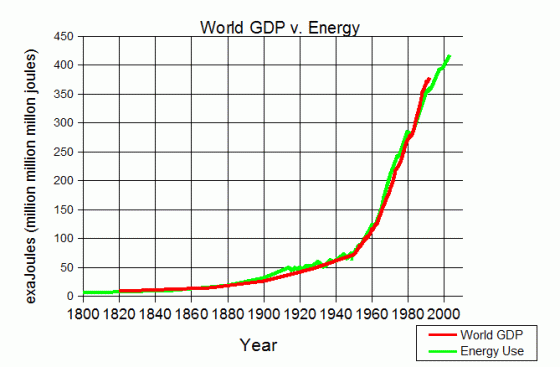
It has been calculated and indeed is undisputed that app 98% of the cost of producing electricity here is governmental parasitism.
Nuclear is currently 40% of the average cost of our power basket.
China is building at 0.27 our costs.
Because China is building in three years and us in ten we have seven years foregone income while paying interest – assuming the normal 10% return that is 1.10^7 = 1.95
Assume China is not entirely without state parasitism – say 10%
VAT and carbon levies 20%
How much could cost be reduced if it was allowed to mass produce reactors - three fold seems a conservative estimate.
60% X 0.27 X 1/1.95 X 90% X 1/1.20% X 1/3 = 0.0208 or 2.08% of current costs.
97.92% parasitism.
Major reductions, not quite as major, could be done by allowing the market to produce shale gas. Any reduction on electricity costs, not just one as major as this, if the laws of supply and demand work, would produce a many fold increase in energy use and therefore a many fold increase in gdp.
Indeed I have previously proposed a 24 point programme to the world's fastest growth, which includes my original CT cutting proposal, and it would work. Theoretically we might expect most of the proposals to increase growth by about an average of 2% a year, Some more, some less.
In practice we might be limited to a bit above the 20% growth Guandong province in China managed for years. Certainly the theoretical maximum, if we make growth our "Number one priority" (Scottish labour leader Jack McConnell promising at 2 elections - he knew what people want even if he lied about giving it) cannot be lower than the actually achieved maximum.
=================================
Saatchi's proposal is a very good one, well thought out and verified. It is a small fraction of our potential.
"The Policy outlined in this document will:
abolish Corporation Tax for 90% of UK companies
reduce the deficit faster than predicted by the OBR
expand employment faster than predicted by the OBR
increase competition and challenge Cartel Capitalism
let millions of people grow tall.
These millions of individuals will enjoy:
the opportunity to say “I am the captain of my ship”
more money
more freedom
the first step on The Road from Serfdom.
The nation as a whole will benefit from:
a change in culture as big as “Own your own Home” in the 1980s
greater economic growth and lower unemployment than forecast by the OBR
more competitive market places
more freedom and independence from Big Government and Big Companies."
I have been pushing for CT cuts since before I started this blog in 2004. Basically following the example of Ireland where they cut CT, in a series of steps to 12.5%, and reduced regulation, particularly on housebuilding and achieved a 7% average growth rate.
So what do I think of Saatchi's slightly different proposal? It is an improvement. His is costed at £10.5 bn. Mine of cutting all CT by slightly more than half would cost just over a billion more. Not much difference. However by concentrating it all on smaller companies he gets some advantages - smaller companies provide more employment growth; smaller companies tend to be more innovative, until they grow into bigger companies; smaller companies have more difficulty borrowing so profits are more important for expansion.
He also has the advantage of being able to run it through an economic model. Lets take advantage of that.
The conclusion is that this £10.5 bn cut would increase growth by about 0.8%, though not in the first year because the investment has to work through. That means that by the end of a 5 year Parliament that growth would have replaced all that tax cut. Saatchi says that this 0.8% estimate is "conservative" and I agree. Indeed that is 1 of 3 reasons I believe the position is much better than he offers:
1 - Irish growth was 7% - 4.5% better than ours. Even if we assume more than half was due to the regulatory cuts (not the common feeling but probably true) and that, because Ireland is so much smaller than us, having lower taxes opened them up to proportionately more investment than us we still come out with the growth potential being around twice the 0.8% given. Also Irish growth did not take a year to take off and this is reasonable if investors see an improved investment opportunity - they will not wait, but start investing immediately, if they can.
2 - Increased national debt is only a problem in relation to the size of the economy. If we have growth of an extra 0.8% in the economy, debt can increase the same without making payment more difficult. Indeed if the size of government is unaltered there is actually proportionately more uncommitted money in the economy, though this is only a marginal effect.
Our current national debt is £1.4 trillion so 0.8% is £11.2 bn, just slightly above initial and maximum borrowing.
3 - If you have a growing economy you need to increase the money supply to keep prices stable. Money in UK circulation is rather larger than 1 year's gdp. In fact it was £2,200 bn in 2010 - presumably about £2,400 bn now. So an extra unexpected 0.8% growth means we can and should print £19 billion extra.
--------------------
This is not estimating conservatively but it is the realistic best estimate and if we don't do it there is no reason to believe reality will be conservative either.
So clearly we should go with this asap.
I would go further - promise that the take on CT and other business taxes will not be allowed to rise - if the economy grows, as it will, increasing the tax take, we will raise the level at which CT comes in (and when it is fully abolished, business rated and other such taxes). This means investors can look forward to a stable profitable investment, which is all they need.
--------------------
But I would like to see this as merely the start.
The formula for economic growth is: Economic Freedom + Cheap Energy
Low business tax is only part, the smaller part, of economic freedom. The greater part is not having parasitic state regulation. At least tax money goes back into the economy, albeit in less efficient ways and excluding the cost of government taxing and returning it. Wealth destroyed by regulation, for example 98% of the cost of electricity, is gone forever.
So we should should cut regulations wherever possible. As a minor effect that also cuts government spending a bit - it costs government all of 1/20th, to regulate, of what it costs the productive economy to be regulated.
75% of housing cost is regulatory - 34% X 75% = 25.5%
(I assume this includes heating it)
The EU regulations come to another 5%
(assuming the cost is equally borne by the people as by the government sector which is an optimistic assumption)
Remaining portion of income that goes to the value of what we actually choose
100% - 25.5% - 5% =69.5%
That 69.5% is, in turn reduced proportionately by all the other factors. Take off commercial building costs (est 2.5%), electricity charges through the rest of the economy (est 2%),accountancy (7.5%), child care (est 2.5%), assorted other (est 10%)
Total 24.5%
Therefore percentage of income we nominally get to spend which we actually get in our pockets & spent on the product not the surrounding regulation
69.5% X (100% - 24.5% = 52.5%
But if the regulatory part of economic freedom costs us more than the tax part the other side of the equation, cheap energy has even more potential. Roger Helmer has written of the advantages of letting decisions on electricity be made on economic not ideological grounds.
The correlation between growth in energy use and in gdp is undisputable.
It has been calculated and indeed is undisputed that app 98% of the cost of producing electricity here is governmental parasitism.
Nuclear is currently 40% of the average cost of our power basket.
China is building at 0.27 our costs.
Because China is building in three years and us in ten we have seven years foregone income while paying interest – assuming the normal 10% return that is 1.10^7 = 1.95
Assume China is not entirely without state parasitism – say 10%
VAT and carbon levies 20%
How much could cost be reduced if it was allowed to mass produce reactors - three fold seems a conservative estimate.
60% X 0.27 X 1/1.95 X 90% X 1/1.20% X 1/3 = 0.0208 or 2.08% of current costs.
97.92% parasitism.
Major reductions, not quite as major, could be done by allowing the market to produce shale gas. Any reduction on electricity costs, not just one as major as this, if the laws of supply and demand work, would produce a many fold increase in energy use and therefore a many fold increase in gdp.
Indeed I have previously proposed a 24 point programme to the world's fastest growth, which includes my original CT cutting proposal, and it would work. Theoretically we might expect most of the proposals to increase growth by about an average of 2% a year, Some more, some less.
In practice we might be limited to a bit above the 20% growth Guandong province in China managed for years. Certainly the theoretical maximum, if we make growth our "Number one priority" (Scottish labour leader Jack McConnell promising at 2 elections - he knew what people want even if he lied about giving it) cannot be lower than the actually achieved maximum.
=================================
Saatchi's proposal is a very good one, well thought out and verified. It is a small fraction of our potential.
Labels: British politics, economics, UKIP, UKIP Policy papers


Thursday, June 05, 2014
How Do You Solve A Problem Like Africa? - UKIP paper #3
I disagreed with the estimable, but sometimes wrong, EU Referendum on the subject of illegal immigration from, mainly, Africa. Dr Richard North there said that deaths of boat people trying to enter Europe are a tragedy (true) and that several times as many must die trying to cross the Sahara (also true). The problem is that tragedy, as Greek tragedy constantly showed, was not avoided by good intentions.
Allowing increased immigration would simply encourage more and do nothing to fix the problem. A problem for the entire human race is that demographic growth is fastest in failed states and cultures and exporting people exports failure to the more successful.
So what can we do to make Africa less of a failure? We have poured trillions into it in "aid" without success and it has tended just to reinforce divisions and kleptocracy.
So here are some ideas, mostly ones I have written on before, and mostly very inexpensive compared to our annual £12bn a year "aid" budget, now collected in 1 place:
1 - Quit the EU. Getting out would allow us to buy food, which Africa can produce. Outside the EU trade barriers we could buy cheap (by our standards) food from them at high (by their standards) prices. By encouraging market solutions this would, alone, almost certainly do far more than our entire "aid" budget now does.
2 - Use our international influence to support the greatly increased use of DDT. The DDT ban has killed more people than Hitler and Stalin combined (app 1 1/2 million a year) - yet before the western campaign started deaths were down to 50,000 a year.
3 - Use our international influence to support Golden Rice. Genetically modified rice with extra protein, which ends the protein deficiency diseases that leave survivors intellectually stunted. The eco-fascists have been responsible for obscene suffering simply because of their Luddite opposition to science.
4 - Support construction of a massive geosynchronous satellite in orbit over Europe/Africa (2 others should follow) able to provide virtually unlimited telecommunications traffic. It is believed that a, probably the, major reason for economic growth in Africa is that mobile phones have allowed people to negotiate trade with each other.
5 - Once such a system exists it will be possible to create a computerised teaching system able to provide a basic but good (QandA) education in the remotest village.
6 - Use the satellite to photo record all land and make computerised records of land ownership. Poor or no title to land is one of the major factors preventing the raising of investment capital across the 3rd world.
7 - Keep a record of speech, pictures and video footage of crime, sent up by mobile phones. I don't expect this to end corruption and brutality quickly but it will provide pressure. Who would have thought starving Africans could have mobile video cameras but such is our modern world.
8 - Where there are guerrilla wars against moderately sensible governments provide drone aircraft to hunt them down.
9 - Use this same network as a banking system using a non-national virtual currency exchangable through mobiles. A prudent banker can make this inflation free simply by not inflating the quantity of money beyond demand (and still make a vast profit).
10 - I have said we should be building a factory mass producing small nuclear reactors. If maximum production exceeds demand we should give/auction excess ones to 3rd world countries. This has the advantage from our point of view that we are guaranteeing they will all sell, even if only at cost prices, rather than making the market entirely subject to political bans.
11 - Build Aquarius style floating islands powered by OTECs. One spin off is deep ocean water that can be used to grow protein rich algae which can, in turn, be supplied as a protein additive.
12 - Lifestraws - a way of cleaning water that the PC brigade hate. These, if mass produced in the hundreds of millions, would have very low marginal cost.
13 - Cut a tunnel under the Chad mountains and divert most of the water from the Congo's tributary, into Lake Chad and from there, through canals and other tunnels, across the Sahara creating lakes (2 virtually inland seas) along the way. My guess is it would be a century before it reached Tunisia but by then the Sahara would be revitalised by a century worth of water and as fertile as it was during the "catastrophic global warming" of 7,000 BC when we have cave paintings from the centre of the, now, desert, showing hippos.
14 - Open the Qattara Depression to seawater - make electricity and use much of it to refine Manganese and other minerals in sea water.
15 - Build a linear accelerator good space launcher from the top of Kilimanjaro (Bifrost here).
16 - A major programme of disease eradication. Africa is subject to a much greater disease reservoir than almost all the rest of the planet. Tackling them needs a continent wide programme. Matt Ridley gives a number of examples here - for example:
--------------------------------------------
I would also, like the crime videoing programme, have a programme of recording all the languages, songs, dances, religions and perhaps most important, ballads of every tribe in Africa through the mobiles programme. The brothers Grimm did a little of that for Europe but we don't know how much we have lost, and in a few generations Africa will have suffered the same cultural loss.
I would also like DNA records (ie frozen blood) to the same extent. It may be 50 years before we know what it all means, but we will still have it then.
--------------------------------------------
Most of these are relatively inexpensive (quitting the EU) or have spin off benefits (guaranteeing sale of small nuclear reactors/space craft). None of them involve more than the minimum direct interaction with local governments. Thus none of them rely on money we pay being passed on successfully. None of them have the obscenity of us telling locals that if they want us to provide power it will only be the most expensive and unreliable windmills, to satisfy political parasites and their friends back here, rather than attempting to maximise any benefit to "aid recipients".
However, even if all this saves millions of lives and makes it far better for a billion, it won't make life in Africa as good as here so it won't stop attempts at economic immigration. The only thing that can do that is stopping it. Japan and South Korea have immigration rates of 0.00% so it can be done, but only if the will is there.
Allowing increased immigration would simply encourage more and do nothing to fix the problem. A problem for the entire human race is that demographic growth is fastest in failed states and cultures and exporting people exports failure to the more successful.
So what can we do to make Africa less of a failure? We have poured trillions into it in "aid" without success and it has tended just to reinforce divisions and kleptocracy.
So here are some ideas, mostly ones I have written on before, and mostly very inexpensive compared to our annual £12bn a year "aid" budget, now collected in 1 place:
1 - Quit the EU. Getting out would allow us to buy food, which Africa can produce. Outside the EU trade barriers we could buy cheap (by our standards) food from them at high (by their standards) prices. By encouraging market solutions this would, alone, almost certainly do far more than our entire "aid" budget now does.
2 - Use our international influence to support the greatly increased use of DDT. The DDT ban has killed more people than Hitler and Stalin combined (app 1 1/2 million a year) - yet before the western campaign started deaths were down to 50,000 a year.
3 - Use our international influence to support Golden Rice. Genetically modified rice with extra protein, which ends the protein deficiency diseases that leave survivors intellectually stunted. The eco-fascists have been responsible for obscene suffering simply because of their Luddite opposition to science.
4 - Support construction of a massive geosynchronous satellite in orbit over Europe/Africa (2 others should follow) able to provide virtually unlimited telecommunications traffic. It is believed that a, probably the, major reason for economic growth in Africa is that mobile phones have allowed people to negotiate trade with each other.
5 - Once such a system exists it will be possible to create a computerised teaching system able to provide a basic but good (QandA) education in the remotest village.
6 - Use the satellite to photo record all land and make computerised records of land ownership. Poor or no title to land is one of the major factors preventing the raising of investment capital across the 3rd world.
7 - Keep a record of speech, pictures and video footage of crime, sent up by mobile phones. I don't expect this to end corruption and brutality quickly but it will provide pressure. Who would have thought starving Africans could have mobile video cameras but such is our modern world.
8 - Where there are guerrilla wars against moderately sensible governments provide drone aircraft to hunt them down.
9 - Use this same network as a banking system using a non-national virtual currency exchangable through mobiles. A prudent banker can make this inflation free simply by not inflating the quantity of money beyond demand (and still make a vast profit).
10 - I have said we should be building a factory mass producing small nuclear reactors. If maximum production exceeds demand we should give/auction excess ones to 3rd world countries. This has the advantage from our point of view that we are guaranteeing they will all sell, even if only at cost prices, rather than making the market entirely subject to political bans.
11 - Build Aquarius style floating islands powered by OTECs. One spin off is deep ocean water that can be used to grow protein rich algae which can, in turn, be supplied as a protein additive.
12 - Lifestraws - a way of cleaning water that the PC brigade hate. These, if mass produced in the hundreds of millions, would have very low marginal cost.
13 - Cut a tunnel under the Chad mountains and divert most of the water from the Congo's tributary, into Lake Chad and from there, through canals and other tunnels, across the Sahara creating lakes (2 virtually inland seas) along the way. My guess is it would be a century before it reached Tunisia but by then the Sahara would be revitalised by a century worth of water and as fertile as it was during the "catastrophic global warming" of 7,000 BC when we have cave paintings from the centre of the, now, desert, showing hippos.
14 - Open the Qattara Depression to seawater - make electricity and use much of it to refine Manganese and other minerals in sea water.
15 - Build a linear accelerator good space launcher from the top of Kilimanjaro (Bifrost here).
16 - A major programme of disease eradication. Africa is subject to a much greater disease reservoir than almost all the rest of the planet. Tackling them needs a continent wide programme. Matt Ridley gives a number of examples here - for example:
There are 2,500 species of mosquito in the world and only one of them — Aedes aegypti — is responsible for carrying dengue fever, a disease that currently afflicts nearly 400 million people and rising.... Last month the Brazilian government gave an Oxford-based company called Oxitec a licence to release into the wild genetically engineered male A aegypti mosquitoes. They carry two extra genes that render their offspring incapable of breeding. Release enough of them in an area and the species all but dies out locally. The beauty of this scheme is that the rarer the species gets, the better the chance that the genetically engineered males you release will mate with any available females, so the technique becomes more effective, not less, as local extinction approachesThere are a lot of diseases there. This plays to our strength of technological knowledge. It should not be allowed to play to our weakness - ecofascism. The "Greens" would certainly oppose curing disease that way but they, in turn, must be opposed.
--------------------------------------------
I would also, like the crime videoing programme, have a programme of recording all the languages, songs, dances, religions and perhaps most important, ballads of every tribe in Africa through the mobiles programme. The brothers Grimm did a little of that for Europe but we don't know how much we have lost, and in a few generations Africa will have suffered the same cultural loss.
I would also like DNA records (ie frozen blood) to the same extent. It may be 50 years before we know what it all means, but we will still have it then.
--------------------------------------------
Most of these are relatively inexpensive (quitting the EU) or have spin off benefits (guaranteeing sale of small nuclear reactors/space craft). None of them involve more than the minimum direct interaction with local governments. Thus none of them rely on money we pay being passed on successfully. None of them have the obscenity of us telling locals that if they want us to provide power it will only be the most expensive and unreliable windmills, to satisfy political parasites and their friends back here, rather than attempting to maximise any benefit to "aid recipients".
However, even if all this saves millions of lives and makes it far better for a billion, it won't make life in Africa as good as here so it won't stop attempts at economic immigration. The only thing that can do that is stopping it. Japan and South Korea have immigration rates of 0.00% so it can be done, but only if the will is there.
Labels: International politics, Science/technology, UKIP Policy papers
Wednesday, June 04, 2014
7/8ths Of Money For Scottish Government Projects Is Disappearing & No MSP Or Civil Servant Will Say Where
This is a motion Glasgow branch agreed to put into our AGM. However the AGM has been postponed for the far indeterminate future, something I regret as among other things, issues of importance to the party can only be discussed by party members in such informal ways.
UKIP policy paper #2
-----------------------------------------------------
UKIP objects to our government projects costing 8 times what they do elsewhere
Proposed by Neil Craig Motion wording, suggested by Robert Malyn
As a matter of law our elected MSPs and councillors are responsible for spending our money prudently but when I asked all 129 MSPs why the new Forth Bridge was so expensive only 2 replied. One said his party (Greens) had opposed it, which was true but not on the grounds of too much pork barrelling but because it wasn't all going to "Green" supporters and a LibDem of my acquaintance who got somebody to look up the record as discussed at the end. This did not result in any specific answer as to why they promote this massive disappearance of our money or where, specifically, it goes.
Though an FoI reply underlined at the end does, if not giving any explanation of where the money goes, at least explain the formula applied to its going.
Though the Forth Bridge is the most glaring example of most of the taxpayer's money going walkabout it is not abnormal as to the ratio of disappearing money that our politicians simply refuse to account for. Here are 20 examples:
1 - New Forth Bridge, costing £2,300 million. Previous bridge cost £19.5 million which, converted for inflation means the new one could have been built for £320 million. To be fair to the SNP the previous Lab/Lib estimate was £4 billion. [8 times]
2 - Scottish parliament. Originally offered a fixed price contract for £40 million. Donald Dewar went on air to say "Tam Dalyell is wicked to suggest it will cost 1 penny more than £40 million". Officially costed at £431 million though there may be undisclosed landscaping costs. [11 times]
3 - Edinburgh Trams. If, after interest, they come out at less than 1 billion it will be surprising despite them being half the length originally promised. In fact if the cost the same as equivalent Australian examples the full length should have cost no more than £110 million. In the sole legal case on the overruns on what was originally said to be a fixed price contract TIE lost because the court found them responsible for at least 90% of overrun. TIE brought no further cases but enforced gagging clauses in the contract they had competently negotiated. [9 times]
4 - Aberdeen bypass. The average European or American road costs £2.4 million per mile. The average Russian costs £6.3 million, but that is said to be a mixture of the survival of Soviet style bureaucracy combined with rampant corruption. The Aberdeen bypass cost £23.3 million per mile.
[10 times]
5 - The M74 Glasgow bypass was (like the Olympics) proudly boasted as coming in under budget and on time. This remarkable feat, a mere £692 million) was achieved by the simple expedient of continuously increasing the budget, which started at £177 million, and extending the completion date.
£ 138 million per km. By comparison an FoI request showed motorways normally cost £6.8 million per lane per km, less than 1/10th of the price. As the minister in charge, Alex Neil, said "This is clear evidence of our robust and effective management of major projects such as this" and who could disagree. [10 times]
6 - Skye Bridge. As this was a PFI project it was comparatively close to budget. When the Bridge contract was first awarded, the partnership estimated it would cost around £15 million, although delays and design changes required by regulators added significantly to the cost (to around £25 million) though ultimately after several years of politics the PFI contract was bought back for what is estimated to have been an overall cost of £56.8 million. [4 times]
7 - Forth Tunnel estimate. This makes the bridge look good, but if we were to assume that was deliberate we would have to accuse John Swinney of lying to parliament and parliamenr being happy to be lied to. He informed them that a Forth Tunnel would cost £6.5 billion, surpassing the world's longest - the 57 km Gothard Tunnel under Switzerland by £300 million. Even worse the Norwegians and Faroese have been cutting hundreds of km of tunnels at about £3 million per km which would make a Forth Tunnel cost under £30 million.
[ 216 times]
8 - Interconnector cable - A cable to take windmill electricity from the Hebrides to the mainland, a distance of about 30 km, is to cost £775 million. By comparison the Norwegians laid a 292 km table at a cost of £50m. My letter on this was published by 2 papers though I only learned about the 2nd months later from somebody so impressed that they had kept a copy and sought me out. [15.5-152 times]
9 - Shetland tunnel. Another unbuilt one. Shetland council got a quote for a Norwegian style tunnel to the island of Whalsay for £22 million which they redefined as £35 million - just above the cost of a new ferry. Except the ferry price turned out not to include a whole lot of necessary but unnoticed construction costs, taking it up to £53 million. Plus subsidised running costs. Plus improved port facilities. Thus,over the life of the ferry it is likely to cost ratepayers around £300 million. A few days after I wrote of this in the Shetland News the council executive wrote that they expected a decision to be made on a fixed link inside 2 months. That was July 2012.
[13 times]
10 - Glasgow's George Square. The council decided to get rid of all the Victorian statues and make it trendy. This was priced at £15 million. Because of a public outcry, to which UKIP Glasgow contributed significantly, this was scrapped and it was decided they would limit the rehab to changing the glaring red tarmac (trendily put in by the council a few years previously) to a traditional shade. However, getting the last laugh at the public, the councillors confirmed that this recolouring, which should have cost £10s of thousands, was going to cost all £15 million allocated.
Incidentally the adjoining City Chambers were originally built for £580K, equivalent to £50 million now, only 3 times the cost of moving some statues.
[150 times?]
11 - Iconic bridge. Glasgow council decided they wanted "a project" so they decided on a footbridge across the Clyde 200 yards from the George IVth bridge which carries road and foot traffic. By going for a trendy design they managed to make it cost £40 million. Again public opinion brought it low (though I was told off in no uncertain terms by the chief LibDem councillor for opposing it - I was then a member of that party & they don't like people thinking for themselves). In the end a compromise was reached - they built a less silly looking but equally unnecessary bridge for £7 million.
[worthless?]
12 - Glasgow Airport Rail Link - This was a favoured project of the LabLib coalition. Originally promised at £130 million it inevitably crept up and was cancelled by the SNP government, at a cancellation cost of £40 million, when it had risen to £300-400 million.
There was and indeed still is an alternative. An overhead automated rail link to Paisley station which has trains to Glasgow every few minutes and the bonus that it would link to Prestwick airport (which could have provided extra business allowing the 2 to work as a hub). The minister, Nicol Stephen, was a LibDem & I (have I mentioned I then thought the party liberal) suggested this. I got back a nice letter from his office promising that they were really interested but that, unfortunately, with no specific offer on the table, they could take it no further but would be really happy if I could come up with one. Buoyed up, even though I wasn't a committee with a £200,000 budget, I contacted ULTRA who were building a (now completed) much more complicated project of that sort at Heathrow Airport. They confirmed to both me and the ministry that this was perfectly feasible and they could contract for £20 million.
I got a reply that when they said had been mistranslated from English and what they had really meant was that they would never, under any circumstances even look at any idea which had not originated from the heads of the 2 ruling parties.
When the SNP came to power I contacted a senior minister (now retired) whom I knew and still respect to tell him of the offer. He passed it on the Transport and in due course I got a friendly letter telling me that unfortunately, until there was an official assessment proving this option "so clearly superior" they couldn't justify looking at it and until they had looked and done that assessment there was no such assessment.
When the project was cancelled I did write to ask if doing the job for £20 million might now be considered clearly superior to doing nothing for £40 m but am still awaiting an answer.
[20 times if it had been completed]
13 - Forth Crossing - keep the old bridge. The original justification for the new Forth crossing was that the cables on the previous bridge were in such a poor state of repair that the bridge could not be saved. By the time the Bill was passed for the new one this had changed to - the cables might or might not be repairable but it will take 6 months to find out and anyway the current bridge is to congested to keep working. Six months later the report came in and said that (A) the cables were significantly less corroded than had been originally designed for (B) they needed no replacement and (C) dehumidification equipment could keep them safe essentially indefinitely. I should also point out (D) that materials technology has improved so much over the decades that we could replace the cables with new ones orders of magnitude stronger and not subject to rusting if we wanted.
The question of congestion, insofar as the problem was on the bridge itself rather than just needing an improvement of approach roads, was solved by an engineer named Tom Minogue.
He told them that it would be possible to put a new lane down the centre of the existing bridge. By making this tidal - southflowing in the morning rush, northwards in the evening - traffic capacity could be increased by at least 50%. This would cost about £10 million. Not £2,300 million.
Almost as if our leaders simply wanted an excuse to grab our money and didn't care how untrue the excuse, he was shown the door. To be fair it is conceivable that there was some other credible reason but if so I wish some of the party politicians involved would say what.
[230 times]
----------------------------------------------------
That is obviously not an actual reason but merely the assertion that there may be some unspecified reason. Nor, obviously, was it truthful since the geology of the Firth of Forth where the previous bridge was built is not different from that of the Forth Estuary where the new one is.
I pressed on with a number of freedom of Information enquiries and got an answer marginally more responsive than that. I was told that for the intervening 40 years the costs of all public projects had been going up by an average of “4% more than the rate of inflation” for the rest of society. That does indeed mean every project. 4% a year compounded over those years does come out to an 8 fold increase beyond inflation. http://a-place-to-stand.blogspot.co.uk/2011/11/scottish-tunnel-project-civil-service.html
I did do another FoI asking the obvious question – why is there this 4% annual rise? The answer was “ it might be the rise in oil prices in the early 2000s”. The law that effect follows cause is more basic than anything even Newton discovered so it was clearly impossible that this could be in any way true for the 40 years before then and improbable afterwards since oil price rises affect the real world as much as the governmental one.
This is not entirely a Scottish problem but we do seem to be worse than average. London's Crossrail, which has not much more than 26 miles of tunnel is costed at 16 bn. Richard Rogers is on record as saying that of the £670 million the Millenium Dome cost only £46 million was spent building it. Our railways are far more expensive than continental ones because the infrastructure building and repair costs many times more. There are 2 possible explanations - incompetence and corruption. If there are more perhaps someone could say. Either way Parliament should be able to debate it and provide an answer. This is, historically, what they exist for.
UKIP policy paper #2
-----------------------------------------------------
UKIP objects to our government projects costing 8 times what they do elsewhere
Proposed by Neil Craig Motion wording, suggested by Robert Malyn
As a matter of law our elected MSPs and councillors are responsible for spending our money prudently but when I asked all 129 MSPs why the new Forth Bridge was so expensive only 2 replied. One said his party (Greens) had opposed it, which was true but not on the grounds of too much pork barrelling but because it wasn't all going to "Green" supporters and a LibDem of my acquaintance who got somebody to look up the record as discussed at the end. This did not result in any specific answer as to why they promote this massive disappearance of our money or where, specifically, it goes.
Though an FoI reply underlined at the end does, if not giving any explanation of where the money goes, at least explain the formula applied to its going.
Though the Forth Bridge is the most glaring example of most of the taxpayer's money going walkabout it is not abnormal as to the ratio of disappearing money that our politicians simply refuse to account for. Here are 20 examples:
1 - New Forth Bridge, costing £2,300 million. Previous bridge cost £19.5 million which, converted for inflation means the new one could have been built for £320 million. To be fair to the SNP the previous Lab/Lib estimate was £4 billion. [8 times]
2 - Scottish parliament. Originally offered a fixed price contract for £40 million. Donald Dewar went on air to say "Tam Dalyell is wicked to suggest it will cost 1 penny more than £40 million". Officially costed at £431 million though there may be undisclosed landscaping costs. [11 times]
3 - Edinburgh Trams. If, after interest, they come out at less than 1 billion it will be surprising despite them being half the length originally promised. In fact if the cost the same as equivalent Australian examples the full length should have cost no more than £110 million. In the sole legal case on the overruns on what was originally said to be a fixed price contract TIE lost because the court found them responsible for at least 90% of overrun. TIE brought no further cases but enforced gagging clauses in the contract they had competently negotiated. [9 times]
4 - Aberdeen bypass. The average European or American road costs £2.4 million per mile. The average Russian costs £6.3 million, but that is said to be a mixture of the survival of Soviet style bureaucracy combined with rampant corruption. The Aberdeen bypass cost £23.3 million per mile.
[10 times]
5 - The M74 Glasgow bypass was (like the Olympics) proudly boasted as coming in under budget and on time. This remarkable feat, a mere £692 million) was achieved by the simple expedient of continuously increasing the budget, which started at £177 million, and extending the completion date.
£ 138 million per km. By comparison an FoI request showed motorways normally cost £6.8 million per lane per km, less than 1/10th of the price. As the minister in charge, Alex Neil, said "This is clear evidence of our robust and effective management of major projects such as this" and who could disagree. [10 times]
6 - Skye Bridge. As this was a PFI project it was comparatively close to budget. When the Bridge contract was first awarded, the partnership estimated it would cost around £15 million, although delays and design changes required by regulators added significantly to the cost (to around £25 million) though ultimately after several years of politics the PFI contract was bought back for what is estimated to have been an overall cost of £56.8 million. [4 times]
7 - Forth Tunnel estimate. This makes the bridge look good, but if we were to assume that was deliberate we would have to accuse John Swinney of lying to parliament and parliamenr being happy to be lied to. He informed them that a Forth Tunnel would cost £6.5 billion, surpassing the world's longest - the 57 km Gothard Tunnel under Switzerland by £300 million. Even worse the Norwegians and Faroese have been cutting hundreds of km of tunnels at about £3 million per km which would make a Forth Tunnel cost under £30 million.
[ 216 times]
8 - Interconnector cable - A cable to take windmill electricity from the Hebrides to the mainland, a distance of about 30 km, is to cost £775 million. By comparison the Norwegians laid a 292 km table at a cost of £50m. My letter on this was published by 2 papers though I only learned about the 2nd months later from somebody so impressed that they had kept a copy and sought me out. [15.5-152 times]
9 - Shetland tunnel. Another unbuilt one. Shetland council got a quote for a Norwegian style tunnel to the island of Whalsay for £22 million which they redefined as £35 million - just above the cost of a new ferry. Except the ferry price turned out not to include a whole lot of necessary but unnoticed construction costs, taking it up to £53 million. Plus subsidised running costs. Plus improved port facilities. Thus,over the life of the ferry it is likely to cost ratepayers around £300 million. A few days after I wrote of this in the Shetland News the council executive wrote that they expected a decision to be made on a fixed link inside 2 months. That was July 2012.
[13 times]
10 - Glasgow's George Square. The council decided to get rid of all the Victorian statues and make it trendy. This was priced at £15 million. Because of a public outcry, to which UKIP Glasgow contributed significantly, this was scrapped and it was decided they would limit the rehab to changing the glaring red tarmac (trendily put in by the council a few years previously) to a traditional shade. However, getting the last laugh at the public, the councillors confirmed that this recolouring, which should have cost £10s of thousands, was going to cost all £15 million allocated.
Incidentally the adjoining City Chambers were originally built for £580K, equivalent to £50 million now, only 3 times the cost of moving some statues.
[150 times?]
11 - Iconic bridge. Glasgow council decided they wanted "a project" so they decided on a footbridge across the Clyde 200 yards from the George IVth bridge which carries road and foot traffic. By going for a trendy design they managed to make it cost £40 million. Again public opinion brought it low (though I was told off in no uncertain terms by the chief LibDem councillor for opposing it - I was then a member of that party & they don't like people thinking for themselves). In the end a compromise was reached - they built a less silly looking but equally unnecessary bridge for £7 million.
[worthless?]
12 - Glasgow Airport Rail Link - This was a favoured project of the LabLib coalition. Originally promised at £130 million it inevitably crept up and was cancelled by the SNP government, at a cancellation cost of £40 million, when it had risen to £300-400 million.
There was and indeed still is an alternative. An overhead automated rail link to Paisley station which has trains to Glasgow every few minutes and the bonus that it would link to Prestwick airport (which could have provided extra business allowing the 2 to work as a hub). The minister, Nicol Stephen, was a LibDem & I (have I mentioned I then thought the party liberal) suggested this. I got back a nice letter from his office promising that they were really interested but that, unfortunately, with no specific offer on the table, they could take it no further but would be really happy if I could come up with one. Buoyed up, even though I wasn't a committee with a £200,000 budget, I contacted ULTRA who were building a (now completed) much more complicated project of that sort at Heathrow Airport. They confirmed to both me and the ministry that this was perfectly feasible and they could contract for £20 million.
I got a reply that when they said had been mistranslated from English and what they had really meant was that they would never, under any circumstances even look at any idea which had not originated from the heads of the 2 ruling parties.
When the SNP came to power I contacted a senior minister (now retired) whom I knew and still respect to tell him of the offer. He passed it on the Transport and in due course I got a friendly letter telling me that unfortunately, until there was an official assessment proving this option "so clearly superior" they couldn't justify looking at it and until they had looked and done that assessment there was no such assessment.
When the project was cancelled I did write to ask if doing the job for £20 million might now be considered clearly superior to doing nothing for £40 m but am still awaiting an answer.
[20 times if it had been completed]
13 - Forth Crossing - keep the old bridge. The original justification for the new Forth crossing was that the cables on the previous bridge were in such a poor state of repair that the bridge could not be saved. By the time the Bill was passed for the new one this had changed to - the cables might or might not be repairable but it will take 6 months to find out and anyway the current bridge is to congested to keep working. Six months later the report came in and said that (A) the cables were significantly less corroded than had been originally designed for (B) they needed no replacement and (C) dehumidification equipment could keep them safe essentially indefinitely. I should also point out (D) that materials technology has improved so much over the decades that we could replace the cables with new ones orders of magnitude stronger and not subject to rusting if we wanted.
The question of congestion, insofar as the problem was on the bridge itself rather than just needing an improvement of approach roads, was solved by an engineer named Tom Minogue.
He told them that it would be possible to put a new lane down the centre of the existing bridge. By making this tidal - southflowing in the morning rush, northwards in the evening - traffic capacity could be increased by at least 50%. This would cost about £10 million. Not £2,300 million.
Almost as if our leaders simply wanted an excuse to grab our money and didn't care how untrue the excuse, he was shown the door. To be fair it is conceivable that there was some other credible reason but if so I wish some of the party politicians involved would say what.
[230 times]
----------------------------------------------------
These are
cases I know of. They tend to be the large ones but I understand the cost of
repairing potholes, per pothole, has gone way up too, which may explain why
they are less repaired than they used to be. However it is not just an
assumption that an average of 7/8ths of public construction money
put up by the taxpayer goes walkabout.
I mentioned earlier that one MSP, when prodded
had had his assistant look up the records and it turned out that one committee
had indeed asked why the new Forth bridge was going to cost so much more than
similar bridges across the world (they hadn’t noticed the cost of the old
bridge). The answer was that “there may be some geological reason” with which, I
regret to say, they were satisfied.That is obviously not an actual reason but merely the assertion that there may be some unspecified reason. Nor, obviously, was it truthful since the geology of the Firth of Forth where the previous bridge was built is not different from that of the Forth Estuary where the new one is.
I pressed on with a number of freedom of Information enquiries and got an answer marginally more responsive than that. I was told that for the intervening 40 years the costs of all public projects had been going up by an average of “4% more than the rate of inflation” for the rest of society. That does indeed mean every project. 4% a year compounded over those years does come out to an 8 fold increase beyond inflation. http://a-place-to-stand.blogspot.co.uk/2011/11/scottish-tunnel-project-civil-service.html
I suspect
many of you could tell rumours of many many other cases which never get
publicly reported. They are not isolated cases, they are how Scotland’s
government works
Every
bridge; every new school; every pothole; every power line; every housing
project; everything has an average of 7/8ths of the money
unaccountable, not being spent on the necessary work. Billions, many billions
of £s every year from the pockets of the people of Scotland. Our elected
representatives, who are legally responsible, simply but resolutely refuse to
discuss cui bono. Think what infrastructure we could afford if it only cost
what it actually costs.I did do another FoI asking the obvious question – why is there this 4% annual rise? The answer was “ it might be the rise in oil prices in the early 2000s”. The law that effect follows cause is more basic than anything even Newton discovered so it was clearly impossible that this could be in any way true for the 40 years before then and improbable afterwards since oil price rises affect the real world as much as the governmental one.
This motion has been deliberately left open to
keep it simple and not tie the hands of UKIP elected representatives, when we
get there but I hope when we do, and we will, we will be unrelenting in turning
over all the rocks of government by the entire cartel of approved parties, and
find what crawls out.
Neil Craig
###############################################This is not entirely a Scottish problem but we do seem to be worse than average. London's Crossrail, which has not much more than 26 miles of tunnel is costed at 16 bn. Richard Rogers is on record as saying that of the £670 million the Millenium Dome cost only £46 million was spent building it. Our railways are far more expensive than continental ones because the infrastructure building and repair costs many times more. There are 2 possible explanations - incompetence and corruption. If there are more perhaps someone could say. Either way Parliament should be able to debate it and provide an answer. This is, historically, what they exist for.
Labels: Government parasitism, Scottish politics, UKIP Policy papers
Friday, May 23, 2014
Any Scottish constitution should liberate us, not enslave us
New ThinkScotland article on the danger of us waking up with a collectivist constitution. Please put any comments there.
This is my Published UKIP Policy Proposal 1
-----------------------------------------------------------
I have written on ThinkScotland before about the purpose of constitutions. I incline to the view that a constitution is necessary primarily to say what the limits on government power are.
As Heinlein put it "Like fire and fusion, government is a dangerous servant and a terrible master. You now have freedom - if you can keep it. But do remember that you can lose this freedom more quickly to yourselves than to any other tyrant. Move slowly, be hesitant, puzzle out the consequences of every word. I would not be unhappy if this convention sat for ten years before reporting - but I would be frightened if you took less than a year....
But in writing your constitution let me invite attention to the wonderful virtues of the negative! Accentuate the negative" Let your document be studded with things the government is forever forbidden to do."
The SNP and the Scottish political establishment seem to consider the opposite. That a constitution should exist to give the power to the state and indeed duty to do ever more, and to remove the possibility of us objecting. This is the precise opposite of the principles on which Anglo-Saxon politics have worked since at least Magna Carta.
This is what that SNP's blockbuster promises (Page 353) :
European Convention on Human Rights (ECHR), would be embedded in the written constitution.
Beyond those there are certain provisions that the present Scottish Government will propose for consideration by the constitutional convention:
■■ equality of opportunity and entitlement to live free of discrimination and prejudice
■■ entitlement to public services and to a standard of living that, as a minimum, secures dignity and self-respect and provides the opportunity for people to realise their full potential both as individuals and as members of wider society
■■ protection of the environment and the sustainable use of Scotland’s natural resources to embed Scotland’s commitment to sustainable development and tackling climate change
■■ a ban on nuclear weapons being based in Scotland
■■ controls on the use of military force and a role for an independent Scottish Parliament in approving and monitoring its use
■■ the existence and status of local government
■■ rights in relation to healthcare, welfare and pensions
■■ children’s rights
■■ rights concerning other social and economic matters, such as the right to education and a Youth Guarantee on employment, education or training
Now most of those sound nice, except the ECHR of which we have actual experience and we know how it means enforced votes for prisoners and interpretations of words which are both unusual and have extended government control of ordinary people, usually in the false name of "minority rights".
Lets look at what they mean, and sometimes what they could well mean if interpreted enthusiastically by a European court that works as it has.
* Equality sounds good but it means the state has a constitutional duty to interfere in our lives any time somebody complains. Does that mean people being sued if results don't produce the "right" number of women or minorities - it does in the USA where their Constitution has been "reinterpreted" to find such a right even though it isn't written.
A few days ago an independent EU candidate was arrested for reading out a Churchill speech about Islam (don't worry you didn't miss it - its only news on the BBC when people get arrested in Russian churches for insulting Christianity - free speech arrests in Britain don't count). However at least in the current Britain this guy will have an opportunity of a trial. Under the SNP's constitution he could make no defence.
* This is even worse. What income, lower than the national average ensures "self-respect"? In which case this is gives the state a right and duty to ensure absolute income equality - not even Mao managed that.
* This makes the catastrophic global warming lie and the SNP's promise of "100% renewable by 2020" the rigorously enforced, unshakable law. To call this economic suicide is greatly understating.
* I'm a bit agnostic about a separate Scotland having nuclear weapons so not to worried about this "leftist" shibboleth.
* Any independent state has this in some form. This is just a token blow against NATO. A separate Scotland would be silly to go to war with anybody anyway.
* Local government will "exist". what does that mean or guarantee?
* If the Scots £ fails to keep parity with the UK one, these rights would become impossible to maintain at parity with UK values. that would mean Holyrood would have no lawful alternative to increasing taxes or printing money. Both are obviously economic suicide but any lawful alternative is excluded.
* Current practice suggests this means the "every kid has a social worker with power over them" legislation and probably an extension of it. Scotland already has twice as many kids per capita in council "care" - the results of which consistently mean that when they grow up they are at the wrong end of any measure of human failure. "Children's rights" in this instance do not mean any rights for children but merely the right of social workers to build bureaucratic empires on their bodies.
* A catch-all. everything will be forbidden except where it is mandatory and subsidised.
Elsewhere, just for political correctness, they promise that a requirement to give 0.7% of gdp, rising to a world beating 1% annually, will be another of these constitutional requirements "which alterith not". Though, as I wrote here previously, the evidence is that "aid" money is almost entirely wasted. Another example, like windmillery that the SNP's "nationalist pride" consists of being proud to be able to show eurocrats and the international apparatchiksthey can have the state remove the absolute maximum of wealth from the Scots people and nothing else. This has had virtually no discussion and unless I miss my guess, will be no more popular here than the Godfrey Bloom
incident proved it wasn't down south. But as with the scots media generally, the issue doesn't even get aired.
I am afraid the statists have stolen a considerable march on this issue. ALL the discussion I have seen of constitutions has been by "leftists" within the political elite. This is a flat repudiation of the entire liberal Enlightenment tradition which was once, correctly, the glory and much of the reason for success of Scotland.
Even if we vote No we may expect these to be raised as part of the "new powers" that Westminster has shown some inclination to give. That would be new powers purely for those in charge not for us.
The paper is also imprecise about how this constitution would be set up. "One of the first and most fundamental tasks of the parliament will be to establish the process for preparing Scotland's first written constitution". Others may be included but, certainly as long as one party has majority, I assume it will be limited to those and such as those. As a member of UKIP (the street fascist attack on us having been publicly supported by Salmond & having been 100% censored by the BBC state owned broadcaster from speaking in the referendum "debate") I am not anticipating even being asked what sort of constitution I would like. Even if, as polling on the upcoming EU election suggests possible, we replace the Tories as Scotland's 3rd party this May.
Presumably between the independence vote and the adoption of the constitution Holyrood would vote through some Articles of Association (as the USA did) which would turn out to reflect what the SNP want anyway. The example there is Blair's evisceration of the Lords on the promise it was only provisional till they worked out how to create an effective second chamber - for which we are still waiting.
Noticeably absent from the Scotland's Future guide is any mention of us getting a referendum on our constitution. That looks like stitch up. This is the same political class that boasts that the, after our pseudo0independence, Scots people will not be subjected to the worry of a referendum on our membership of the EU as the poor benighted English will.
Free market proponents of separation generally say that after it happened Scotland would be forced into the real world. The lunacies of our current leaders would not be maintained. That without the safety net of Westminster the Scottish people would vote, sharply, for the sort of traditional liberalism that is working worldwide. The problem is that constitutions are designed to keep particular values in place.
To remove the duty of ensuring we have the world's most expensive electricity and highest taxes would require junking the brand new document - probably requiring at least a 2/3rds majority and a lot of time. Meanwhile we would be stuck with an economy with all the freedom, charm and success of North Korea.
Perhaps I should join the "debate" and say what sort of constitution I would go for to maximise freedom and growth. Any bets that I could come up with a constitution limiting government interference and maximising freedom and economic growth that would both represent "traditional Scottish values" (going back to the Enlightenment) rather better than windmill subsidies do, and would, after any genuine uncensored "debate" would get more voting support from the Scottish people than the SNP's selection of collectivist shibboleths would.
This is my Published UKIP Policy Proposal 1
-----------------------------------------------------------
I have written on ThinkScotland before about the purpose of constitutions. I incline to the view that a constitution is necessary primarily to say what the limits on government power are.
As Heinlein put it "Like fire and fusion, government is a dangerous servant and a terrible master. You now have freedom - if you can keep it. But do remember that you can lose this freedom more quickly to yourselves than to any other tyrant. Move slowly, be hesitant, puzzle out the consequences of every word. I would not be unhappy if this convention sat for ten years before reporting - but I would be frightened if you took less than a year....
But in writing your constitution let me invite attention to the wonderful virtues of the negative! Accentuate the negative" Let your document be studded with things the government is forever forbidden to do."
The SNP and the Scottish political establishment seem to consider the opposite. That a constitution should exist to give the power to the state and indeed duty to do ever more, and to remove the possibility of us objecting. This is the precise opposite of the principles on which Anglo-Saxon politics have worked since at least Magna Carta.
This is what that SNP's blockbuster promises (Page 353) :
European Convention on Human Rights (ECHR), would be embedded in the written constitution.
Beyond those there are certain provisions that the present Scottish Government will propose for consideration by the constitutional convention:
■■ equality of opportunity and entitlement to live free of discrimination and prejudice
■■ entitlement to public services and to a standard of living that, as a minimum, secures dignity and self-respect and provides the opportunity for people to realise their full potential both as individuals and as members of wider society
■■ protection of the environment and the sustainable use of Scotland’s natural resources to embed Scotland’s commitment to sustainable development and tackling climate change
■■ a ban on nuclear weapons being based in Scotland
■■ controls on the use of military force and a role for an independent Scottish Parliament in approving and monitoring its use
■■ the existence and status of local government
■■ rights in relation to healthcare, welfare and pensions
■■ children’s rights
■■ rights concerning other social and economic matters, such as the right to education and a Youth Guarantee on employment, education or training
Now most of those sound nice, except the ECHR of which we have actual experience and we know how it means enforced votes for prisoners and interpretations of words which are both unusual and have extended government control of ordinary people, usually in the false name of "minority rights".
Lets look at what they mean, and sometimes what they could well mean if interpreted enthusiastically by a European court that works as it has.
* Equality sounds good but it means the state has a constitutional duty to interfere in our lives any time somebody complains. Does that mean people being sued if results don't produce the "right" number of women or minorities - it does in the USA where their Constitution has been "reinterpreted" to find such a right even though it isn't written.
A few days ago an independent EU candidate was arrested for reading out a Churchill speech about Islam (don't worry you didn't miss it - its only news on the BBC when people get arrested in Russian churches for insulting Christianity - free speech arrests in Britain don't count). However at least in the current Britain this guy will have an opportunity of a trial. Under the SNP's constitution he could make no defence.
* This is even worse. What income, lower than the national average ensures "self-respect"? In which case this is gives the state a right and duty to ensure absolute income equality - not even Mao managed that.
* This makes the catastrophic global warming lie and the SNP's promise of "100% renewable by 2020" the rigorously enforced, unshakable law. To call this economic suicide is greatly understating.
* I'm a bit agnostic about a separate Scotland having nuclear weapons so not to worried about this "leftist" shibboleth.
* Any independent state has this in some form. This is just a token blow against NATO. A separate Scotland would be silly to go to war with anybody anyway.
* Local government will "exist". what does that mean or guarantee?
* If the Scots £ fails to keep parity with the UK one, these rights would become impossible to maintain at parity with UK values. that would mean Holyrood would have no lawful alternative to increasing taxes or printing money. Both are obviously economic suicide but any lawful alternative is excluded.
* Current practice suggests this means the "every kid has a social worker with power over them" legislation and probably an extension of it. Scotland already has twice as many kids per capita in council "care" - the results of which consistently mean that when they grow up they are at the wrong end of any measure of human failure. "Children's rights" in this instance do not mean any rights for children but merely the right of social workers to build bureaucratic empires on their bodies.
* A catch-all. everything will be forbidden except where it is mandatory and subsidised.
Elsewhere, just for political correctness, they promise that a requirement to give 0.7% of gdp, rising to a world beating 1% annually, will be another of these constitutional requirements "which alterith not". Though, as I wrote here previously, the evidence is that "aid" money is almost entirely wasted. Another example, like windmillery that the SNP's "nationalist pride" consists of being proud to be able to show eurocrats and the international apparatchiksthey can have the state remove the absolute maximum of wealth from the Scots people and nothing else. This has had virtually no discussion and unless I miss my guess, will be no more popular here than the Godfrey Bloom
incident proved it wasn't down south. But as with the scots media generally, the issue doesn't even get aired.
I am afraid the statists have stolen a considerable march on this issue. ALL the discussion I have seen of constitutions has been by "leftists" within the political elite. This is a flat repudiation of the entire liberal Enlightenment tradition which was once, correctly, the glory and much of the reason for success of Scotland.
Even if we vote No we may expect these to be raised as part of the "new powers" that Westminster has shown some inclination to give. That would be new powers purely for those in charge not for us.
The paper is also imprecise about how this constitution would be set up. "One of the first and most fundamental tasks of the parliament will be to establish the process for preparing Scotland's first written constitution". Others may be included but, certainly as long as one party has majority, I assume it will be limited to those and such as those. As a member of UKIP (the street fascist attack on us having been publicly supported by Salmond & having been 100% censored by the BBC state owned broadcaster from speaking in the referendum "debate") I am not anticipating even being asked what sort of constitution I would like. Even if, as polling on the upcoming EU election suggests possible, we replace the Tories as Scotland's 3rd party this May.
Presumably between the independence vote and the adoption of the constitution Holyrood would vote through some Articles of Association (as the USA did) which would turn out to reflect what the SNP want anyway. The example there is Blair's evisceration of the Lords on the promise it was only provisional till they worked out how to create an effective second chamber - for which we are still waiting.
Noticeably absent from the Scotland's Future guide is any mention of us getting a referendum on our constitution. That looks like stitch up. This is the same political class that boasts that the, after our pseudo0independence, Scots people will not be subjected to the worry of a referendum on our membership of the EU as the poor benighted English will.
Free market proponents of separation generally say that after it happened Scotland would be forced into the real world. The lunacies of our current leaders would not be maintained. That without the safety net of Westminster the Scottish people would vote, sharply, for the sort of traditional liberalism that is working worldwide. The problem is that constitutions are designed to keep particular values in place.
To remove the duty of ensuring we have the world's most expensive electricity and highest taxes would require junking the brand new document - probably requiring at least a 2/3rds majority and a lot of time. Meanwhile we would be stuck with an economy with all the freedom, charm and success of North Korea.
Perhaps I should join the "debate" and say what sort of constitution I would go for to maximise freedom and growth. Any bets that I could come up with a constitution limiting government interference and maximising freedom and economic growth that would both represent "traditional Scottish values" (going back to the Enlightenment) rather better than windmill subsidies do, and would, after any genuine uncensored "debate" would get more voting support from the Scottish people than the SNP's selection of collectivist shibboleths would.
Labels: constitutional amendments, Scottish politics, ThinkScotland, UKIP Policy papers
