

Click to get your own widget

Sunday, June 22, 2014

Why Dowsing Works

   Dowsing works. It has been practiced since the 15th C, with what clients say is success. There are thousands of reputable people who have no doubt it works. After WW2 the officer in charge of a British army base in Germany tried it when he couldn't get mains supply. The base is still using the well he found.
is that dowsing is a very
  Dowsing doesn't work. When tested dowsers have repeatedly done little better than average. That little is seen in a lot of ESP phenomena and is well worth attention but it is irrelevant to the level of success claimed. When the Amazing Randi, debunker of a range of ESP phenomena turned up with his $10,000 prize for successful dowser he was inundated with people who clearly genuinely wanted to be tested because they thought it would be easy (rather different from séance runners who don't want his attention) - they failed.

   So what is going on. This is my guess:

   There is water down there almost everywhere. Dig deep enough even in the Sahara and you will find aquifers. What is needed is the confidence to keep digging. If a successful dowser says there is definitely water people will dig till they find it, where otherwise they would do a few feet and give up.

    So it works in similar psychological way to the placebo effect. That is a very real effect.
=======================================
    So what lessons does this have for the rest of reality.

    That when people believe it can be done it can be (usually).

    And on the other hand "When there's a will to fail, obstacles can be found". - Prof John McCarthy

    If Columbus hadn't believed he could sail across the Atlantic (because he though he thought the Earth was about 1/5th the size it is) he wouldn't have tried, or given up after a couple of weeks.

     If Kennedy hadn't nailed his credibility to getting to the Moon by 1970 they wouldn't have (his scientific advisors thought the timetable loony).

    In Heinlein's book Methuselah's Children humanity develops a way of ending aging because they know a group of conspirators have found out how and they only have to replicate the research. It works even though what they know is wrong.

    If we believe the ecofascists that nothing can ever be done until it has been done successfully, for decades, it won't be.

    If the political class say loudly enough that we need a tram system and are sufficiently committed to spend £1 billion on it we will get one (well half of one).

    If the political class say finding life on Mars for £2 million; cutting tunnels at the same cost as Norwegian ones; automated trains sooner than automated cars, can't be done then it can't even though they all easily and cheaply could if there was a will to succeed.
   
    If we say we can get rid of the parasite political class we can. But not if we say we can't.

   And lets have major X-Prizes for things we don't currently even have an idea how to do - FTL drive; anti-gravity; age reversal; teleportation (at above the level of atoms); life after death; a Scottish government willing to allow us cheap housing; telepathy; time travel; dowsing. What's the downside to encouragement?

Labels: , ,


Saturday, June 21, 2014

More On Modular Housing

   I have, on a number of occasions, written about how we could have inexpensive, comfortable, high tech housing any time, and anywhere if we were allowed.

   In particular I have written of container homes, built out of shipping containers (10' X 10' X 40') which are widely in use already. Here are some more pictures.


   These have the great advantage that they can be converted easily and thus cheaply and are already available.

   However the real necessity for off site modular housing is simply that it be road transportable to the site.

  So what can legally be road transported - a width of 10' (3m) of 60' (18m) and about 20' (6m) in height (though bridges limit the last).
            The book Why Construction Is So Backward by Woodhuysen et al contains a drawing of such a home. Being 20" tall means 2 floors. In fact I am sure it would be easy to do a fold up 3rd floor on top because it wouldn't be load bearing.

        18m X 3m by just 2 floors is a home of 108 m.

British families are living in some of the most cramped conditions in Europe with more than half of homes falling short of minimum modern space standards, new research has found.
 
The study found the UK has the smallest homes by floor space area of any European country with the average new build property covered just 76sq m compared with almost double that amount of 137sq m in Denmark.


More here

      3 floors would be 162 m or "module" means you can have 2 together, or as many more as you want.

      Incidentally with that much space, doubled to allow infrastructure and small gardens you get 9,260 per km, with 3 per family that is 28,000 per km. London is 8,382 km which would mean a population of 230 million. That is without multi-storey living like Keetwonen. That is not a population level I would ever aspire to but it does show that there is no sort of space limitation on this.
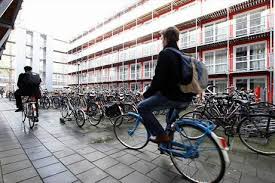
Keetwonen student apartments –
       One libertarian option is just to classify these as temporary structures, which they obviously are, and get all building regulators off them.

http://howtobuildashippingcontainerhome.blogspot.co.nz/

Labels: , ,


Tuesday, May 27, 2014

From the Register:

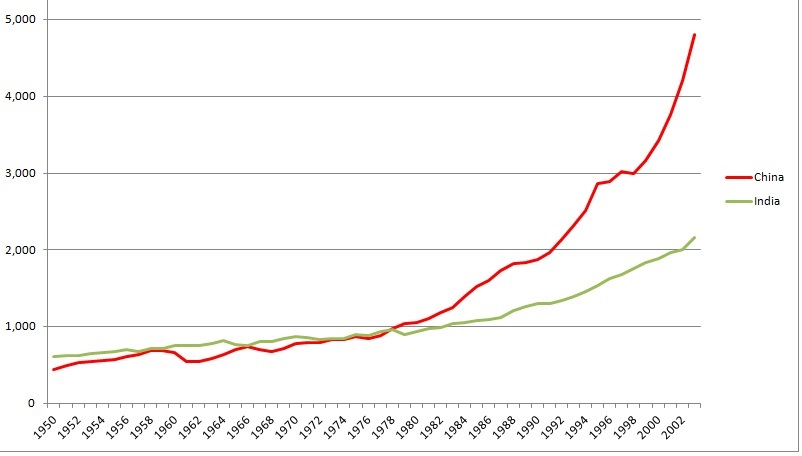
China will become the world's biggest economy this year, overtaking the United States in GDP. As the FT drily notes, "Most economists previously thought China would pull ahead in 2019."
So China powers on, at a greater pace than had been predicted by Western economic experts, who are supposed to know about these things. But our leaders still can't seem to figure out why.

   Which shows the power of compound growth.  Back in 2008 I discussed this, pointing out that at 10% growth gdp doubles in 7 years and that by 21 years from then (15 from now) they would have reached our current per person wealth.

    Of course we could have had such growth any time we wanted as I have been saying since starting this blog. Indeed since then I have come to the conclusion we could have grown more easily and faster than China, had the political parasites in charge wanted it. But they don't.

     The Register goes on to say why China is managing this - because they are competent people just as capable of innovation as we are (or were) which is true but not the whole story.

  The graphs don't cover exactly the same period, though the trend is unmistakable but if we take the 1990 to 2002 period electricity production goes up just under 3 fold and gdp went up just under 3 fold. Who woulda thought? Allegedly absolutely nobody in our political class (except in Holyrood where it is provable they know.

"In modern times the main driver of economic growth has been, and continues to be, energy" - Jim Mather, SNP minister. Jim was the only competent and patriotic SNP MEP but unfortunately has now retired.

Labels: , ,


Thursday, March 20, 2014

Newt on Minimum Wages

       This is from an article Newt Gingerich did recently.


    Not exactly an absolute correlation. Also one must make allowances for the variation in average national income - Greece & Portugal are less than half as well of as us so it is obvious minimum wage would have to be half as well (though this does rather make a nonsense of the theories that minimum wage laws either produce fairness or increase earnings. US minimums well below those of European states that they are richer than are also going to cause less interference in the market.

   In theory low minimum wages should do as little harm as no minimum wages because neither discourage people from paying the amounts of money real employers are willing to  pay.

   But overall there is a clear trend that those countries with no minimum wage laws, or with minimums, low compared to national income, have generally lower levels of unemployment.

   Who would have guessed?

  But it is better to have evidence. 

Labels: , ,


Friday, March 07, 2014

 This article now up on ThinkScotland. Please put any comments there.

Ending foreign aid? What if we ended Scotland's "aid"?

by Neil Craig

I READ an article in Der Spiegel recently by an African economist calling for an end to “aid” to Africa, and it got me thinking.

"Huge bureaucracies are financed (with the aid money), corruption and complacency are promoted, Africans are taught to be beggars and not to be independent. In addition, development aid weakens the local markets everywhere and dampens the spirit of entrepreneurship that we so desperately need.

As absurd as it may sound: Development aid is one of the reasons for Africa's problems. If the West were to cancel these payments, normal Africans wouldn't even notice. Only the functionaries would be hard hit. Which is why they maintain that the world would stop turning without this development aid....

“A portion of the corn often goes directly into the hands of unscrupulous politicians who then pass it on to their own supporters to boost their next election campaign.

“.....our politicians were overwhelmed with money, and they try to siphon off as much as possible.

The late tyrant of the Central African Republic, Jean Bedel Bokassa (pictured), cynically summed it up by saying: "The French government pays for everything in our country. We ask the French for
money. We get it, and then we waste it."

Which, shamefully, strikes home here. Turning down money isn't exactly easy but the comparison between Emperor Bokassa and our own politicians is fairly obvious as is the demand that ever more money be available for the special interest groups that our ruling cartel support. If the billions spent on windmills, quangos, anti-smoking officers and campaigns – and on our NHS, which spends 25 per cent more per head than in England but with worse health outcomes – normal Scots wouldn't notice either.

Rather than the hairshirt option of turning it down, how about simply not letting it rest in the bureaucrat's hands and pass it on to the people? This would allow the economy to grow (only the Greens publicly admit they want recession). As Scotland grows to be the richest and not, coincidentally, lowest taxed part of Great Britain we would see accounts moving into balance.

Thinking of “aid” I also recalled this article in The Scotsman:

SCOTS enjoy £1,300 more spending per head on public services such as the NHS and schools than the average UK citizen, official figures have shown.

Which reminded me of that Der Spiegel article and how it could be adapted for Scotland.
"Huge bureaucracies are financed (with the aid money), corruption and complacency are promoted.... If [Westminster] were to cancel these payments, normal [Scots] wouldn't even notice.
Only the functionaries would be hard hit.”

It is a matter of fact that our education system is now, for the first time in 700 years, not better than the English. Our NHS has considerably worse results than the UK average.

Despite the Scotsman article automatically starting off invoking NHS and schools the fact is that we spend an awful lot on more per head on the quangos that Jack McConnell and others promised a "bonfire of" and on ecofascist parasitism.

£1,300 per head – to nitpick that is the UK average which contribute to - for a pure rest of the UK, without Scotland that is a £1,420 differential. With a population of 5.3 million that gives us £7.5 billion to spare if we decided, as a nation, that we could get along with the same state spending they do south of  the border.

There may be an argument that in some departments we need a bit more (pensions for example because we have a more aged population) but that should inevitably be generally balanced by correlated patterns (schooling because we have a more aged population), though the departments involved and their sock puppets never seem to make the latter arguments. Still - £7.5bn must be close to the mark.

We could do that simply by deciding that any Scottish department which costs more per capita than the southern average has a hiring freeze and a freeze in increased payments until the entire government is matching the UK average. That would mean a roughly 5% average cut in employees, as retirees are not replaced, and a cut in other costs matching inflation – we would get down to average costs well inside one parliament. This would also give those in the more competent government departments an incentive to point out wasteful spending elsewhere since the sooner waste is cut the faster the balance point is reached.

So what to do with £7.5 billion?

We will soon be able to cut income tax by 10p rather than the original 3p "tartan tax". That comes to
about £3.5 billion.

Though Scotland doesn't have the direct power to change corporation tax Professor R. Macdonald sometime ago wrote of "Scotland's hidden tax cutting power – that we do have the power to provide rebates on taxes. The UK raises £43bn in corporation taxes so Scotland must be about £3.6bn. Corporation Tax, because it is a tax directly on wealth creation (not for example on wealth possessed) is the most directly destructive of such creation. Giving a rebate of 50% would make our economy as attractive to investors as Ireland’s was during its two decades as a "Celtic Tiger" economy growing at 7% a year. That rebate would cost us £2 bn.

Let’s say a 20 per cent cut in business rates. Again that gives us a substantial economic competitive edge. About £500 m.

That's £6.0bn out of £7.5bn.

Maybe we don't cut completely to match UK averages. Maybe my figures turn out to be wrong but that still leaves wriggle room. Maybe we put it into a £200 per head payment (as Alaska does). Conceivably we put it into some of the technologically progressive things I have suggested before (X-Prizes, educational prizes, the Scottish Tunnel Project, automating railways).

Does anybody doubt that "normal Scots" would notice a 10p cut in their income tax. Or in being part of a successful fast growing economy? Or indeed, that we would not notice the decline in the number of governmental busybodies telling us what to do.

The one fly in this ointment is, as has sometimes been pointed out though not quite in such terms – that if we spend our bonus in a way which actually makes us better off and grows the economy the English would notice and take the Barnett formula bonus away from us. But who cares – if we had the successful fast growing economy that is being paid for we would be paying enough tax to match, or exceed the differential we now get via Barnett so there would be no "bonus" for us to fight over.

And by proving that even a little free marketism (this article says nothing about cutting the fuel poverty government has created or the massive costs of regulatory parasitism) we would give an example to the rest of the country and once again be admired as go-getting Scots, as we were for most of the last three centuries, rather than whinging Scots as our present political class have made us.

Labels: , ,


Wednesday, February 26, 2014

Constitutional Amendments 19 Banking Liability

     Limited liability companies are one of the social inventions that made entrepreneurialism possible. By limiting the liability of shareholders to their investment it became practical for large ventures that few individuals were able to afford possible. By comparison in partnerships every partner is liable for all the losses another partner makes. So long as those trading with them knows it is a limited liability company, which is why it is a legal requirement companies use the term "ltd" on correspondence, they know the risk they run.

     However banking is a different matter. Banks have to be big to be stable (though probably not "to big to fail"). However currently banks own your money as an asset & their debt to you is a liability so if they go bust you will, by definition get only so much in the £ back, or would if governments didn't bail them out. Worse than that, because it is limited liability, the managers can walk away or even, as the Fred Goodwin case showed, keep their pensions or assets which have been removed from the bank before it collapsed. This creates what is known as a moral hazard - that there is an incentive to take unjustified risks because the benefits of risks go to the managers, in the form of bonuses and promotions, but the costs are borne by society.

    So I think we should at least roll back the limitations on liability for those looking after people's money.

      Dan Hannan suggests this:

      reform would be the one backed by Steve Baker MP and the Cobden Centre, which is being introduced on Wednesday as a Ten Minute Rule Bill by the leader of Direct Democracy's Westminster wing, Douglas Carswell. Essentially, Douglas wants to amend the law so that depositors remain the owners of the money which they place in bank accounts. Currently, contrary to widespread belief, such assets are legally the property of the bank. Douglas's reform is to be recommended on several grounds: as a consumer protection measure; as a way of removing a peculiar legal exemption enjoyed by banks, but by no other businesses; as a prophylactic against the credit booms that precede recessions.
    
     The major, still current, example of a massive unlimited liability financial organisation is the Lloyds insurance organisation, which did indeed go bust some time ago and a number of Lloyds "names" (people who have guaranteed their assets for a share of the business profits) did indeed lose heavily, but the organisation survived.

      I'm agnostic as to how far we should go in increasing bank liability - having deposited money remain the property of the depositors so that in the event of failure they get it first/ making directors of banks financially liable for losses/ making shareholders (actually partners) liable up to a set value per share/ making them liable to an unlimited extent - but any of these steps would act as a greater or lesser discouragement of the moral hazard of casino banking and encouragement to fiscal conservatism by those responsible for people's deposits.

     In turn this would be negative feedback to the sort of boom and bust cycles we have recently seen.

Labels: , ,


Friday, December 13, 2013

Rail Costs - the Facts

     As I have said before I think there is a place for rail, if we get it running fully automated, with lighter vehicles and a braking system that would allow trains to run close together. All of that is currently technologically possible. If not probably best to tarmac them over and call them roads.

    This, from Transport Watch, is a listing of current technological specs. It is damning:

1. Capacity and use
(a) Rail has one third to one quarter the capacity to move people compared with motor roads managed to avoid congestion - go look at Waterloo.
(b) National Rail carries an average flow per track equivalent to only 300 buses plus lorries per day. It is difficult to find a minor road anywhere in the country so lightly loaded in terms of vehicles.
(c) The density of use achieved by the National Rail system is one third to one fifth that obtained from the Motorway or from the Trunk road and motorway network.
(d) Only 3% of passenger journeys go by national rail corresponding to just 6% of all motorized passenger miles. (Now, August 2013,  7.5%)
2. Energy consumption
In 2003 the fuel consumption of national rail in the UK was equivalent between 280 and 298 million UK gallons of diesel - passenger rail returning 115 passenger-miles per gallon and rail freight 181 tonne-miles per gallon, ignoring the drag in and out to the rail head, and 144 tonne miles per gallon if the drag in and out is 10 miles at each end of the line haul. In comparison:
(a)  An express coach may return 10 miles per gallon in uncongested conditions. With 20 people aboard that yields 200 passenger miles per uk gallon
(b)  A lorry may return 8 miles per gallon and deliver and average of 15 Tonnes (30 tonnes out back empty). That yields 120 tonne-miles per UK gallon
Applying those values to the national rail function yields 222 million gallons - 20-25 % less than by rail.
New data is available at facts sheet 5, leaving the conclusion in tact
3. Journey lengths, speed and fares
(a) Dividing passenger-km by passenger journeys available from Transport Statistics Great Britain yields an average passenger journey length of 41 km (25 miles).
(b) The 2004 National Travel Survey data shows that 50% of passenger rail journeys are less than 30 km (19 miles) long and that 90% are less those 120 km (75 miles) long. For most of those journeys the express coach, given the right of way, would match the train for journey time particularly after taking account of a service frequency up to 12 times greater.
(b) Fares by express coach are often a fraction of those by train despite the coach paying taxes and making a profit. If rail were to operate without subsidy fares would have to double at least without loss of passengers.
4. Safety
The railway lobby has embedded in the public mind the notion that rail is overwhelming safe compared with road. That has been achieved by (a) ignoring usage, so exaggerating the relative safety of rail by a factor of 18 and (b) comparing passengers killed in so-called "train accidents" with all those killed system-wide on the road network. E.g.
In contrast to that we find that (a) if ordinary traffic, void of motorcycles, pedestrians and cyclists were to be transferred to railway alignments, then the deaths per passenger-km (the death rate) would be similar to, or below, that imposed on society by the railways and (b) if rail passengers transferred to express coaches using rail's rights of way the death rate suffered by those passengers would be halved - see facts sheet 2  (This now out of date.  We now believe deaths to passengers are so few in number and so variable, by either rail or express coach as to make comparisons impossible, See facts sheet 2)
5. Widths and headroom  (See Facts sheet 3)
Despite many examples of successful conversions the railway lobby pretends railways are too narrow and lack adequate headroom to be converted to roads. The reality is that although greater widths may be desirable:
(a) A two-track railway typically offers room for a UK standard 7.3-metre carriageway with one-metre marginal strips but no other verges.
(b) On the approaches to towns and cities there is often room for a dual two or three lane highway.
(c) Where there is overhead electrification headroom would often be adequate for a triple-decker.
6. Costs
(a) The annual capital cost of rail passenger rolling stock is 3 times as high as equivalent floor space in express buses.
(b) Track maintenance for rail costs are between 5 and 10 times that required by road transport.
(c) The cost per track-km of the West Coast Main-Line Modernisation programme is 10 times higher than the cost per lane-km of building the M1 built from scratch including the cost of land.
(d) The net tax revenue per lane-mile for the Motorway and Trunk Road network has the range £(275-360) thousand per year. In contrast the 20,000 miles of rail track is being subsidised to perhaps £5 billion per year or at the rate of £250 thousand per track-mile.
(e) The rail Modernisation Programme was to cost over £60 billion. Its target was to increase passengers by 50%, e.g.. from 6% to 9% of passenger-km, and to increase rail freight from 11% to 17% of tonne-km. However, that could have only a negligible effect on traffic - reducing growth from 15% to 13% over 10 years. Further, despite the Government's guarantee Railtrack's share price collapsed prior to receivership. Hence, in purely financial terms, the £60 billion was and is being almost entirely wasted - equivalent to burning the residential accommodation for a city of 1.5 million people.
(f) In contrast, replacing the railway lines by a road surface managed to avoid congestion would cost at most £12 billion. The effect would be to offer faster journey times for all but the longest journeys at fares a fraction of those charged to most by rail passengers.
For more detail see the facts sheets 7 to 9
Wp ref. Website/Topic 2
PDF: 
 
 
 "a unit cost of £12.5 million per track-km. (Source is the SRA).

Alternatively .... (at decade old prices) ..... the cost of the national programme had the range £(6.25-8.7) million per track-km.

In contrast to that the Independent of 17th February 1999 reported a Treasury study which estimated the replacement cost of the M1 as £2.1 billion for all works and land, or £2.5 billion at 2007 prices.  The lane length, assuming 6 lanes all the way from the M25 to Leeds, is 1800 km. Hence the cost is £1.5 million per lane-km......

Furthermore the motorway and trunk road network is used 2.5 to 3 times as intensively as is the national rail network despite the latter having the advantage of serving the hearts of our towns and cities.  That widens the cost advantage of road to a factor in the range 12.5 to 30."

Labels: , ,


Tuesday, November 12, 2013

How To Limit Immigration, Without Racial Quotas And In The National Interest

"IN TIMES of austerity, travel documents come cheap. Portugal is the latest of several European countries to start selling visas to foreign investors; others are slashing their prices. These schemes grant the right to live and travel within the European Union. A passport often follows a few years later.

Christian Kälin of Henley & Partners, a consultancy, says Portugal’s Golden Residence Permit is the “most attractive in Europe”. It needs investment of €1m ($1.3m) in financial assets over five years, €500,000 in property or the creation of ten jobs. Spain is mulling a “golden visa” at the same price. Ireland asks for a donation or investment of €500,000 (it cut this from €1m in July).

Five countries will provide the right kind of investors with passports particularly swiftly. Two are in the EU: Austria and Cyprus, where the cash-strapped government has just cut its price from €10m to €2.5m. The others are Caribbean: St Kitts and Nevis, Antigua and Barbuda, and Dominica. Their passports bring not just camouflage but also some handy visa-free travel."

     Is there anything wrong with this.

     In my opinion only that the citizenship it sells is for the entire EU but the selling is done by individual countries.

     I can't see anything wrong with the principle indeed why not take it further. UKIP policy is to permanently allow net immigration of 50,000 a year, but we want to select for the skilled and those likely to be net contributors to the economy.

     Why not auction off these 50,000 citizenships? The people buying them are highly unlikely to be welfare dependents. They are likely to have some substantial economic talent, even if it is only salesmanship.

     I might add they have to pass an IQ test putting them half a standard deviation above average IQ (ie 106) but that may just be me. However it would be in the genetic national interest without having any racial connotations that anybody who does not accept any IQ differences between races could object to. And obviously it could not include the right to bring in other family members for free.

      Since the more of something you have for sale the lower the price you have to accept  I don't think we would get as much as the $250,000 (£150,000) people pay to become citizens of Antigua but I would expect it would settle at between £50K - £100K. If we make the IQ qualification I suggest the price would automatically be lower.

      In libertarian terms it also solves an ideological problem. Most libertarians have never accepted citizenship as a property and thus been dubious about any limits on immigration but if people are buying and selling it then, by their definition, it is property and fits the theory.

      What to do with the £2.5 - 5 billion?

     I suggest investing the lot in the Aquarius floating island concept developed by the Millenial Foundation and powered by ocean thermal power (OTEC). Prices are not fully determined but should come in at no more than £2 bn per island with a potential population of 100,000. such islands can, incidentally, provide enough algae grown high protein food to each feed millions of people and as previously described, building them would provide dockyard employment.

Labels: , ,


Saturday, October 26, 2013

Energy From Shale Can Grow Immensely Whenever Allowed

  From a couple of new posts on the GWPFl

This graph shows how the shale gas industry is taking off in the USA

  OK these are North Dakotan and Texan fields but they account for 75% of US growth.

  Note that this rise started in 2010m the year our "supporting shale" coalition government came to power. This is a nearly 10 fold  growth rate in shale over the period. Does anybody doubt that we could have done the same if the Tories had supported it, or that we would have achieved growth if that had happened. Or indeed that Grangemouth would have been booming if it had had access to shale, though to be fair to the Tories, Scotland has its own government and the SNP say  “In Scotland, with our renewable potential, we don’t need the hassle” - less active in saying they were actively avoiding the hassle of having people employed in Grangemouth but clearly they are.

    I did report a previous graph which showed the then, by previous standards, spectacular growth from 2007-10, which now looks pretty ordinary (but exceeded the growth rate they expected to continue).
       Another sign of how progress rates tend to be underestimated, even by me.

     And this article reported by GWPF proves my point. It comes from somebody who I am sure thinks himself a technological progressive but who I think is being overly restrained in his vision.

“If we have the courage to do big things, all of humanity has a fine future. Everything is possible with energy.”

.... says Lawrence M. Cathles, Cornell professor of earth and atmospheric sciences.

“In spite of our apparent environmental problems, we stand a remarkable chance of achieving solutions,” he says. “Societies all around the world are living longer. We have more access to food, clean water and energy… and we’ve never been more healthy.”

Cathles outlines his optimism about the world’s prospects for sustaining the human population in an environmentally responsible way in his article, “Future Rx: Optimism, Preparation, Acceptance of Risk,” in a special publication of The Journal of the Geological Society, released Oct. 24.

“If we have the courage to do big things, all of humanity has a fine future,” says Cathles in the article, which addresses food sustainability, natural resources and energy levels, and what he calls the “Grand Challenge” of the next century for everyone to achieve a European standard of living. In his paper, Cathles proposes a path to achieving that standard.

Today the world hosts 7.13 billion people, and Cathles says that while humans are living longer, the world population will peak at 10.5 billion about 100 years from now. The most essential resource is energy, and today most of the world uses less than 2 kilowatts of power per person (for heat, lighting, transportation and manufacturing), while those at the European standard of living (the average French or German citizen, for example) use 3.5 times more. The world currently consumes energy at the rate of 15 trillion watts (15 terawatts), with 86 percent from hydrocarbon sources.

Meeting the Grand Challenge would require energy production of 50 terawatts today and 75 terawatts 100 years from now, ideally all from zero carbon energy sources, says Cathles. Growing from 15 to 75 terawatts over a century requires a growth rate of 1.6 percent per year, which is modest, he says, compared with the U.S. growth rate of 2.6 percent over the past 50 years and China’s recent 12 percent growth rate and their planned growth over the next 10 years of 7 percent annually.

The lion’s share of the power expansion could be met by wind, solar power produced in deserts or nuclear; but by far the least environmentally intrusive, feasible and realistic option is nuclear, he says. The oceans have enough dissolved uranium to sustain 10.5 billion people at a European standard for more than 100 centuries, and the extraction footprint would be tiny.

Everything is possible with energy, nothing is possible without it,” says Cathles.

    A growth rate in energy use far in excess of 1.6% is easily possible as he effectively admits by mentioning China. The mention of wind and solar is merely arse covering - nuclear is it, with a side order of shale (though improvements in solar efficiency means it is not as useless as it seems.

    But the important thing is that he acknowledges the obvious last line. Obvious to intelligent people, but not to the ruling class of the western world.  

Labels: , ,


Tuesday, October 22, 2013

Morbid Obesity Costs Twice As Much As Trident

   James Dellingpole has a highly amusing post today about government waste  £5 billion a year:
    

In the 1980s, the Judge Dredd strip in 2000AD ran a series of stories about the League of Fatties – people so grotesquely obese that they could only waddle around with the help of a trundle wheel supporting their enormous bellies. Back then, in our innocence, we thought it was dystopian satire…
If you haven't yet read Max Pemberton's Spectator cover story Obesity Is Not A Disease I urge you to do so. It describes a social problem of quite grotesque, wobble-jowled, saggy-bottomed enormousness: the vast sums of money – £5 billion a year – being funnelled from our pockets in order to pay for the extra healthcare costs of the clinically obese.

And we're not just talking pleasingly rotund, or "carrying a little bit of weight girls", here.
Take the East Midlands Ambulance Service. It emerged this week that it has been picking up so many fat patients — weighing in excess of the 28-stone maximum — that it needs a new fleet. It has, hitherto, been struggling along with just one ambulance for fatties (a ‘bariatric’ vehicle), but now thinks all 272 of its ambulances need to be upgraded with double-wide stretchers for patients who (it says) can weigh in at 55 stone. The plan will cost £27 million.
.....Here's how that process of cause and effect should work with obesity: you eat too much, you get fat; your food bills rise to accommodate your expanding girth; so too does the cost of your health insurance, both to cover the extra cost of your "bariatric" specialist treatment and also because you are that much more likely than a thinner, fitter person to require medical care; also, people will hate sitting next to you on aeroplanes, only fellow fatties (or the odd thin person, maybe, with a bear fetish) will want to have sex with you, you will probably smell more and die younger. In a free country you will, of course, remain as free to get as fat as you like. But there will be consequences for your actions in the form of mild social opprobrium, increased financial penalties and so on. Thus, without any meddling or hectoring or needless expenditure from the Nanny State, fat people will be encouraged to get thinner because they will find it in their best interests to do so.

What our current socialised healthcare system does, unfortunately, is to remove this vital connection between cause and effect. Not only are the obese cushioned from the financial consequences of their wanton self-indulgence but they inhabit a culture so in thrall to the idea of victimhood, so fearful of "judgementalism" and so wary of causing offence that it doesn't even dare hint that there might be a problem with being fat.

This cannot end happily. It won't end happily. When future historians come to survey what it was we did wrong before the Great Collapse, one of the details that will tickle them to the point of incredulity is this: that with Britain's national debt fast approaching 100 per cent of GDP, and with the NHS approaching breaking point, it was yet considered good practice for the state to spend £5 billion a year it hadn't got – not to build a new airport or finance a nuclear power station but simply to enable millions of fat people to go on enjoying their apparently unalienable right to stuff their lardy faces at Greggs and McDonald's."

     The solution is obviously not eating. Somebody who is bedridden by being 55 stone is clearly being fed by somebody else.

     The libertarian answer would be to let them choose to give up or die and would work one way or another.

     The authoritarian one is to arrest the feeder for abuse. Perhaps also fitting them with an electronic collar that would give a small shock any time they swallowed more than a set amount. That would work & keep them alive.

     This is an example of how wealthy we are as a society & how when nothing else can harm us, we have become a self-harming society. This is a fact via Tim Worstall which I have waited for an excuse to use and this is certainly it:

      "In 1870 the daily wages of an unskilled worker in London would have bought him (not her: women were paid less) about 5,000 calories worth of human, not horse food: not oats (although Scotsmen would disagree) but bread--5,000 wheat calories, about 2½ times what you need to live (if you are willing to have your teeth fall out and your nutritionist glower at you). In 1800 the daily wages would have bought him about 3,500 calories, and in 1600 2,500 calories. Karl Marx in 1850 was dumbfounded at the pace of the economic transition he saw around him. That was the transition that carried wages from 3500 calories per day-equivalent in 1800 to 5000 in 1870. Continue that for another two seventy-year periods, and we would today be at 10,000 calories per unskilled worker in the North Atlantic today per day. Today the daily wages of an unskilled worker in London would buy him or her 2,400,000 wheat human-food--potato--calories. Not 10,000. 2,400,000. That is the most important fact to grasp about the world economy of 1870. The economy then belonged, even for the richest countries, much more to its past of the Middle Ages than to its future of--well, of you reading this."

     By that standard, and it is a good one, we are all 1,200 times better off than in 1870.

     Nobody in the Middle Ages could afford to be 55 stones. Another, even more demeaning effect is that nobody but a king could afford to kidnap and feed 3 girls without anybody noticing as American bus drivers now can.

     I maintain that a wealthy society is far better than a poor one but no silver lining is without a wisp of cloud.

     But on silver linings I commented on Dellors saying what we could do with the money wasted on this:

     " Brilliant article James.
Much needed.
Imagine what we could do with £5bn a year

Build 8 x 1 GW nuclear plants each year for free,
Cut Corporation Tax by 40%
Cut Income Tax by 1.5p
Put it into a Space X-Prize Foundation and get space development 12 times what NASA gets.
Build 5 OTEC powered floating equatorial islands annually, which would each produce enough algae to feed 10 million hungry people annually.
Build HS2 in 16 years or preferably a Hyperloop in 2.
More than match all the money spent on research on stopping/reversing aging worldwide.
At £20K each, build 250,000 new modular houses annually.
A fair trial and hanging for 50,000 government parasites, war criminals, child abusing "professional carers" and pensioner freezers annually."

Labels: , , ,


Friday, October 18, 2013

An Energy Policy to Get Out Of Recession

   I am proud to present Mike Haseler's speech and graphs from his recent talk at UKIP Glasgow's Getting Out Of Recession discussion here and here. It starts with the basics and goes on to prove, in my opinion, the virtual total correlation between energy use and growth, which I regard as a significant contribution to economics :

An Energy Policy to Get Out Of Recession

By Mike Haseler 

  • In this talk I will outline an argument that a good energy policy is not only critical to get us out of recession but that energy is so intrinsically linked to GDP that energy policy more or less dictates how our economy performs.
Energy
  • My five year old son said: “ENERGY IS THE POWER TO MAKE US DO THINGS"
  • Coriolis introduced the idea of energy being the work done.
  • Work is things such as lifting a weight up or e.g. the work done by a weight dropping. For example the weight in an old clock does so much work or a certain weight of water turning a water mill.
  • With the development of steam power, people began to realise that burning things to produce heat was also a way of creating energy or replacing the work done by a human or animal turning a wheel.
  • At first people like the Luddites thought that all this "cheap labour" produced by burning wood or fossil fuels like coal was a "bad thing" because in effect coal was a cheap labourer replacing the more costly "food powered labourer".
  • That did not happen.
  • Replacing human labourers, by machinery did not end the need for human labour. In the industrial age, mankind's labour was needed in addition to machinery.
  • We had "human machines" whose energy derived from food. And machines producing work, first from water & wind, and then the cheaper coal and eventually gas and oil.
  • Both machines and humans "work".
GDP
GDP or gross domestic product can be measured or more accurately estimated, by a number of techniques. For our purposes the best measure to illustrate the point is that:
  • GDP is total (inflation adjusted) earnings from work (+ a few others)
  • Rising GDP is an indication of a prosperous economy. In other words when GDP is rising even allowing for inflation, we are all earning more and more or to turn it around, we are all spending more and more.
  • But what does this really mean?
  • The key to understanding GDP, is to understand how inflation is calculated. This is done by calculating the cost of a "basket of goods" which is thought to represent the cost of goods purchased by the typical household.
  • So, if the cost of this basket increases, inflation goes up (seldom comes down).
  • So, another way to describe rising GDP is that on average we can all purchase a bigger and bigger basket of typical goods.
GDP & Energy
  • Both energy and GDP are related to work.
  • GDP is the goods the average person can purchase on an average income.
  • Energy is the work done by a unit of energy ... which at one time was the average work by a person.
  • GDP is earnings from the work done by the average person.
Why Energy increases Prosperity
  • A long time ago, the work done in the economy was entirely human.
  • That work was powered by food.
  • The energy per adult male was about 2-3000 calories per day (c10,000kj or 10megajoule) (about 100ml of petrol.)
  • Then about a million years ago, man stumbled across fire - the energy available increased and so did our comfort.
  • A couple of thousand years ago, that energy increased still further when we domesticated animals. Animals could labour in our place or in some societies slavery increased the work done per "citizen". Those labourers had to be fed - our energy demand increased alongside increased prosperity.
  • So, even before money, energy was adding to prosperity.
A side issue Correlation
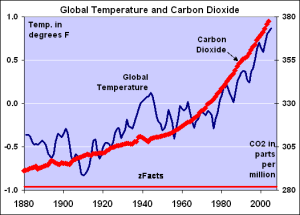
  • We have all heard that some warmist say that they "are certain" manmade CO2 caused the 20th century temperature rise.
  • They mean CO2 levels rise was "correlated" with global temperature rise (Fig1).
Enerconics1_html_m544c8644Fig 1: Caution: The match of the CO2 and temperature graph above is somewhat deceptive. Since one is temperature and one is CO2
  • this is not exactly convincing.
  • Much of the global temperature change such as the 1940 bump is unexplained by changes in CO2.
The graph is bogus
  • graph is in fact entirely bogus.
  • no reliable CO2 data before 1958, so that portion of the graph is entirely fiction.
  • Effect of CO2 is much smaller than suggested.
  • Actual rise due to CO2 greenhouse warming is as shown below (blue line).
  • The graph breaks down after 1998 as shown by my graph #3.
Enerconics1_html_m7a832eb9Fig 2: Real relationship - not known before 1958 and much less after
Enerconics1_html_41d9e56Fig 3: ... and relationshop breaks down after 2000
GDP is energy
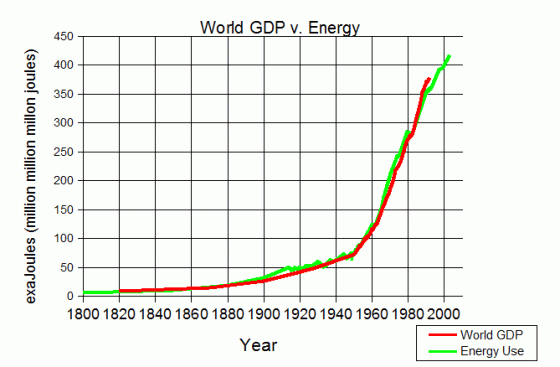
  • World GDP and world energy show a much higher degree correlation.

Enerconics1_html_m68263661Fig 4: World Energy. (in exajoules) versus worldGDP (scaled to fit)
Enerconics1_html_73710a2
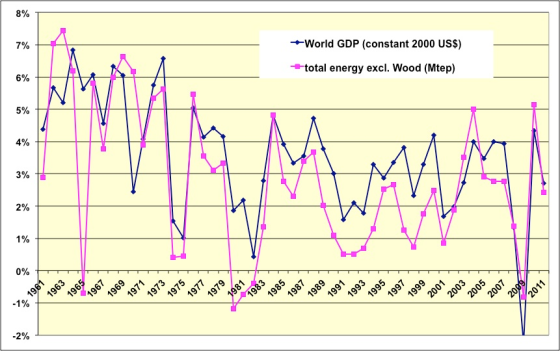
Fig 5: Change in world GDP against change in energy usage
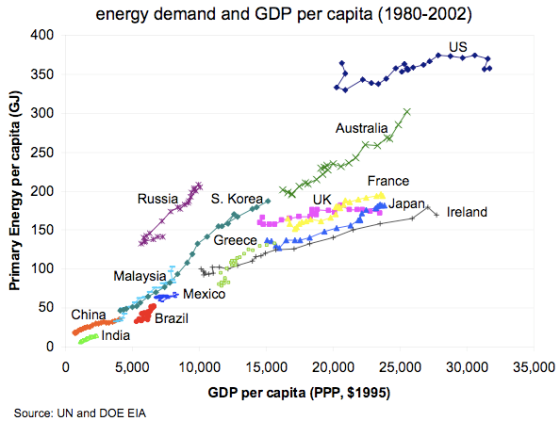
Enerconics1_html_2fc8ea1bFig 6: GDP per country versus energy usage
  • As world GDP (blue) rises and falls, total world energy use (pink) also rises and falls in sync.
  • And if we look at Fig 6 we see that GDP per capita rises the more energy each country has.
  • This shows that for all reasonable purposes Energy is a proxy for world GDP. In other words if GDP rises, energy rises, or if energy usage rises then we should expect GDP to rise.
Enerconics1_html_629264eFig 7: Changing energy use and GDP for selected countries
  • As fig 7 shows, there is a natural increase in energy use as countries increase GDP.
  • Or is it the other way around? Does rising energy availability lead to rising GDP?
Enerconics1_html_43888f0e
Fig 8: Cost of meterials against energy in production
  • graph shows energy used in producing materials is very closely linked to the cost.
Energy use does not increase as a result of rising GDP,
but rising GDP and rising energy use are the same thing!
The problem with Green economics - destroy the economy to "Save the planet"
  • Long known that we cannot have GDP growth without growing the availability of energy.
  • Usually, argument is: we must reduce economic activity to "save the planet".
  • What happens when we reduce energy usage?
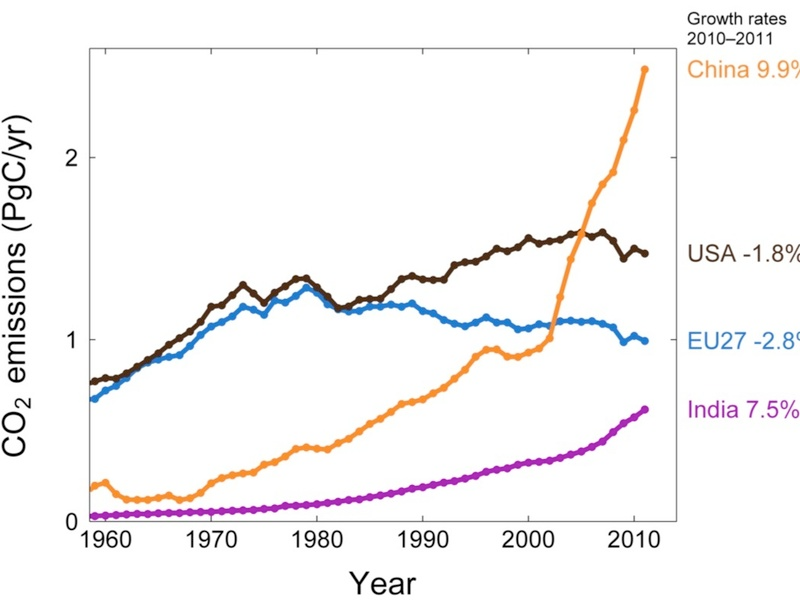
  • Looking at energy use of the USA, China, India and the EU from 1980, only the EU has seen a drop in energy usage
Enerconics1_html_1141c965
Fig 9: Energy Usage of USA (brown) EU (blue) China(Orange) India (purple)
  • And what has been the effect on GDP?
  • GDP has gone down
Enerconics1_html_m4289fcb2Fig 10: GDP (inflation adjusted) for USA (blue) & EU (orange Kyoto signatory) and India (yellow) & China (green) which were not obliged to cut CO2 under Kyoto
The problem with green economics - CO2 is not a problem
  • Global temperature has not risen in last 16 years
  • Severe weather has not increased
  • CO2 is an essential plant food which increases agricultural output
  • Moderate warming as we expect from the greenhouse effect of the small increase in CO2 is overwhelmingly beneficial ... as anyone with a greenhouse will know! ... particularly in Scotland.
  • So, the anti-capitalist argument of "destroy the world economy to save the planet" is just hogwash.
The problem with green economics - Energy saving schemes don't work
  • The reason for this is obvious when we understand that energy and money are two sides of the same measure.
  • However in practical terms, all saving money from e.g. insulating our homes does, is to save us money.
  • What do we then do with this extra money?
  • We spend it .... on goods which have taken just as much energy to produce as the energy saved.
  • So ... just the same amount of energy is used ... just in a different place.
The reality of energy and economics - money is stored energy
  • Rising GDP means we can all afford to buy a bigger and bigger basket of the typical goods.
  • Those goods take energy to produce. For food, that energy is largely natural. For manufactured goods, most of that energy is from fossil fuels.
  • The energy used to produce goods - the "stored energy value" of e.g. a "Mars bar" or an apple, or even a simple steel knife, set by energy costs in manufacture.
  • Whilst energy use may vary between manufacturers.
  • In a free market, all other things being equal we choose the lowest cost goods.
  • The cost of goods is largely determined by the energy use
  • In free market we choose the goods using the lowest energy to produce.
From this I think we can draw three conclusions:
  • In a free market, the cost of any good largely reflects the energy used in producing that good.
Therefore because free markets encourage the lowest priced goods.
  • In a free market, the energy used in producing any good is minimised.
The cost of energy, whether food like wheat, oil, coal or wind is mainly determined by the goods used in producing the means to harvest the wind and the process of harvesting it. And as the price of those goods like steel for windmills is largely determined by the energy used in their production it is almost certainly true that:
  • If any energy source per KWH costs more than the average market price for energy in KWH, then the energy consumed in producing that energy is greater than that produced.
  • Rather than a free market being wasteful ... free markets are the best way to ensure maximum energy efficiency.
  • Distortions to the market tend to reduce energy and economic efficiency.
  • The result is economic decline as we have seen in Europe.
How to revitalise the Scottish Economy:
  1. Stop politicians interfering with the cost of energy. Even if CO2 were a problem, because wind is so expensive, it is almost certain that more CO2 is produced as a result of this policy than without it.
  2. Stop wasting our money on wasteful wind.
  3. Stop trying to reduce energy usage
  4. Encourage fracking
  5. Encourage nuclear fusion.

Labels: , , ,


Saturday, October 05, 2013

How to Cut Government Spending 100% And Then Some

Government spending is to be £719 billion next year.

1 - Freeze civil service hiring, wages, promotions, benefits and require non-salary budgets to be cut 2% in each department for a year and fire 3%. This would cut, after inflation, salaries by about 11% and including benefits and budgets about 9% overall - £72 billion.

2 - Stop subsidisng fakecharities - save £20 bn.

3 - Fire useless quangos - £50 bn

4 - Fire the child "caring profession"/child buggering services - £20 bn.

5 - Hypothecation of pensions and the NHS i.e. that a set amount of national insurance and tax (probably combined into 1 tax)  is automatically set aside for these and run without political interference - OK this doesn't end the cost but it does make it non-governmental -
£144 bn for pensions
£130 bn for health
(In 2008 Income tax and National Insurance was £260 bn making up £95% of these 2014 figures so it must slightly exceed those 2 now. Any change in pensions/NHS spending would depend on a popular referendum to change these rates)

6 - Cut £10 bn from overseas aid - £10bn

7 - Stop subsidising windmills - £25 bn

8 - Government owned factory mass producing nuclear reactor profits - + £50 bn profit

9 - Fire 200,000 elfin safety inspectors (government budgets seem to be at least £100k per employee) - £20 bn

10 - Fire the same again of other useless government inspectors - £20 bn

11 - Allowing shale gas to be produced and pay the current 30% extra tax - est +£30 bn - granted this is a new source of revenue not spending cut but it has the same effect on other taxpaying

12 - Quit the EU and end our direct payments - £16 bn

total so far £607 bn

13 - A second year of #1 (9% less than 1st year as starting for 9% lower base) - £65bn

14 - A 3rd year of #1 (out of a 5 year Parliament) - £58 bn

Total £730 billion. So we come out with a profit of £11 bn.

OK, OK, not entirely serious - I'm going for general effect not accuracy. I have been doing a fair bit of double counting - if you have already closed down quangos and inspectors you can't save more by cutting them another 9%.

But far from non-serious either.
I have taken no account of the greatly increasing growth we would get from cheap nuclear and shale; cutting destructive regulation; and the multiplier effect of this wasted money being released by tax cuts.

AND THEN THERE IS ANOTHER SPECTACULAR EFFECT

A 10% growth rate, which I have repeatedly shown is possible if we go for it, means government can produce 10% more money each year which has to be spent somewhere, without any inflationary effect whatsoever (indeed not doing so would be recessionary by making money scarcer than the goods it represents). UK money supply was £2,200 bn in 2010  (say £2.4bn by 2014) so that means it would be expected to print about £240 bn in the first year and growing proportionately to gdp thereafter . That would pay off the national debt in 4 years, (£240 + 264 + 290 + 319 = £1,113 bn).

 Then we would have to actively find ways to spend it!

Labels: , ,


Friday, October 04, 2013

Scottish X-Prizism & How To Improve Our Standard Of Living

      This is the X-Prize Foundation site. http://www.xprize.org/

      They have a number of relatively small prizes on offer. The biggest one seems to be the Google lunar lander one. Worth $30 million. They have 4 other active ones. So in total it is offering under $50 million (£30 million).

      So a very small action on the British government's part would be to offer to award an extra 50% to any winner that was a British company. In theory that could cost £15 million but in practice odds of all 5 being won by British companies or organisations would be to small to measure  even if we were the world leader in most sciences.

       It is even something Scotland alone could do. The odds of us having to pay out anything would be up there with the odds of a windmill running 24/7.

      But it would encourage scientists to move here.

     And it would encourage countries worldwide to look at prizes as a concept.

      I haven't changed my mind about wanting to spend 4% of gdp (app £65 bn) on prizes. But start where you are.
--------------------------------------------------

This comment on John Redwood. He had asked for ideas on how to reduce the cost of living for ordinary people. Although he didn't put a comment on it, it took 2 days for it to be posted which usually means it was severely critical of somebody (not in this case) or that he was looking closely at it:

http://johnredwoodsdiary.com/2013/10/01/the-cost-of-living/#comments

"I agree about cutting electricity costs (90% is possible) and housing (at least 3/4 state parasitism).

Nursery care in Britain costs 40.9% of average wages, an enormous burden. In Estonia, a very libertarian nation (also an EU member so for once they aren’t to blame) it is 6.6%. This can only be our regulatory parasitism. How about allowing an unregulated “child minding” industry and let parents choose whether they want regulated or not.

There are 200,000 elfin safety mafia. The rule of thumb is that each state inspector cost industry 20 times what they cost government so that is 4 million worker’s work destroyed. 18% of gdp. In turn, since wealth is correlated to safety that means they kill 1,000 times the 100 odd people they save annually.

I assume the government has at least another 200,000 regulators in other fields like environment.

A legal right to challenge regulations if they have a cost benefit ratio 4 times higher than in some comparable industry would exercise downward pressure on parasitism.

Automated rail would cut cost by about 1/3rd and more than double capacity, reducing fares and goods transport costs.

Go for land value tax with owner’s valuation and the right to buy at 3 times owner’s valuation. That would grease the wheels of progress.

All together that looks like it would more than double the individual’s disposable income even without cutting the 40% of gdp the state spends or making an allowance for increasing growth."

Labels: , ,


Sunday, September 15, 2013

"Caring Professions" Stealing Children - Probably The Most Obscene Political Parasitism We Have & One Of The More Expensive

   H/T Tim Worstall for leading me to this:

"Education Secretary says officialdom and red tape have prevented the authorities from stepping in to protect children and have helped grooming rings to operate.


He also condemns social services departments across the country for the “indefensible” practice of “decanting” problem children to far-flung homes, away from friends and family, and routinely located in some of the country’s worst crime hot spots. And he voices dismay at how children’s homes have failed to provide basic protection while costing taxpayers on average six and a half times
as much to care for a single child as it would cost to send them to Eton.


Mr Gove makes the comments, in an article for The Daily Telegraph, as his department publishes the most comprehensive information ever compiled about children’s homes in England.
 

The report, seen by The Daily Telegraph, exposes how councils in England are spending more than a £1 billion a year to care for fewer than 4,900 children. It calculates that councils now spend an average of £4,000 a week — or £208,000 a year — to place one child in a home, several times what it could cost to educate them at some of Britain’s top public schools.


In some cases the total amount spent is running at several times that level. According to the figures, one council — Bexley in Kent — spent more than £58,000 a week per child — £3 million each — on specialist privately run homes last year."

   From Michael Gove which says a lot about how much power ministers actually have, unless they are willing to go to the wall.

   Clearly our "social services" are out of control, some, like Bexley, further out than others.

   I have previously discussed this as a particularly obscene example of Pournelle's rule that "the purpose of government spending is to pay government employees and their friends, the nominal purpose is, at best, secondary".

    Relatively few children are taken seized by "professional carers" because they are being harmed. Indeed when they are really being harmed, overwhelmingly by a new, stupid and violent, boyfriend of the mother, who is acting on the same evolutionary drive that causes a lion to kill the cubs of its mate when they aren't his, because it increases the chances of his cubs replacing them. For some reason "professional carers" tend to steer clear of violent boyfriend situations and much prefer stealing children from law abiding, decent people.

     The fact that our "social work" class insists that in virtually all circumstances they prevent the real father looking after Baby P and his ilk is why this obscenity is repeated so often. The solution is obvious.

     What normally happens is that they are said to be "at risk", a classification that needs no actual evidence beyond the gestapo/social worker saying so (or occasionally an opinion from an "expert" who has been paid £25K for the opinion without having to go to the inconvenience of seeing the kid. In a number of cases the "at risk" definition has been proven not only corrupt but an entirely political charge made against UKIP, EDL or members of with unapproved political opinions - how long till somebody who doesn't approve of redefining marriage or total power to social workers is thus punished. Then they disappear into the "care" system, thereby ensuring continued employment and empire building by the "carers" and a life of abuse for the victim/care charge.

    Nobody seriously disputes that sexual abuse is not merely common but endemic within the "care" system and, as with the police who didn't investigate the Rochdale case because it was "a lifestyle choice" by the victims, this is nodded at.

   Nor is there any dispute that, by almost any definition of human failure - imprisonment, homelessness, drug abuse, alcohol abuse, illiteracy, unemployment, failure of their own children - those who grow up in "care" are deeply damaged.

   All of that not only justifies but demands that any civilised society get rid of these obscene "caring" parasites. A society that puts children in harm's way is not a society to be proud of.

    Even if the real parents aren't perfect - a certainty since who is - all of history shows they will be more caring of their own kids than those with no stake.

   I suggest:

A - All these cases should be investigated and in any circumstances where the kids want to go home (they must be free to say so not browbeaten by the presence of their tormentors)

B - In any case where a child has been taken into "care" officiously as an abusive act of overgovernment, the "carers" involved and the immediate boss who instructed them, should be fired, and never again be eligible for state employment. Ditto any "expert" paid to testify in support of grabbing children, when their report turns out to be false. there is also a case for suing such scum for fees, pay and indeed the harm they did.

C - From now on there should be an explicit duty of whistleblowing, affecting all "social workers" and police, that if they know, or are in a situation where "a reasonable person" (common legal phrasing) would know, of abuse, unjustified seizure of children or "expert" collusion, they have a duty to go public and if they don't are then also inelegibale for future state employment.

   My guess is that this would reduce child social work departments by about 90% while leaving in place almost everybody who had a positive role.
#######################################

   The other point here is the amount of money we are paying for this obscenity.

   Gove says £208,000 a year. However the number in care is far greater than that.

    It is 91,000 in the UK in 2012 (incidentally 89,000 when I previously reported so things are getting worse).

    That comes to £18.93 billion, one sixth of our entire national governmental deficit.

     Bear in mind that we can probably sustain a deficit of about £50 bn without increasing the national debt as a proportion of gdp.

     This is on the assumption that all 91,000 are being treated the same and on the more questionable assumption that all the costs of child departments of social workers are being counted. Thus the figure may not be exact but it is unlikely to be overcounted.
########################################

Scottish case:

"31 July 2012 there were 16,248  children looked after by local authorities, an increase of less than one per cent since 31 July 2011.  The number of children looked after has increased every year since 2001"

    That is 18% of the UK total, with 8.5% of total population (or taking England, NI and Wales alone at 74,752 - 22% in a population of 9.1% the size.

    It is, unfortunately, the experience that our government "services" tend to cost 25% more than the UK average (apparently due to "the freight" costs in the Highlands ;-) ).

   In which case the assumed cost in Scotland should be {16,248 X 204,000 X 1.25} £4,143 million.

   Roughly 1/8 of our total budget for something which not only does not add one iota to human happiness but adds a massive amount to the total of human misery.

   I can also call this #26 of my 24 point programme out of recession
######################################

   And, of  course, not only is this censored from our state broadcasting propagandists but they are actively assisting the parasites in extending their reach.

    This is the BBC pushing for these "carers" to keep their meal tickets up till age 26. Naturally the BBC censor any slightest hint anybody might not like that. And of the need to increase numbers taken, again, naturally with any disagreement censored.

Labels: , , ,


Tuesday, September 10, 2013

25 Point Programme Out Of Recession / Constitutional Amendments 18

   This is the 24 point programme I devised some time ago for getting out of recession, which no politician or economist has actually disagreed with, or endorsed:

http://a-place-to-stand.blogspot.co.uk/2011/11/we-could-get-out-of-recession-in-days.html

I'd like to add this 25th point:

25 - Make it illegal for government to give any money to any charity that, in the last 5 years, has advertised for more government. That isn't a charity's job and the conflict of interest is clear. Similarly make a legal requirement that any funding from outside the country of any "charity" that has pushed a political opinion be registered and subject to a 50% windfall tax - half of this money to be earmarked for organisations committed to reducing the size of government. In the same way, over the next 5 years, be 10% as much money as our state donated to pro-government charities should be donated to organisations promoting smaller government.

The same ban should apply to any government department, quango or council and they should be limited to spending not more than 1/2% of their budget on PR/press liaison /raising awareness or such activity under other names.

According to Chris Snowdens admirable report  on sock puppets"Between 1997 and 2005, the combined income of Britain’s charities nearly doubled, from £19.8 billion to £37.9 billion, with the biggest growth coming in grants and contracts from government departments (Smith and Whittington, 2006, p. 1). According to the Centre for Policy Studies, state funding rose by 38 per cent in the first years of the twenty-first century while private donations rose by just seven per cent".

This suggests donations to fakecharities was at least half of the increase ie £9.05 bn (£37.9-£19.8bn) and that this amounts to 38% of total funding of 138% which would thus be £32,9bn. Assuming only the same is being spent directly by government this comes to over £60 bn spent by government on advertising how much more of it we need. Since that comes to over half the budget deficit it is clearly something we could well manage without.

=======================================

I am also including this under CONSTITUTIONAL AMENDMENTS 18 since, by reducing the power of government to frighten us with their "endless series of hobgoblins, all of them imaginary (Mencken) would significantly improve quality of life and reduce the parasitic power of the state.


Labels: , , , ,


Sunday, September 01, 2013

Rich Countries Can More Easily Get Richer

  I have previously argued against a meme common to politicians in slow growing advanced countries - that it is easier for undeveloped countries to grow because they are simply "playing catch up" using technology already invented.

    History does not show that. Indeed it shows that while being developed/undeveloped is not the most important factor in growth (economic freedom & sometimes energy resources are) the general trend is that the less developed countries grow slower.

   If this were not so the disparity between the wealthiest and poorest would not now be around 150:1. Around 1800 when the Industrial Revolution started even the richest countries were always close to literal starvation in bad harvest years so the poorest, however defined, could not have been much poorer.

   What factors allow advanced countries to grow faster?
*Well with Moore's Law and fast growth in other advanced countries our basic industries are clearly capable of very fast growth.
*On the other hand, while agricultural productivity is increasing everywhere it is not going to double easily so countries where agriculture are the basic industry are at an enormous disadvantage.
*Poor countries simply cannot take as large a fraction of their income out of keeping themselves alive and putting it into investment as rich ones can.
*Rich countries have good communications infrastructure, both transport and telecom, and good communication is an absolute necessity to any industry. Good communications are probably very important in promoting the rule of law without which no economy can grow.
*Rich countries can afford good education and an educated workforce is another necessity.

It is likely that some of this is being levelled by shipping containers, easy international transfer of investment money, and online education but that still leaves a major disparity.

Where rich countries are growing slower I think it is entirely when they decide to promote ecofascist Luddism - a self-indulgence which the literally and metaphorically hungry countries do not have time for.

   This lecture was brought on by this article on how robotics is already levelling the apparent advantage in cheap workers that China and the like have. This is how technological progress trumps previous advantages.
------------------------------------------------------
Much has been said over the last few years about the loss of American jobs to other countries. The fact is that China and India, as well as other cheap labor countries, have taken a good number of jobs.

Many of these jobs will likely never return. I wrote a 2006 article for the E-Commerce Times titled "Why Money Chases Cheap Labor -- The Outsourcing Phenomenon." The article attempted to explain why industry will probably always follow the path of least resistance when trying to lower the costs of manufacturing. The reason for this is that industry has to be competitive in order to remain viable.

 Is there a way, however, by which industry can stay competitive -- especially with its labor costs -- without outsourcing jobs? There is, and the answer is robotics. Smart Robots Robots have come a long way. There was a time when robots were mainly used in the auto industry..... Now, because of smart robots, factory personnel can focus on training the robots and supervising what they are doing. 

If you are an American manufacturer, why would you outsource the assembly of your product in order to garner the low labor costs of a foreign country, when you can purchase robots that can do the same job as good or better than foreign workers, and at a similar or lower price? It just wouldn't make sense.
-------------------------------------------
I came to that article via Futurepundit which ran with the concept:

Wondering what are the ideal attributes of countries where to run huge robot factories?
  • very small human populations (so lower taxes needed to support them).
  • lots of natural resources.
  • low border exposure to teeming masses of poorer people.
  • exceptionally highly (primarily imported) skilled human workers.
  • governments which the capitalists can totally dominate.
I'm thinking big sovereign islands....

Think of Ireland. It seems a great place to put lots of totally automated factories. The Irish government has low corporate taxes. The population is small enough that a huge concentration of factories in Ireland would not need to be heavily taxed in order for the government to subsidize high living standards for most of the populace.

To which I commented & he replied

Manufacturing countries will have to have plentiful reliable electricity supplies which probably means nuclear plants (possibly shale). With robotics good enough to build a robot that can walk & chew gum, the far simpler problems of running robotic nuclear plants will be solved. However the real problem with nuclear is the Luddite scare. That may well exclude Ireland from becoming an industrial heartland.

I suggest that just as good rule of law may be more important than low taxes (taxes can only take a part of your money) a technologically progressive, low regulation, anti-Luddite culture may be even more important (I think such Luddism is already cutting western economies by 100% of their potential while taxes can only take 50%).

That could be Singapore, seasteding and Elysium (the latter only for high value/low weight items).
----------------------------------
Neil Craig,
Iceland makes sense as a major manufacturing center for robotic factories. Cheap, reliable geothermal electricity. Small population. Sea port. Near export markets. I should have thought of this sooner.
and he has since done that article on Iceland
===================================
    Doing my British patriot bit I can suggest that Britain, while perhaps a bit on the large side, could fit very well into that format if we ever got a government not addicted to anti-tech Luddism. That is the defining question.

   I could also see Scotland doing it or indeed something like the Islay Community of Tomorrow I suggested some time ago. That would not necessarily be independent of the UK but would have a self selecting technologically progressive population, as would a seasted.

Labels: , ,


This page is powered by Blogger. Isn't yours?

British Blogs.