Click to get your own widget

Wednesday, June 25, 2014

The "World's Greatest Problems" Solved - Government's "longitude prize"

  This is the government's recent new "Longitude Prize" of £10 million to solve the world's greatest problems. Clearly it is neither a Longitude Prize nor an X-Prize, nor a serious attempt to solve real problems, but a bit of PR spinning by people who know nothing about any of them except that focus groups have said they are popular.

    A real X-Prize, of which the real Longitude prize was an example, is given for a very specific objective technical achievement. Anything else is just government patrimony.

    Still - that focus groups have said that X-Prizes are popular and that is an important and welcome development.

    I have added my solutions in italics:

"The vote takes place between 22 May and 25 June, and will be held by the BBC on its Horizon website and by text. You can also sign up to a newsletter to keep up to date on the latest news. The winner will be announced on 25 June and will become the focus of the £10 million prize fund.
The challenges are as follows:
  • flight: how can we fly without damaging the environment? By airplane - they release CO2 which is beneficial to crop growth without having any downside like the "contributes to catastrophic global warming" totalitarian lie
  • food: how can we ensure everyone has nutritious, sustainable food? Market freedom, Britain quitting the EU and letting us trade with 3rd world food producers; and building the OTEC powered floating islands whose by product is seafood in vast quantities.
  • antibiotics: how can we prevent the rise of resistance to antibiotics? Keep some sorts off the agricultural market and held in reserve.
  • paralysis: how can we restore movement to those with paralysis? Powered exo-skeltons like those used for the ceremonial first kick in the Brazilian World Cup.
  • water: how can we ensure everyone can have access to safe and clean water? Life straws and free markets. Lomberg has repeatedly pointed out that we could supply clean water to the world for a small fraction of the cost of fighting the "catastrophic warming" fraud, so I suppose getting rid of our corrupt, totalitarian Fascist political class pushing the fraud would be a major step.
  • dementia: how can we help people with dementia to live independently for longer? A better question - probably safer housing and interactive computer systems would work. I may come back to this.

The food and water issues are dealt with as parts 11 & 12 here.

Minister for Universities and Science, David Willetts, said:
This prize will challenge scientists to tackle one of today’s greatest scientific problems. What makes this prize so innovative however, is that the public will be given the power to decide which area of science and society will benefit from this funding.
This is everyone’s opportunity to play a part in what could be the next scientific milestone.

  Well I guess I have pretty much solved the "world's greatest problems" - is that worth £10 million or will it go to someone more respectful of the partasitic scum in power? 

Labels: , ,


Monday, June 16, 2014

Big Engineering 68 Constitution On Computer

   In 2009 I wrote a Big Engineering article on offering a prize for an open source computer programme able to function as a judge on matters of international law - a relatively simple field because there isn't much of it.

   Big Engineering 40 World Peace By Prize

   With Moore's Law (computer capacity doubles every 18 months) it has now increased some million times since 1980 & 250 times since 1997 (now 10 million or 2,500 times). Time for something bigger. The golden aim of such computer science is something that can pass the Turing Test - be able to carry out a conversation indistinguishable from that of a human (& more technical way of saying a computer with human level intelligence). I will aim for something lower - or higher.

I propose a series of prizes should be put up for a process culminating in the establishment of an open source computer programme which could determine the legality of national actions under international law.


The prizes should start with something capable of rendering a simulated decision in a war game atmosphere which both sides agreed was satisfactory. Then a larger prize for something used in a real situation & ultimately for one
which
successfully acts as a judge on the International Court of Justice, or if that option is refused, is able, on its own to render judgement in a years worth of different cases with judgements not agreed by a worldwide panel, to be inferior to the ICJ rulings. It is obviously necessary that, though the copyright remains in the designer's hands, the programme be open source so that it can be checked & run by anybody who needs to be able to trust it.Also here 

Law is a very computer like system with either/or decisions, set rules, logic & great importance laid on previous examples. As such it would be much easier for a computer programme to impersonate a superior judge than an ordinary human being.

It is overstating to say this would provide peace on Earth but it would provide a framework for it. Conflict usually occurs when both sides have convinced themselves they are in the right. Even where it isn't it is usually important for bystanders to be able to make a decision on that order.
 
     I think this is possibly the most important of my proposals over the years (& I have a high opinion of the value of many).
 
      There is a common feeling that "Peace on Earth" is highly desirable.
 
      Most of our problems are, by a broad definition, political - caused by human argumentativeness. However the rest of the world has yet to agree.
 
     I was diffident about this because, at the time, not being a computer specialist, I didn't know how technologically practical it was.
 
     That changed when the Turing Test, mentioned above, was passed a few days ago:
 
    "Eugene Gustman like an ordinary 13-year-old boy – so third of the judges decided the event Turing Test in 2014, which was held on June 8. Gustman said that he loves hamburgers and candy, and his father works as a gynecologist. But in fact, such a person does not exist – in fact, a program developed by a team of computer engineers led by English Vladimir Veselov and uraintsa Eugene Demchenko.

The fact that a third of the judges believed in the reality of the boy – this is a very significant figure. Under the terms of the test, developed in 1950 by the legendary scientist Alan Turing, it can be considered for the program passed if at least 30 per cent of judges are confident in communicating with the person."

    Of course those who don't want to accept it say that 30% approval is to low a bar and so on, and they may have a point, but it doesn't matter. Moore's law is continuing and progress is going to continue.

    Ray Kurwzeil here call it a premature announcement; that he thinks the test somewhat fixed and he "has seen better". This is probably true however being a 13 year old boy, on all subjects, is clearly a much more complicated task than being a Supreme Court judge discussing only the subject of the logical processes of the law. Whether a true Turing test or not it is clearly enough for a judge programme.

   There can now be no reasonable dispute that that proposal is currently practical. And not much, that we can go further.

   Which is why I am now proposing that the same process be applied to interpretation of constitutions. The whole point of a constitution is to say what government can, cannot & possibly must do and government itself is obviously an unsuitable entity to interpret this. Which is why we have "separation of powers" and judges, nominally independent of government deciding - except that, being human appointees there can be no certainty of them being independent.

   But an open source computer programme has to be because it can be tested by anybody (well anybody who knows how)  and while many will dislike some decisions, because they will dislike the constitutional assumptions (republicans in Britain, gun opponents in the US) they will have to be consistent, whoever is making the case - that's what impartial justice means.

    We should design a programme to act as a Supreme Court for interpreting constitutional law. In turn new laws, or indeed a new Scottish constitutional settlement can be tested before it is enshrined. making laws mean what we want them to mean is most of constitutional law. With this programme that can be done quickly and easily. For example we have little idea how the redefinition of marriage will affect other laws, and currently we have no way of definitively knowing until after, perhaps decades after, passing it. 
 

Labels: , , ,


Saturday, May 03, 2014

Government Now Looking For British Spaceport

Rockets could take off from a spaceport in Britain within five years after ministers launched a search for a suitable site.

The UK Space Agency has been tasked with opening a site by 2018, with the first flights having lift-off within a year.

A remote site, away from homes and businesses, will be required in the plan to better prepare the UK to deal with threats from space – and offer trips to space tourists.
The government has launched a search for a site for a spaceport to become the UK's answer to Cape Canaveral
Mr Willetts said: ‘We want an area where there is not much civil airspace, where it is not very busy,” said Mr Willetts.

‘It might be smaller airports, it might be underused or disused RAF airfields.
‘We’re starting to look at relatively remote parts of the country,’ he told the Telegraph.

http://www.dailymail.co.uk/news/article-2617763/Rockets-lift-UK-five-years-government-remote-spaceport.html#ixzz30f5dfico
==============================================

7 years ago I made a rather more ambitious proposal for a British and indeed world spaceport which could have been running by now. Even the commenting environmentalist (& several "environmentalists") who objected had no doubt it would work. Ah well.

I have written this to David Willets and we will see:

Dear David Willets,
                                  I am very pleased to see that you are now actively promoting the development of a British spaceport. I would like to repeat a suggestion I made to the previous government and to our space agency (& I believe also to you when appointed).

       It is ancillary to your current proposals, which I very much hope will result in a British spaceport being set up at Lossiemouth or similar in Scotland. I am informed that the reason Virgin went originally to Sweden was because nobody in the Holyrood government was remotely interested in helping them get through the Luddite regulatory morass that affects so much here (& makes even Westminster look efficient by comparison). Indeed an announcement on that basis before the referendum might be opportune.

        However with space industry growing at 10% annually in Britain and the potential for much more we will need as much spaceport capacity as possible.

         My option requires some spending on port facilities, possibly a launch site (though there is an airport already) and limited road and power infrastructure but these could easily be paid for out of a bond issue, redeemable from their use. It would be more likely to augment a UK mainland spaceport, being able to handle larger, including non man-rated cargos.

         It would also have the potential to be the chief spaceport of the western hemisphere. I am assuming Singapore, which has no more potential than this, will be the eastern one.

         This is the proposal I made:


Ascension Island is an unimpressive 35 square mile rock extruded from the Mid-Atlantic Ridge though fortunately not currently tectonically active. It is one of a number of small left overs from the British Empire situated just 7.5 degrees south of the equator. Currently its main importance is that it has a substantial Anglo-American airbase big enough to handle regular Hercules flights to the Falkland Islands. Current British government practice is to discourage migration, tourism & development, presumably to prevent the locals being able to object to the base. "In order to gain an entry to Ascension Island, people need the written permission of the Administrator. It is nearly impossible to take up permanent residence. Employment is a requirement to stay on the island. The UK government has asserted that no inhabitant of Ascension Island has a "right to abode".

The values I am concerned about are, in order, that it is near the equator, that it is under British legal authority & that it is an island far from the nearest shore. The UK rule & isolation mean that it & any business activities on it are secure. The position on the equator & being surrounded by sea make it one of the best places in the world for 1 particular business.

Developed properly it could be Earth's prime spaceport.

The Earth rotates & the equator rotates at 1000mph, which is 10% of the speed needed to reach orbit. From the equator costs to orbit are therefore much more than 10% less than they can be elsewhere. This is why Cape Canaveral & Baikonur are located in the southernmost parts of their respective countries. Moreover the automatic position reached in orbit from the equator is an equatorial orbit which is easier to match to than orbits starting at some other point & would allow communication satellites to hold a relatively stable position in the sky.

Developing the island conventionally would not be hard, which is why our government have had to actively prevent it. 3 of the world's richest territories are places with few natural resources which have become wealthy as British colonies. This is because our law ensures contracts are worth the paper they are written on & because being part of the Empire keeps them safe from predatory neighbours & even more importantly from police chiefs & political leaders, not necessarily more irresponsible than those of Springfield but who should not be trusted with the power of absolute sovereignty. The 3 are
Bermuda, the Cayman Islands & Hong Kong (Hong Kong may not be British anymore but it got rich that way - in 1948 it got 2 million Chinese refugees, without the "aid" provided to the much less numerous Palestinians to keep them refugees). The success of these places, now richer than Britain, supports the libertarian view that beyond upholding the law most of the rest of government is parasitic & the old fashioned imperialist view that the natives generally benefited from our Empire.

Thus much of what is needed is merely to do nothing. No bans on immigration & development, allow commercial & tourist flights, don't charge corporation & most other taxes (the place is hardly a source of revenue currently). To develop it into a space port we would first need the UK government to have
set up an X-Prize Foundation as I have previously suggested. Beyond that a little infrastructure - a good harbour & an Ocean Thermal Energy Converter (OTEC) able to produce enough power to hydrolyse as much hydrogen & liquid oxygen as might be needed or indeed to run a laser launching system. An extra effect of an OTEC is that by bringing nutrient rich deep ocean water to the surface it can facilitate algae & fish industries. Marshall Savage's book The Millennial Project details how & I have borrowed extensively from him for this idea, which is considerably less ambitious than his floating islands proposal. The US would have to be squared but if Pearl Harbour does not have to be isolated I don't see this base as presenting insuperable security problems, indeed good harbour facilities should make it a more useful base.

I am envisaging a spaceport in perhaps 10 years, launching a fleet of shuttles developed from "3 operational spacecraft which have achieved low earth orbit, returned to earth, and flown to orbit again three times in a period of three weeks" (as Dr Pournelle's X-Prize proposal suggests) relatively accessible from the North Atlantic shores of Britain, the USA & Europe. It may sound very Dan Dare but I see no reason why a forward looking self confident nation couldn't create it. I would welcome criticisms & refinements. Isn't the island's name a magnificent example of serendipity.


    As I say I would welcome any criticism. All the discussion on the subject has confirmed that it would work - even those who don't want it to.

    Because I have had no reply to this from various government sources when suggested over the last 7 years; because a previous enquiry showed that the government had simply binned, without consideration, a 2009 proposal for an X-Prize Foundation which would probably have made us leader in space industry by now if that had been desired; and because, on another occasion, I was informed by the Scottish executive that they would never, under any circumstances, give any consideration to any concept that did not come directly from the brow of the leadership I am forced to make a formal request.

      Under the Freedom of Information Act I request all documentation relating to the Ministry's/Agency's consideration of this, or of the decision to bin it without consideration, specifically including all reasons for doing it, or for deciding not to bother.

       I trust this is not an insuperable inconvenience - perhaps it will even give you the leverage to get the civil service to give you an honest answer on feasibility.

Neil Craig
map of ascension island,


Labels: , , ,


Friday, February 28, 2014

More Promoting Moore's Law Type Trends

    This is a follow up to the Thechnium article on Moore's Law yesterday. I put the following comments on it:

How to stop the equivalent of Moore's Law? It has been done withy nuclear power. Up till about 1970 newbuilding of reactors (& to 1980 their completion) had been on a rising curve both as a proportion of power use and in total.

Then the ecofascists gained enough power to push through anti-nuclear scare stories, all of which were either wholly or largely false, and the industry was effectively halted. Since then the catastrophic global warming fraud has been used to increase the cost and reduce usage of electricity across the developed world, hence recent recession.

An entirely different example was the way the 16thC Japanese government rolled back the use of cannon by (1) requiring all cannon makers to be licenced then (2) requiring them to live in the capital then (3) issuing no new licences then (4) inducting all cannon makers into the aristocracy but at the same time saying they couldn't make cannon.

A common trait is that both banned products (reactors and cannon) are big objects that are difficult to hide while other technologies not banned (computing capacity, muskets in Japan & crossbows in medieval Europe) are smaller and portable when government inspectors turn up.

and in reply to a mention of Arthur C. Clarke in reference to progress not being as fast as the science fiction writers who promised flying cars and Moon settlements by now

neilcraig  

Different case where Clarke underestimated (& all right-thinking people thought he was impossibly optimistic) - the space elevator in Fountains of Paradise is set in mid 2100s because of the assumption that there would be no material to make it of earlier. In fact we have buckytubes which, theoretically, could do it now.

You can see how my mind is revolving around the question of using economics/social engineering to speed up the process.
 

Labels: , ,


Thursday, February 27, 2014

Moore's Law and Other Trends Can Be Improved By Good Economics

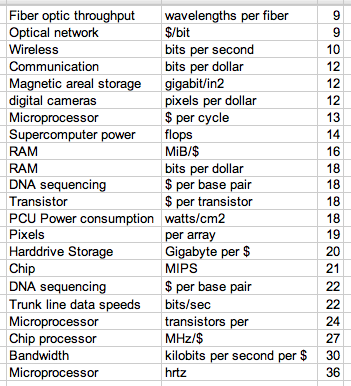
   This is a fascinating article about trends in progress. Some, a surprising number of information related ones, are indeed growing at approx. Moore's Law rates, or faster. This is doubling time in months

Doublingtimes

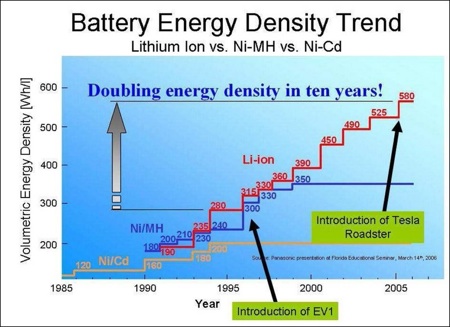
     Others are "merely" growing at slower rates eg batteries, which has only doubled in 10 years - only 25% annual growth,
Battery Energy Density
Nonetheless we are clearly seeing growth in human progress far faster than ever in history.

It is also possible that those factors which are growing, comparatively, are still at the lower end of the S curve. If so the fact that we don't see anywhere that the rate of acceleration is slowing suggests that overall humanity is still on the lower end of technological progress.

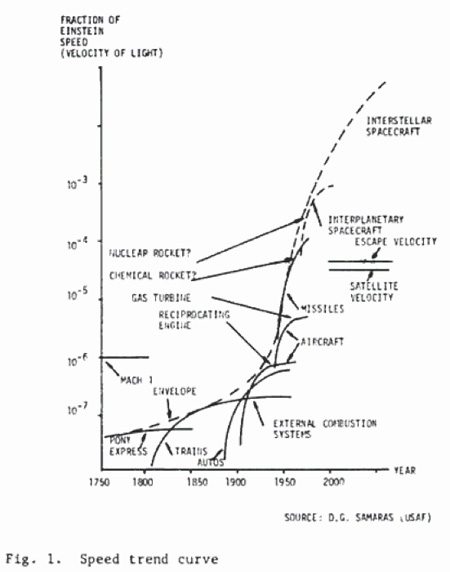
    Even in the case of maximum speed where the graph appears to show a tailing off of the slope  
Martino72-43
this is because the upward graph is logarithmic - if it were proportional the curve would be shown as accelerating - except the page would be 10,000 times higher.

     I urge you to read the entire article.

     Some excerpts:

in 1953 the Air Force...
Charted the curves and metacurves of speed. It told them something preposterous. They could not believe their eyes. The curve said they could have machines that attained orbital speed... within four years. And they could get their payload right out of Earth's immediate gravity well just a little later. They could have satellites almost at once, the curve insinuated, and if they wished -- if they wanted to spend the money, and do the research and the engineering -- they could go to the Moon quite soon after that.
It is important to remember that in 1953 none of the technology for these futuristic journeys existed. No one knew how to do go that fast and survive. Even the most optimistic die-hard visionaries did not expect a lunar landing any sooner than the proverbial "Year 2000." The only voice telling them they could do it was a curve on a piece of paper. But the curve was right. Just not politically correct. In 1957 the USSR launched Sputnik, right on schedule. Then US rockets zipped to the Moon 12 years later.........

Today when we stare at the plot of Moore's Law  we can spot several striking characteristics of its 50 year run. The first surprise is that this is a picture of acceleration. The straight line descending slope of the "curve"  indicates a ten fold increase in goodness for every tick on vertical log axis. Silicon computation is not simply getting better, but getting better faster. Relentless acceleration for five decades is rare in biology and unknown in the technium before this century.....

     Secondly, even a cursory glance reveals the astounding regularity of Moore's line. From the earliest points its progress has been eerily mechanical.  Without interruption for 50 years, chips improve exponentially at the same speed of acceleration, neither more nor less. It could not be more straight if it had been engineered by a technological tyrant. Yet, we are to believe that this strict nonwavering trajectory came about via the chaos of the global marketplace and uncoordinated ruthless scientific competition......

Is Moore's law inevitable, a direction pushed forward by the nature of matter and computation, and independent of the society it was born into, or is it an artifact of self-organized scientific and economic ambition?

Moore and Mead themselves believe the latter. Writing in 2005, on the 40th anniversary of his law, Moore says, "Moore's law is really about economics." ......

Finally, in a another reference, Mead adds : "Permission to believe that [the Law] will keep going," is what keeps the Law going. Moore agrees in a 1996 article: "More than anything, once something like this gets established, it becomes more or less a self-fulfilling prophecy......

Why don't we see Moore's Law type of growth in the performance of solar cells if this is simply a matter of believing in a self-fulfilling prophecy? Surely, such an acceleration would be ideal for investors and consumers. Why doesn't everybody simply clap for Tinkerbelle to live, to *really* believe, and then the hoped for self-made fairy will kick in, and solar cells will double in efficiency and halve in cost every two years?......

Consider another encapsulation of accelerating progress. For a decade or so biophysicist Rob Carlson has been tabulating progress in DNA sequencing and synthesis. Graphed similarly to Moore's Law (above), in cost performance per base pair, this technology too displays a steady drop when plotted on a log axis. I asked Carlson how much of this gain is due to Moore's Law. If  computers did not get better, faster, cheaper each year, would DNA sequencing and synthesis continue to accelerate? Carlson replied:
....  Moore's law must have had some effect through cheap hardware that enables desktop CAD, but that is fairly tangential. If Moore's Law stopped, I don't think it would have much effect......
 the trends were operative even when people disbelieved it." Ray Kurzweil dug into the archives to show that something like Moore's Law had it origins as far back as 1900, long before electronic computers existed, and of course long before the path could have been constructed by self-fulfillment. Kurzweil estimated the number of "calculations per second per $1,000" performed by turn-of-the-century analog machines, by mechanical calculators, and later by the first vacuum tube computers and extended the same calculation to modern semiconductor chips. He established that this ratio increased exponentially for the past 109 years.....

    [More competition]  mandated that henceforth their improvement would be 60% a year. This spurred an escalation of R&D investment, faster growth by the competitors, and more R&D by IBM so that by the late 1990s onward, the slope of growth increased to more than 100% per year. The slope of progress can be changed by pouring money down it. Mark Kryder says, "My  guess is that you could double the density growth rate with something less than the double the R&D dollars." The slope can also be changed by regulations. Larry Roberts offers this evidence for the effects of the US Telecommunications Act of 1993. "From before 1960 until de-regulation about 1993, the cost per terabit of communications [red line in the graph below; the blue is Moore's Law] dropped very slowly, halving every 79 months. Then, once fiber was in place, DWDM and free enterprise took the market price down fast, halving every 12 months." ......

Everyone of them is getting twice as better every year or two no matter the technology. What's up with that? Engineer Mark Kryder's explanation is that this "twice as better every two years" is an artifact of corporate structure where most of these inventions happen. It just takes 1-2 years of calendar time to conceive, design, prototype, test, manufacture and market a new improvement, and while a 5- or 10-fold increase is very difficult to achieve, almost any engineer can deliver a factor of two. Voila! Twice as better every two years. Engineers unleashed equals Moore's Law.....

Should we ever arrive on other inhabited worlds in our galaxy, we should expect some of them to have reached the stage of microelectronics in their own technium. .... Whenever it begins the steady acceleration of progress in solid-state computation should last for at least 25 doublings (what we've experienced so far), or a 33 million-fold increase in value. But while Moore's Law is inevitable in its progression, its slope is not.

The slant of increase in a particular world may indeed be a matter of macro-economics. Here Moore and Mead may be correct: the slope of the Law rests on economics. Whether computing power doubles every month or every decade will depend on many factors of that particular society: population size, volume of the economy, velocity of money, evolution of financial instruments. The constant speed of discovery might hinge in part on the total available pool of engineers, whether it is 10 thousand versus 10 million. A faster planetary velocity of money may permit a faster doubling period. All these economic factors combine to produce a fixed constant for that world at that phase. If Moore's Law turned out to be a universal fixture in the computational phase of civilization, this fixed constant might even be used as a classification marker. ....

Like the Air Force's 1953 graph of top-speed, the curve is one way the technium speaks to us. Carver Mead, who barnstormed the country waving plots of Moore's Law, believes we need to "listen to the technology." As one curve inevitably flattens out, its momentum is taken up by anther S-curve. If we inspect any enduring curve closely we can see how definitions and metrics shift over time to accommodate new substitute technologies.

     Which suggests that if we decide, as a society, to increase or reduce the rate of progress it can be done. We are not at the optimum rate of progress and probably not close to it. how do we improve it - this is not an exhaustive list (I will have to give thought to that) but - cut government regulations, stop making nuclear power or GM effectively illegal; have a culture that respects technological competence; and most of all, a massive X-Prize Foundation funding technological innovation with a substantial part of national wealth as I have previously suggested.


Labels: , ,


Monday, December 30, 2013

Daily Mail Xmas Eve Letter On X-Prizes

    I saw this letter, which went out to all and sundry in the Scottish & UK media, in the Scottish Daily Mail on Eve, after I thought it had been rejected:
-------------------------

 The Chinese automated Moon Lander has been generally described as 40 years late.

  Well it is 40 years after Apollo perhaps but NASA couldn't do it now and it seems likely that it will be of more scientific use than the Apollo landings because the lander has ground penetrating radar and it will work for several months.
   
       It can't return rocks to Earth but that's promised for future voyages.

     Remarkably China's space budget just £320 million (or £800 million if you're guided by Euroconsult) By comparison Britain's space budget is £330 million, almost all simply handed over to ESA, whose total budget in turn is about half of the $20 billion NASA spends.

     This makes China's space efforts remarkably small and remarkably successful or NASA & ESA remarkably useless which is probably more likely. 
 
      China's budget is just 60p per person per year. Clearly the Chinese are not so much racing for space as engaged in a gentle stroll while the west slides slowly backwards.

       This reinforces UKIP's belief that if instead Britain's space budget were pledged as a prize in a space travel competition such as the X-Prize Foundation, we could soon become a world leader in commercial space development.
 
     And if we also added the £500 million NERC (a minor quango  most people have never heard of) spends, largely spent on advertising the warming scare, we'd be a racing certainty
 
Neil Craig
UKIP Glasgow
------------------------------------------------------
 
    Editing was mostly to simplify language ("per year" rather than "annually" and removed nothing important. Since it doesn't change anything except to marginally improve it I have kept the Mail's wording. It is clear that they looked at & edited this seriously and I appreciate this, particularly when other papers decided not to. In particular the reference to UKIP, normally a killer for the rest of the press, was not excised. Indeed both the last 2 paragraphs could have been removed without making the letter unintelligible - I wrote it that way because I would rather have had the bowdlerised version out than none. Thus the Mail have exceeded my expectations whereas the rest fell below them.
 
   I am pleased with this letter. It hits 4 of my hobbyhorses - space, X-Prizes, UKIP and state funding of the warming scare as well as countering the xenophobia our media normally display against whichever countries we are currently being taught to hate.  
 
Link to the remarkable budget figures  US$500 million (official); US$1.3 billion (Euroconsult).


Labels: , , ,


Saturday, December 21, 2013

"In human years, this would be like a 60-year-old converting to a 20-year-old in these specific areas"

   "A mouse is as much of a miracle of biology as an elephant, but the elephant is more impressive"
                                                     Robert A. Heinlein


      Bear that in mind when reading this from Next Big Future:

December 19, 2013

Partial reversal of aging achieved in mice by restoring mitochondria cellular communication

Researchers have discovered a cause of aging in mammals that may be reversible.

 The essence of this finding is a series of molecular events that enable communication inside cells between the nucleus and mitochondria. As communication breaks down, aging accelerates. By administering a molecule naturally produced by the human body, scientists restored the communication network in older mice. Subsequent tissue samples showed key biological hallmarks that were comparable to those of much younger animals.


Cell - Declining NAD+ Induces a Pseudohypoxic State Disrupting Nuclear-Mitochondrial Communication during Aging

Highlights

• A specific decline in mitochondrially encoded genes occurs during aging in muscle
• Nuclear NAD+ levels regulate mitochondrial homeostasis independently of PGC-1α/β
• Declining NAD+ during aging causes pseudohypoxia, which disrupts OXPHOS function
• Raising nuclear NAD+ in old mice reverses pseudohypoxia and metabolic dysfunction

Summary

Ever since eukaryotes subsumed the bacterial ancestor of mitochondria, the nuclear and mitochondrial genomes have had to closely coordinate their activities, as each encode different subunits of the oxidative phosphorylation (OXPHOS) system. Mitochondrial dysfunction is a hallmark of aging, but its causes are debated. We show that, during aging, there is a specific loss of mitochondrial, but not nuclear, encoded OXPHOS subunits. We trace the cause to an alternate PGC-1α/β-independent pathway of nuclear-mitochondrial communication that is induced by a decline in nuclear NAD+ and the accumulation of HIF-1α under normoxic conditions, with parallels to Warburg reprogramming. Deleting SIRT1 accelerates this process, whereas raising NAD+ levels in old mice restores mitochondrial function to that of a young mouse in a SIRT1-dependent manner. Thus, a pseudohypoxic state that disrupts PGC-1α/β-independent nuclear-mitochondrial communication contributes to the decline in mitochondrial function with age, a process that is apparently reversible.

Communication breakdown

Mitochondria are often referred to as the cell's "powerhouse," generating chemical energy to carry out essential biological functions. These self-contained organelles, which live inside our cells and house their own small genomes, have long been identified as key biological players in aging. As they become increasingly dysfunctional overtime, many age-related conditions such as Alzheimer’s disease and diabetes gradually set in.

Researchers have generally been skeptical of the idea that aging can be reversed, due mainly to the prevailing theory that age-related ills are the result of mutations in mitochondrial DNA—and mutations cannot be reversed.

Sinclair and his group have been studying the fundamental science of aging—which is broadly defined as the gradual decline in function with time—for many years, primarily focusing on a group of genes called sirtuins. Previous studies from his lab showed that one of these genes, SIRT1, was activated by the compound resveratrol, which is found in grapes, red wine and certain nuts.

Ana Gomes, a postdoctoral scientist in the Sinclair lab, had been studying mice in which this SIRT1 gene had been removed. While they accurately predicted that these mice would show signs of aging, including mitochondrial dysfunction, the researchers were surprised to find that most mitochondrial proteins coming from the cell’s nucleus were at normal levels; only those encoded by the mitochondrial genome were reduced.

“This was at odds with what the literature suggested,” said Gomes.

As Gomes and her colleagues investigated potential causes for this, they discovered an intricate cascade of events that begins with a chemical called NAD and concludes with a key molecule that shuttles information and coordinates activities between the cell’s nuclear genome and the mitochondrial genome. Cells stay healthy as long as coordination between the genomes remains fluid. SIRT1’s role is intermediary, akin to a security guard; it assures that a meddlesome molecule called HIF-1 does not interfere with communication.

For reasons still unclear, as we age, levels of the initial chemical NAD decline. Without sufficient NAD, SIRT1 loses its ability to keep tabs on HIF-1. Levels of HIF-1 escalate and begin wreaking havoc on the otherwise smooth cross-genome communication. Over time, the research team found, this loss of communication reduces the cell's ability to make energy, and signs of aging and disease become apparent.

“This particular component of the aging process had never before been described,” said Gomes.

While the breakdown of this process causes a rapid decline in mitochondrial function, other signs of aging take longer to occur. Gomes found that by administering an endogenous compound that cells transform into NAD, she could repair the broken network and rapidly restore communication and mitochondrial function. If the compound was given early enough—prior to excessive mutation accumulation—within days, some aspects of the aging process could be reversed.

Cancer connection

Examining muscle from two-year-old mice that had been given the NAD-producing compound for just one week, the researchers looked for indicators of insulin resistance, inflammation and muscle wasting. In all three instances, tissue from the mice resembled that of six-month-old mice. In human years, this would be like a 60-year-old converting to a 20-year-old in these specific areas.
One particularly important aspect of this finding involvesHIF-1. More than just an intrusive molecule that foils communication, HIF-1 normally switches on when the body is deprived of oxygen. Otherwise, it remains silent. Cancer, however, is known to activate and hijack HIF-1. Researchers have been investigating the precise role HIF-1 plays in cancer growth.

“It’s certainly significant to find that a molecule that switches on in many cancers also switches on during aging,” said Gomes. “We're starting to see now that the physiology of cancer is in certain ways similar to the physiology of aging. Perhaps this can explain why the greatest risk of cancer is age.”

“There’s clearly much more work to be done here, but if these results stand, then certain aspects of aging may be reversible if caught early,” said Sinclair.

The researchers are now looking at the longer-term outcomes of the NAD-producing compound in mice and how it affects the mouse as a whole. They are also exploring whether the compound can be used to safely treat rare mitochondrial diseases or more common diseases such as Type 1 and Type 2 diabetes. Longer term, Sinclair plans to test if the compound will give mice a healthier, longer life.
################################################
 
     Lets not overstate it. A scientific claim shouldn't be treated very seriously until it has been repeated. On the other hand is impressive and there is quite a lot of other work going on on what causes and can be done about aging, so somebody getting such a result isn't so strange.
 
    I have previously written about the M-Prize, put up by the Methuselah Foundation. This is a relatively small prize awarded for extending the life of a mouse.
 
   "pure science prizes, like the M-Prize whose importance to aging research cannot easily be underestimated, has achieved repeated successes with funding which government would consider insufficient to carry as pocket change."
 
    Earlier I went into some detail about the M-Prize:
 
The Methuselah Mouse prize is a very good example of how to use such prices since actual profits to be made in extending the lives of mice are minimal but the possible crossover to humans when it has been achieved is unlimited. They also, having made awards, have a proven record of success.
    And I have mentioned it in passing several times here, and once when a lecturer at the Royal Phil spoke on aging asked his opinion of the prize - he hadn't head of it but then he wasn't confident of such research.
 
     And then a few weeks ago I mentioned the future of aging research on Brian's "Debate", though never expected any such speedy confirmation.
==================
 
    No doubt this research would have been done, though somewhat later, without the spur of this prize since the spur of ending aging is a potentially enormous one though further away. However "somewhat later" is equivalent to millions of lives.
 
    I expect the major contribution to this research by government will turn out to be regulating, slowing and perhaps preventing it in case it turns out the cure turns out to be carcinogenic or something. The idiocy of that is obvious and it may well be that the governments of countries not run by anti-progress Luddites will appreciate this.

Labels: , ,


Wednesday, December 18, 2013

How The Quangocracy Get Rich Making Britain Poor

        An impressive article in the always credible Register. This just would not get published by our dead tree press or state controlled broadcasters. Indeed hasn't been.

       It is about NESTA, whose X-Prize subgroup I previously and wrongly praised as at least having potential, though I decried that both their prizes were for bicycling nonsense.

       It is about how a Brit who approached them for financial support to develop a touch computer screen back in the 1990s, was given endless runaround, had information made public, saw NESTA blatantly lying about giving him £100K support and thus eventually was bypassed by competitors. Some excerpts:

Nesta began life in 1998 with a £250m endowment, using the interest on the sum to fund its activities. Its first chairman was Labour supporter and donor Lord Puttnam of Queensgate.

He was succeeded by top adman Sir Chris Powell, who, as the son of Air Vice-Marshal John Frederick Powell, belongs to one of the most powerful and influential families in British public life. Sir Chris's elder brother Charles, now Baron Powell of Bayswater, was an ambassador and private secretary to Prime Minister Margaret Thatcher. His younger brother Jonathan became Blair’s Chief of Staff in Downing Street, a title created by the incoming premier, granting Jonathan unprecedented power over civil servants. Meanwhile, Sir Chris headed the advertising agency BMP, which was used by Labour from 1972 to 1997......

"When I first approached Nesta I was told that I would receive a funding decision within 6 weeks," he says. "However, it took Nesta a year to just write the contract. To put that in perspective, it took Apple only 2 years to conceive, develop and commercialise the entire iPhone."

'No one at Nesta has a science or engineering background'


It would be many months before the organisation's bureaucracy finished processing his paperwork. Fentem said he had been troubled to learn, that spring, from a manager at the quango that that “no one at Nesta has a science or engineering background”, in the manager’s own words.

“When he saw the look of horror and disbelief on my face he quickly said, ‘But we're trying to remedy that’,” Fentem recalled.


Send in the Clowns


Was Nesta truly committed? The sum [£20 K]seemed paltry compared to some other grants the outfit was dishing out.

In 2003 the press reported that Angela de Castro, a Brazilian-born clown, had won £39,200 for a study to “evolve her clowning expertise and look deeply into what clowning has to offer contemporary society”, according to Nesta. That cash also covered travel expenses so the performer could learn from “master clowns” around the world.

Requests for jaunts were favourably received. Later it would emerge that Nesta spent over £1m on “dream time fellowships”, which encouraged artists to take a year off to "explore". .....

Nesta’s apparent frivolity didn’t stop there. The Lottery Act that had created the outfit urged it to protect an individual’s intellectual property (IP). Yet, astonishingly, even before Nesta had signed a contract with Fentem, we're told it published the details about his work on its website, alerting competitors.......

In an internal review conducted in December 2004 which The Register has seen, Nesta itself conceded that "milestone" requirements [were] not set out sufficiently clearly in the contract to provide certainty on when they have been met." It continued: "Milestone renegotiation issues can only be resolved through discussion between awardee and programme staff...to identify a way forward."

But Nesta and Fentem could not reach an agreement. He told us: "They wouldn't acknowledge that they'd wasted such an enormous amount of my time."

To add insult to injury, Nesta continued to claim publicly it had invested £100,000 in his multi-touch screen tech........   (my suspicion is that they had, but £80 K of it was shuffling the paper at their end - Neil)

       He subsequently tried to get an investigation, contacting the "independent" ombudswoman Helen Abrahams over the fact that NESTA had tried to get him in bed with a potential investor who was employing NESTA personnel and who they knew to be about to go bankrupt, as it did leaving him stuck

each request to investigate Nesta was turned down by Abraham. Her office cited a clause in the 1967 Parliamentary Commissioner Act which allowed it to “exercise its discretion” not to investigate contracts. The parts of the complaint which did fall under its remit, it declared, were so “entwined” with the contracts that its hands were tied. ....

A former council official, ombudsman Abraham had launched a project called "Ombudsman's Principles" which took two years to define what an Ombudsman should do. Proudly enshrined in the 2007 publication "Principles of Good Administration", these included "Getting it right", "Being customer focused", "Being open and accountable", "Acting fairly and proportionately", "Putting things right" and "Seeking continuous improvement".

Later dubbed “the Quango Queen”, Abraham retired with a £1.45m pension pot in December 2011, claiming £9,100 on hotel expenses in her final nine months in the job. Her career had included spells at the quangos Housing Corporation, the Benefits Agency and the National Association Of Citizens Advice Bureaux and the Committee On Standards In Public Life. She also acted as the Health Service Ombudsman for a full nine years, until just two years ago, in 2011.....

Today, the iPad is capable of manipulating images and driving virtual instruments – and this was all work Fentem was perfecting in 1999, work that had to be “relearned” by Apple after acquiring Fingerworks. Acquiring Fentem's potentially superior British technology could have allowed Apple to bring products to market faster.

But thanks to the bungling British quangocracy, Apple never even saw his work.

In fact, in a bizarre twist, Nesta actually contacted Fentem asking for royalties statements, gross receipts and updates on his trading status the following year in a letter seen by The Register.

In its first five years handling a £250m endowment, NESTA saw a return of just £228 in royalties ("Puttnam fund hit by row on ‘follies waste’" - Sunday Times - behind paywall).

“A few years ago,” Fentem recalls, “I was interviewed about my work by the British Council - the article was for a magazine distributed by their 'creative embassies' around the world. After the usual questions about my influences etc, they asked me what my message would be to young people thinking about coming to work or study in the UK.”

“I said, 'Don't'. 'Don't what?' asked the woman from the British Council...'Don't come. Don't come to the UK....that would be my message'."
############################################
I commented:

  I have long campaigned for a well funded X-Prize Foundation run by successful engineers, scientists, accountants and venture capitalists not politicians and civil servants.
To be fair such an organisation would not have directly funded this project in advance but if they had known that by achieving a target, short of commercial viability, the winning company would have won anything from hundreds of thousands to millions, real venture capitalists would have showered him with immediate offers of financial support.

---------------------------------

   If you take Pournelle's dictum that "the purpose of government programmes is to pay government employees and their friends, the nominal purpose is, at best, secondary, all of this makes sense.

   A quango of well connected parasities is set up to hand over money to luvvies but to keep a little public credibility and to empire build it then extends its remit to cover scientific stuff. But since the purpose was never to promote any technology but merely provide gainful employment for their own, they never actually hired anybody who knew anything about technology. Then as a nice little earner they tried to get him in bed with a "friendly" investor who they knew was going bankrupt but was paying them. Rather than, for example, brokering a deal with Apple, who weren't paying any of them.

PS    I also suspect that NESTA weren't actually lying about having spent £100,000 on this. Just that £20,000 went to Fentem to invent the thing and £80,000 to "government employees and their friends" to watch as he did so and to shuffle papers and, ever so slowly, draw up contracts.

PPS  His last words remind me of a friend, who knew, who said "Britain's Space Agency must be the worst space agency in the world, they charge you £6,000 to fill in a form".

Labels: , ,


Tuesday, December 17, 2013

Congratulations China

       The Chinese automated Moon Lander was last item on ITV and has been generally described as "40 years late" by our media. 40 years after Apollo perhaps but NASA couldn't do it now.

        It does seem likely that it will be of more pure scientific use than the Apollo landings because the lander has ground penetrating radar and since it will work for several months, will cover a much greater area.
########################################
From Wikipedia

The Yutu rover is slightly smaller than the Mars Exploration Rovers, Spirit and Opportunity, and carries similar instruments: panoramic cameras and two spectrometers, one operating in the infrared, the other using alpha particles and X-rays (APXS).[8][14] Yutu is equipped with a robotic arm to position the APXS near the target sample.
The rover has a mass of approximately 120 kilograms (260 lb) and a payload capacity of approximately 20 kg (44 lb).[1][2][15] It may transmit video in real time and has automatic sensors to prevent it from colliding with other objects.

Power[edit]

The six-wheeled rover is designed to explore an area of 3 square kilometres (1.2 sq mi) during its 3-month mission, with a maximum travelling distance of 10 km (6.2 mi). Energy would be provided by a solar panel, allowing the rover to operate through lunar days. During the lunar nights, the lander and the rover will go into 'sleep mode'.[12] Heating will be provided by use of radioisotope heater units (RHU) and two-phase fluid loops.[16]

Scientific payload[edit]


The planned landing site was Sinus Iridum, a lava-filled crater 249 km in diameter. Arrow shows location of Soviet Lunokhod 1 rover. The actual landing took place east of it, on Mare Imbrium, about 44 km southeast of Laplace F crater
The Yutu rover carries a ground-penetrating radar and spectrometers to inspect the composition of the soil and the structure of the lunar crust beneath it.

Ground-penetrating radar[edit]

The rover carries a ground-penetrating radar on its underside, allowing for the first direct measurement of the structure and depth of the lunar soil down to a depth of 30 m (98 ft), and investigation of the lunar crust structure down to several hundred meters deep.[13]

Spectrometers[edit]

The rover carries an alpha particle X-ray spectrometer[14] and an Infrared spectrometer to analyze the chemical element composition of lunar samples.

Cameras[edit]

There are two panoramic cameras and two navigation cameras on the rover's mast, which stands ~1.5 m (4.9 ft) above the lunar surface, as well as two hazard avoidance cameras installed on the lower front portion of the rover. Each camera pair may be used to capture either stereoscopic three-dimensional imaging or range-sensor two-dimensional imaging.
########################################

      It cannot return rocks to Earth but that is promised for future voyages.

     Remarkably China's space budget is low  US$500 million (official); US$1.3 billion (Euroconsult).

     That is £320 million or £800 million. By comparison Britain's space budget is £330 million, almost all simply handed over to ESA, whose budget in turn is about half of the $20,000 million NASA spends.

     This makes China's space efforts remarkably small and remarkably successful or NASA and ESA remarkably useless which is probably more likely. That is 60p per person annually. Clearly they are not so much racing for space as engaged in a gentle stroll while the west slides slowly backwards.

      It reinforces my and UKIP's belief that if even only our current space budget was put into an X-Prize Foundation, we might well quickly become the world leader in commercial space development. If we also added the £500 million NERC spends, largely on advertising the warming scare, we would be a racing certainty.

Labels: , ,


Friday, December 06, 2013

Shettleston By Election

    The Shettleston by election result. 4th place puts us well ahead of the LudDums and, as always, the Greens. 3rd would have been wonderful but beating those 2 is well worth it. This ward was always a certainty for Labour so winning was never an issue, what matters is the trend. What we did manage was to put more people on the ground than the Tories - basically, as a party their members are averaging about 80, and I suspect their voters aren't much younger.  

Name of CandidatePolitical PartyElectedVotes
Martin NEILLScottish Labour Party Yes202653.56%
Laura DOHERTYScottish National Party (SNP) 108628.71%
Raymond MCCRAEScottish Conservative and Unionist Party2245.92%
Arthur Misty THACKERAYUKIP1293.41%
Jamie COCOZZAScottish Trade Unionist and Socialist Coalition681.80%
James SPEIRSScottish Liberal Democrats 53

Labels: , ,


Thursday, December 05, 2013

How To Choose Which Technology Prizes To Fund - Ask The Customers

        For an excessively long time I have been promoting X-Prizes as the most effective way of encouraging technological progress (by ensuring the rewards to innovation are likely to be closer to proportionally as good as from the other factors of production.

        At one stage, purely as a way of saving tax money, I suggested, as part of my 24 point programme for world class growth, that providing a greater tax allowance than normal charitable donations get could do that.


18 - Beyond an official technology prizes foundation (#12) mainly orientated on space technology, the government should give extensive tax relief for any privately funded technology prizes. Prizes mean that though government can choose to have winners, simply by putting up enough prizes, they don't have to try to pick the winners in advance as grant funding does. Private prizes have the additional benefit that people thinking outside the traditional government "box" can come up with ideas & promote them. This is less important for space development where the technological challenges are mainly engineering & the problems well understood. By comparison pure science prizes, like the M-Prize whose importance to aging research cannot easily be underestimated, has achieved repeated successes with funding which government would consider insufficient to carry as pocket change.

19 - Adopt as an aim that 2% of our GNP should be available for these private & public X-Prizes. Most of this could come from a reduction in grants, it would certainly lead to a far more than 2% increase in GNP (probably much more than a 2% increase in the annual rate of GNP growth) & would do far more for British status worldwide & long term security than the 3% of GNP spent on the military. The evidence is that prizes are 30-100 times as cost effective as the normal government grants & advance payments. If they don't produce results obviously no prize is awarded so that is infinitely more cost effective :-)

        At the time I saw this as a second best option because ordinary multi-millionaires, putting up prizes might insist on their prizes being for technological achievements different from the space ones I wished for (& expected government to obediently support).

       In this exchange on comments Mike Haseler's Scottish Sceptic site he made this point which has made me reverse my opinion. Getting the ideas for X-Prizes from one central source, even such wise ones as myself or the government, is not as good as drawing them from a widespread mass of potential customers as prizes funded by individuals would be.

     Scottish Sceptic says:    

I remember when I first entered industry. Timex in Dundee had this massive manufacturing plant, but they saw the real money went to the equipment designers. So when I started I was put into their answer: an R&D department which was created to “think up good ideas” for products.

At the time, being a wet behind the ears physics/electronics graduate that seemed a very sensible idea. But very soon I began to realise that all we were doing was “inventing” products which the nerdy people in R&D thought we wanted … or worse stereotypical ideas of what other people wanted.

I even introduced the revolutionary idea of … asking shop workers what they thought about our products designed for them … and the reply was not very complementary … but by then it was too late to change much.

From this experience I learnt that successful companies need real customers … they need demanding customers who are willing and able to communicate with the design staff – because only that way does the company produce goods which will sell.

What has happened in UK science, is that the necessary customer in industry has been eliminated, and now we have nerds in academia trying to second guess what commerce and industry would want if there was any to take up and use their research.

And instead, now the politicians have become the customer … and so research is more and more pushing political viewpoints and has less and less economic benefit.

neilfutureboy says:    

That post encourages my ever unflagging enthusiasm for X-Prizes. Specifically that prizes, if suggested by potential customers (which includes us all) would be not only a financial driver of innovation but would drive it in a useful direction.

Labels: , ,


Saturday, November 23, 2013

X-Prize - McKinsey Report

   This links to an extensive report by McKinsey & Co on X-Prizes along with prizes of all sorts. It is a few years old now and not quite as enthusiastic as I am. This is largely because it doesn't foresee the sort of mass spending on prizes I do. Also by not concentrating on technology prizes it is concerned about how much the prize reflects glory on the awarder and worries that 2 much money spent on prizes will mean some go unreported. I see X-Prizes purely as a way of stimulating innovation - if it also makes the field more respected that is gravy.

   However the graphs are valuable.

Увеличение количества призов по данным McKinsey & Company

     This is the recent increase in prizes in recent years. However it includes more conventional prizes like the Booker and other arts prizes which have barely risen so it considerably understates the rise in technology prizes.


  The report also says that 52% of prizes by value comes from foundations, 27% from corporations and only 17% from government, a ratio we should be prepared to work with.
 
   As part of McKinsey's concern about numerous prizes it calculates that there is an average 0.0275 rise in publicity for prizes per $1,000 in value but that this average varies widely. I'm happy with that - it suggests that good prizes will get publicity, that there is a major place for even quite small prizes but that even so multi-million £ prizes are not going to go unnoticed.
 
   It also has a choice tree which concludes that prizes alone are the optimum when there is a clear definable target and many possible winners willing to take a risk which applies in technology cases unless the project is so big only 1 company/conglomerate can undertake it.
 
   I am comfortable with that, bearing in mind that when such a conglomerate says this (& says it should get a grant) it may not be unbiased and if a prize is offered to the rest of the world it will do no harm - if the conglomerate come in first the prize isn't won. By this rule the best way to promote virtually any technology is through prizes, occasionally with a grant to a preferred bidder (which should never exceed the prize value and be repayable out of prize money if the bidder wins).


Labels: , ,


Tuesday, November 05, 2013

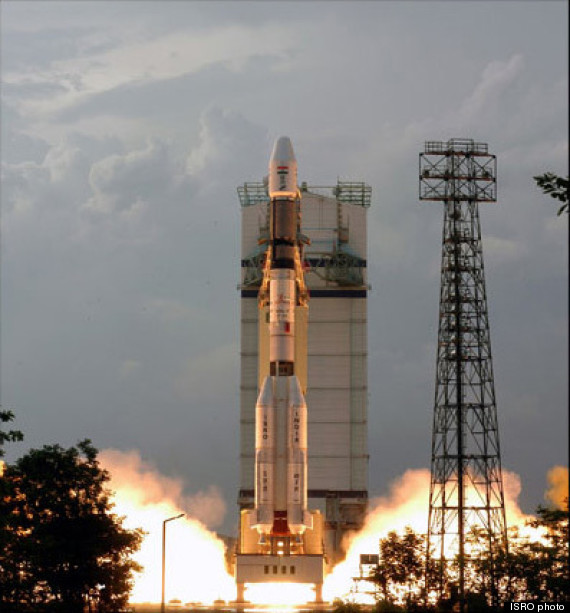
India's Mars Probe Lifts Off

 I'm sure Indians will be, rightly, proud today. As the Register says:

"India's delayed Mars mission is on the countdown for launch, and barring further delays or mishaps, will begin its trip on Tuesday, November 5, from a southern coastal island near Chennai.
The Mangalyaan (Mars Orbiter Mission probe) was announced in August 2012, with a combined objective to prove that India has the technological ability to get to Mars, and to collect data for future missions.
The Mars probe would be, at least, a remarkable achievement of economy: at 450 crore Rupees, or about US$74 million, (£45m) the price is more like that of a new university campus than a Mars mission.

However, unlike current US efforts, India isn't attempting to land on the Red Planet, but to reach orbit. The orbiter will be riding a PLSV C25 launch vehicle, due to lift off at 2.38 pm on November 5 (local time), with a 40 minute flight that will get it to Earth orbit.

The mission will spend between 20 and 25 days in Earth orbit before being pointed at Mars to spend nine months in travel, arriving in late September 2014"

    Price comparable to the original estimate I made for a Scottish asteroid landing X-Prize.

    The depressing thing is that the British obedient media seem to have made this largely a story about usgi8ving foreign aid to India.

    This is a spiteful and mean attitude. India is still a country of enormous poverty. Our "aid" comes to about 22p per head and will stop in 2015 anyway. I'm not convinced that "aid" does or is even meant to aid - sometimes it is to secure deals; sometimes it is to ensure our favoured dictators stay friendly. If helping the 3rd world were the real intent we would quit the EU, allowing us to buy their food at a lower price than within the EU but a higher price than they get for it. That would do far more to develop their economies. And if we were giving aid to do good then India, where there is a very good growth rate and less corruption than elsewhere, is where we would give it.

   The subtext to our media's coverage is "how dare these brown people we brought civilisation to and patronised endlessly now engage in a technological venture we haven't" and that is a shameful attitude.

    The shame is that we could be doing it, yet we spend virtually nothing on space (granted we spend £330m on ESA but that is not going on space - it is going on bureaucracy and ensuring that a proportionate number of favoured companies in each country get a bit of the pork barrel).

     We could, if we put that money into space development in the way everybody knows would be most effective, ie an X-Prize Foundation easily outpace India and perhaps even the USA. But our ruling class and obedient media would rather engage in meanspirited racism.
 

Labels: , ,


Thursday, October 17, 2013

Greg Cochran On Scientific Progress, Education & "Social Science"

   I've recently been going through much of the politically incorrect Greg Cochran's site. Here is some stuff of interest:

   How doctors are not good at spotting anomalies and thus in spotting potential scientific breakthroughs. This means that there must be potential "low hanging fruit" if we look.

   I would also add that the regulatory burden on medicines is so heavy that it must be holding back or indeed preventing research in new medicines. This is to prevent horrors like thalidomide but, at about £1 billion just to get a new medicine accepted, I am certain a cost benefit analysis would show lives saved by not having thalidomide would be a fraction of those lost by not having hundreds of useful medicines.

    I would suggest that restrictions on testing should be entirely lifted for subjects of 60 or over and that medicines not tested up to government level should be available, clearly labelled as such, I suspect that other institutions would spring up willing to test more cheaply & quickly than government and that companies would be happy to put them on the label.

   Specifically any successful medicine against Alzheimers (there are a number of candidates) will not be available for at least 10 years and I am certain a lot of people, seeing early onset, would risk it.
-----------------------------------------------------
we were discussing per-pupil expenditure by state in primary and secondary education. Utah is famous for having the lowest per-pupil funding in the country. We are right next to and similar in many ways to Wyoming, which has one of the highest funding levels in the country. The dollars per student are $7,200 in Utah and $18,000 in Wyoming according to this source. Caution is always in order, of course, but these numbers are in broad agreement with other sources and other years.
What does Wyoming get for the extra $11,000 per student? A quick assay is to look at NAEP scores. Here are eighth grade math scores for white students over the last two decades:
Utahwyoming
A quick look shows that Wyoming is getting nothing at all for their extra $11,000

    So spending has between little or nothing to do with success. This, incidentally, explains how Habits of Highly Successful Countries could find there was no correlation between education budgets and economic success.
------------------------------------------------------------
The standard belief in the academy is that there are no such personality differences between ethnic groups and races.  It’s not that they have some kind of argument based on genetics and selection and prehistory that makes such differences super-unlikely: no, it can’t be true because it would hurt their feelings.

You know, the people populating the social sciences are bound to be right about something, eventually.

This is why he is politically incorrect.
----------------------------------------------------
One fairly obvious, little-discussed variety of low-hanging technological fruit are those ideas and devices that are already known – to but a few.  Secrets.

Sometimes important secrets are deliberately kept for a long time.  Consider the Chamberlen family.
Peter Chamberlen the elder [1560-1631] was the son of a Huguenot surgeon who had left France in 1576. He invented obstetric forceps , a surgical instrument similar to a pair of tongs, useful in extracting the baby in a  difficult birth.   He, his brother, and  his brother’s descendants preserved and prospered from their private technology for 125 years.

Sometimes the future is already here, but not generally known.  Sometimes it’s hidden, sometimes it’s forgotten, sometimes it’s in Latin. There have to be better ways of finding and disseminating those secrets.

I have discussed this and the Chamberlens before. I put up this comment.

This is a strong argument for either watertight patent laws, which I don’t think is possible, or a significant part of gdp going to technology prizes.

I've read that 3rd parties get 3 times as much value from inventions as the inventors do which means prizes should be about 3 times the value obtained by patents. This is difficult to estimate but looks like at least 6% of gdp.

You may be interested in http://a-place-to-stand.blogspot.co.uk/2013/01/did-patents-create-step-change-in.html
-----------------------------------------------------          

Most people think that science and math and engineering are found everywhere, like soccer, but actually, they are regional practices, more like hurling or tossing the caber.  In the map, countries are resized according to the number of scientific papers they produce.  Population size plays a role, but average productivity matters more.  Note that Singapore, with a population of 5 million, looks bigger than Indonesia, with 240 million people.
 

Labels: , ,


This page is powered by Blogger. Isn't yours?

British Blogs.